 Back
BackProbability: Events, Sample Spaces, and Probability Rules
Study Guide - Smart Notes
 Tailored notes based on your materials, expanded with key definitions, examples, and context.
Chapter 3: Probability
3.1 Events, Sample Spaces, and Probability
Probability theory provides a mathematical framework for quantifying uncertainty in experiments and observations. This section introduces the foundational concepts of experiments, sample spaces, sample points, events, and the calculation of probabilities.
Definition of Experiment
Experiment: An act or process of observation that leads to a single outcome that cannot be predicted with certainty.

Sample Points and Sample Space
Sample Point: The most basic outcome of an experiment.
Sample Space (S): The collection of all possible sample points for an experiment.


Examples of Sample Spaces
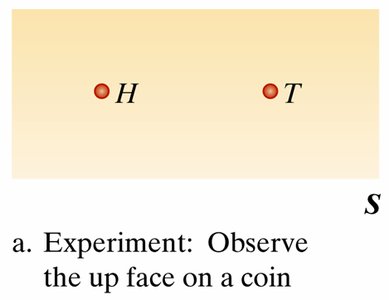
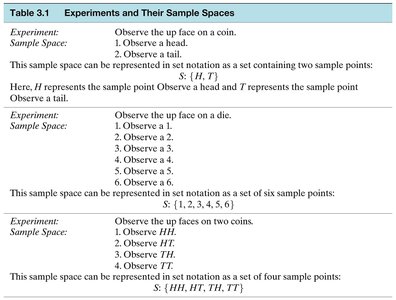
Coin Toss: S = {H, T}
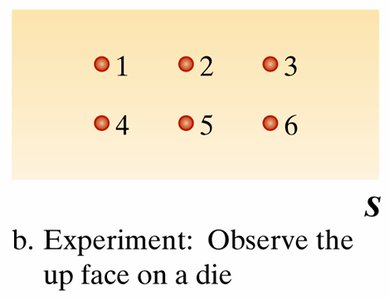
Die Roll: S = {1, 2, 3, 4, 5, 6}
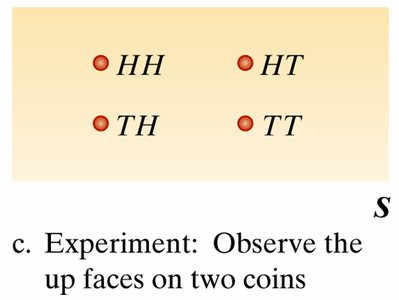
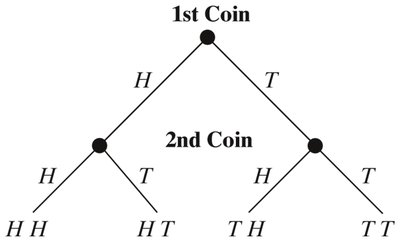
Two Coin Tosses: S = {HH, HT, TH, TT}
Tree Diagrams
Tree diagrams are useful for visualizing all possible outcomes of multi-stage experiments, such as tossing two coins.
Probability Rules for Sample Points
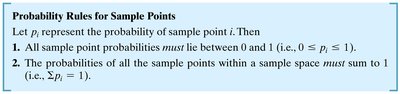
Let pi represent the probability of sample point i.
All sample point probabilities must lie between 0 and 1:
The probabilities of all sample points within a sample space must sum to 1:
Definition of Event
Event: A specific collection of sample points (a subset of the sample space).

Probability of an Event
The probability of an event A is calculated by summing the probabilities of the sample points in the sample space for A.
For equally likely outcomes:


Steps for Calculating Probabilities of Events
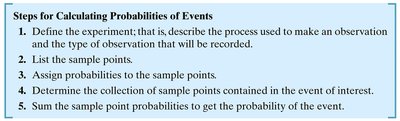
Define the experiment.
List the sample points.
Assign probabilities to the sample points.
Determine the collection of sample points contained in the event of interest.
Sum the sample point probabilities to get the probability of the event.
Example: AAMFT Study of Divorced Couples
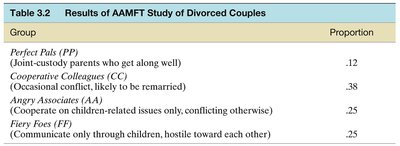
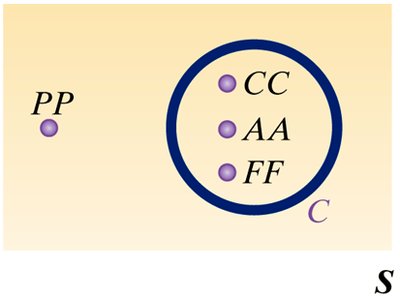
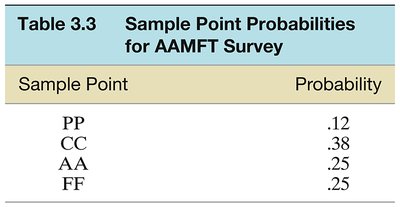
The American Association for Marriage and Family Therapy (AAMFT) classified divorced couples into four groups based on their post-divorce relationships. Probabilities are assigned to each group based on observed proportions.
Group | Proportion |
|---|---|
Perfect Pals (PP) | 0.12 |
Cooperative Colleagues (CC) | 0.38 |
Angry Associates (AA) | 0.25 |
Fiery Foes (FF) | 0.25 |
3.2 Unions and Intersections
Events can be combined using set operations such as union and intersection, which are fundamental to probability calculations.
Union of Events
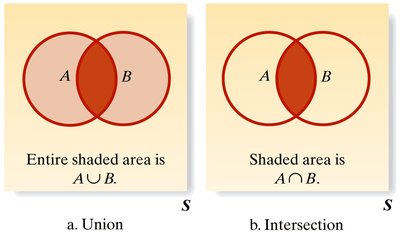
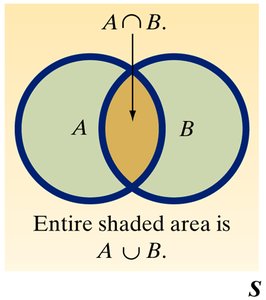
The union of two events A and B (denoted ) is the event that occurs if either A or B (or both) occur.

Intersection of Events
The intersection of two events A and B (denoted ) is the event that occurs if both A and B occur.

Venn Diagrams
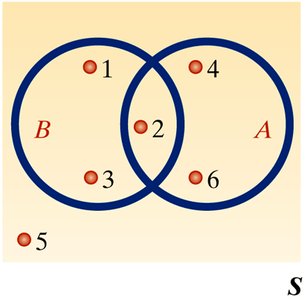
Venn diagrams are useful for visualizing unions and intersections of events within a sample space.
3.3 Complementary Events
The complement of an event consists of all outcomes in the sample space that are not in the event.
Definition of Complement
The complement of event A (denoted ) is the event that A does not occur.

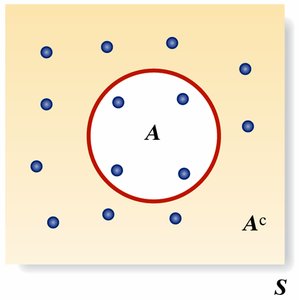
Rule of Complements
The sum of the probabilities of complementary events equals 1:

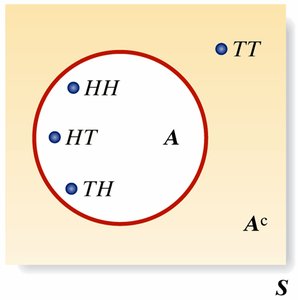
3.4 The Additive Rule and Mutually Exclusive Events
The additive rule allows us to calculate the probability of the union of two events. Mutually exclusive events cannot occur together.
Additive Rule of Probability
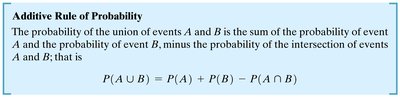
Mutually Exclusive Events
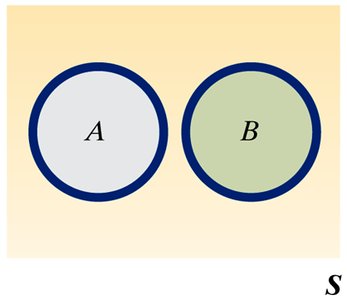
Events A and B are mutually exclusive if contains no sample points (i.e., ).
For mutually exclusive events:


3.5 Conditional Probability
Conditional probability quantifies the probability of an event given that another event has occurred.
Conditional Probability Formula
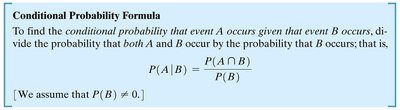
The conditional probability that event A occurs given that event B occurs is: (assuming )
Example: Die Toss
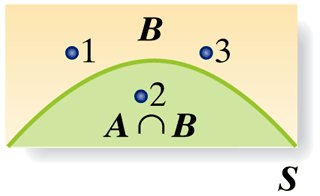
Let A = {observe an even number}, B = {observe a number less than or equal to 3}.
, ,
Summary Table: Key Probability Concepts
Concept | Definition/Formula |
|---|---|
Experiment | Process leading to an outcome |
Sample Space (S) | Set of all possible outcomes |
Event | Subset of sample space |
Probability of Event A | |
Union | |
Intersection | |
Complement | |
Additive Rule | |
Mutually Exclusive | |
Conditional Probability |
Additional info: The notes above are expanded with academic context and examples to ensure clarity and completeness for college-level statistics students.
