 Back
Probability: Independence, Multiplication Rule, and Conditional Probability
Study Guide - Smart Notes
 Tailored notes based on your materials, expanded with key definitions, examples, and context.
Section 5.3 - Independence and Multiplication Rule
Independent and Dependent Events
Understanding the relationship between events is fundamental in probability theory. Two events are considered independent if the occurrence of one does not affect the probability of the other. Conversely, events are dependent if the occurrence of one event influences the probability of the other.
Independent Events: The outcome of one event does not change the likelihood of the other event occurring.
Dependent Events: The outcome of one event alters the probability of the other event.
Example: Flipping a coin and rolling a die are independent events; earning a bachelor’s degree and earning more than $100,000 per year are dependent events.
Disjoint Events Versus Independent Events
It is important to distinguish between disjoint (mutually exclusive) and independent events. Disjoint events cannot occur simultaneously, while independent events can occur together but do not influence each other.
Disjoint Events: No outcomes in common; if one occurs, the other cannot.
Independent Events: Occurrence of one does not affect the probability of the other.
Key Point: If two events are disjoint and both have positive probability, they are not independent.
Multiplication Rule for Independent Events
The Multiplication Rule allows calculation of the probability that two or more independent events all occur.
Formula:
Example: Probability of rolling a 6 twice with a fair die:
Multiplication Rule for n Independent Events
For multiple independent events, the probability that all occur is the product of their individual probabilities.
Formula:
Example: Probability that three randomly selected 24-year-old males all survive the year:
Computing "At Least" Probabilities
To find the probability that at least one event occurs, use the complement rule.
Formula:
Example: Probability that at least one of 1000 randomly selected males dies during the year:
Summary: Rules of Probability
Probability bounds:
Sample space:
Addition Rule:
Complement Rule:
Multiplication Rule: (if independent)
Section 5.4 - Conditional Probability and the General Multiplication Rule
Conditional Probability
Conditional probability quantifies the likelihood of an event occurring given that another event has already occurred. The notation is read as "the probability of event F given event E." Conditioning restricts the sample space to only those outcomes where event E has occurred.
Formula:
Example: Probability of rolling a 3 given the outcome is odd:
Conditional Probability Rule
The conditional probability rule can also be expressed in terms of counts:
Formula:
Interpretation: Divide the number of outcomes in both E and F by the number of outcomes in E.
Example: Marital Status and Gender
Conditional probabilities can be computed using real-world data, such as the marital status and gender of U.S. residents. The table below summarizes this information:
Marital Status | Males (in millions) | Females (in millions) | Totals (in millions) |
|---|---|---|---|
Never married | 49.5 | 43.2 | 92.7 |
Married | 66.3 | 64.2 | 130.5 |
Widowed | 3.5 | 11.5 | 15.0 |
Divorced | 12.3 | 16.6 | 28.9 |
Separated | 2.0 | 2.6 | 4.6 |
Totals | 133.6 | 138.1 | 271.7 |
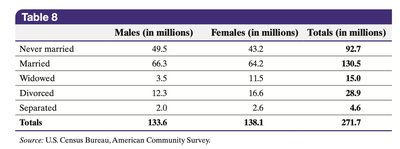
Example: Probability that a randomly selected individual has never married, given that the individual is male:
Example: Probability that a randomly selected individual is male, given that the individual has never married:
Example: Birth Weights of Preterm Babies
Conditional probability can be used to analyze medical data. For example, if 12.7% of all births are preterm and 0.22% of all births result in a preterm baby weighing 8 pounds, 13 ounces or more, the probability that a preterm baby weighs this much is:
Formula:
Interpretation: This is an unusual outcome, as it is less than 5%.
General Multiplication Rule
The General Multiplication Rule is used when events are not necessarily independent. It states that the probability of both events E and F occurring is the probability of E times the probability of F given E.
Formula:
Example: Probability that a speeding driver gets pulled over (0.8) and gets a ticket given pulled over (0.9):
Key Takeaways
Independence and dependence are crucial concepts in probability.
Multiplication rules differ for independent and dependent events.
Conditional probability restricts the sample space and is calculated using the conditional probability rule.
Real-world data, such as census tables, can be used to compute conditional probabilities.
