 Back
BackProbability Rules and Applications: Compound Events, Disjoint Events, and Multiplication Rule
Study Guide - Smart Notes
 Tailored notes based on your materials, expanded with key definitions, examples, and context.
Compound Events and Probability Rules
Definition of Compound Event
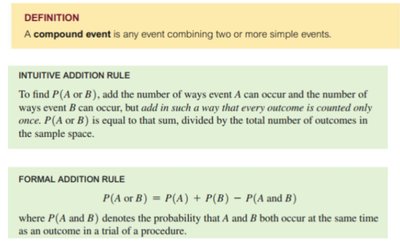
A compound event is any event that combines two or more simple events. Compound events are fundamental in probability theory, as they allow for the calculation of probabilities involving multiple outcomes or actions.
Addition Rule for Probability
The addition rule is used to find the probability that either event A or event B occurs. This rule is especially important when events may overlap or be mutually exclusive.
Intuitive Addition Rule: Add the number of ways event A can occur and the number of ways event B can occur, ensuring that every outcome is counted only once. Divide this sum by the total number of outcomes in the sample space.
Formal Addition Rule: The probability that event A or event B occurs is given by: This formula accounts for the overlap between A and B, subtracting the probability of both events occurring together.
Disjoint (Mutually Exclusive) Events
Events A and B are disjoint (or mutually exclusive) if they cannot occur at the same time. In other words, disjoint events do not overlap, and the probability of both occurring together is zero.

Example of Disjoint Events: Rolling a die and getting either a 2 or a 5. These outcomes cannot happen simultaneously.
Example of Non-Disjoint Events: Drawing a card from a deck and getting a red card or a face card. Some cards are both red and face cards.
Multiplication Rule and Independence
Definition of Independent and Dependent Events
Two events A and B are independent if the occurrence of one does not affect the probability of the occurrence of the other. If the occurrence of one event does affect the probability of the other, the events are dependent.
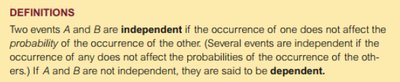
Example of Independent Events: Flipping a coin and rolling a die. The outcome of the coin does not affect the die.
Example of Dependent Events: Drawing two cards from a deck without replacement. The first draw affects the probability of the second.
Multiplication Rule for Probability
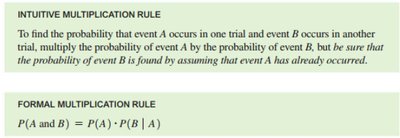
The multiplication rule is used to find the probability that two events both occur. For independent events, multiply the probability of event A by the probability of event B. For dependent events, multiply the probability of event A by the probability of event B given that A has already occurred.
Intuitive Multiplication Rule: Multiply the probability of event A by the probability of event B, assuming event A has already occurred.
Formal Multiplication Rule: where is the probability of B given A.
5% Guideline for Cumbersome Calculations
When sampling without replacement and the sample size is no more than 5% of the population, selections can be treated as independent for practical purposes, even though they are technically dependent.
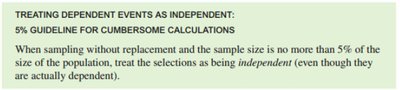
Application: This guideline simplifies calculations in large populations, such as drug screening among employees.
Applications and Examples
Drug Testing Example
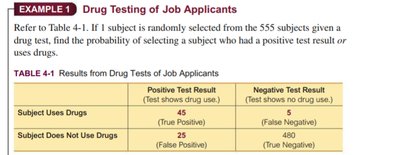
Consider a scenario where a subject is randomly selected from 555 job applicants who underwent drug testing. The probability of selecting a subject who had a positive test result or uses drugs can be calculated using the addition rule.
Positive Test Result | Negative Test Result | |
|---|---|---|
Subject Uses Drugs | 45 (True Positive) | 5 (False Negative) |
Subject Does Not Use Drugs | 25 (False Positive) | 480 (True Negative) |
Drug Screening and the 5% Guideline Example
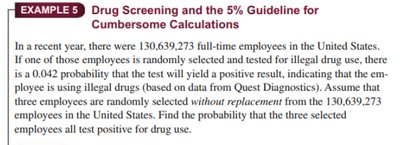
Suppose three employees are randomly selected without replacement from a population of 130,639,273 full-time employees in the United States. The probability that all three test positive for drug use can be calculated using the multiplication rule and the 5% guideline.
Contingency Table Example: Texting and Drinking While Driving
Contingency tables are used to analyze the relationship between two categorical variables. The table below shows the number of high school drivers who texted while driving and/or drove when drinking alcohol.
Drove When Drinking Alcohol: Yes | Drove When Drinking Alcohol: No | |
|---|---|---|
Texted While Driving | 731 | 3054 |
No Texting While Driving | 156 | 4564 |
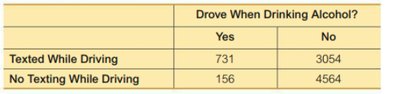
Purpose: This table allows calculation of probabilities for various combinations of texting and drinking behaviors, and helps determine whether events are disjoint.
Sample Space and Probability Calculations
Sample Space for Multiple Outcomes
The sample space is the set of all possible outcomes for a random experiment. For example, the sample space for having 5 children, each of whom can be a boy (B) or a girl (G), consists of all possible sequences of B and G.
Example: BBGBG, GGBBB, etc.
Number of Outcomes: For 5 children, there are possible outcomes.
Probability Calculations Based on Sample Space
Probabilities can be calculated by counting the number of favorable outcomes and dividing by the total number of outcomes in the sample space.
Example: The probability that all 5 children are boys is .
Summary Table: Key Probability Rules
Rule | Formula | When to Use |
|---|---|---|
Addition Rule | To find probability of either event A or B occurring | |
Multiplication Rule | To find probability of both events A and B occurring | |
5% Guideline | Selections treated as independent if sample size ≤ 5% of population | For large populations, sampling without replacement |
Additional info: Academic context was added to clarify definitions, rules, and examples, and to ensure completeness for exam preparation.
