 Back
BackProbability Rules and Counting Techniques – Study Notes for Statistics
Study Guide - Smart Notes
 Tailored notes based on your materials, expanded with key definitions, examples, and context.
Probability Rules and Counting Techniques
Introduction to Probability
Probability is a fundamental concept in statistics that quantifies the likelihood of random events. It is essential for understanding uncertainty and making informed decisions based on data. This chapter covers the basic rules of probability, methods for determining probabilities, and essential counting techniques used in probability calculations.
Probability Rules
Random Processes and Probability
A random process is a situation where the outcome cannot be predicted with certainty for a single trial, but the long-term proportion of outcomes can be determined through repeated trials. For example, flipping a coin multiple times allows us to estimate the probability of getting heads.
Probability: A measure of the likelihood of a random event, representing the long-term proportion of times a particular outcome is observed.
Experiment: Any process with uncertain results that can be repeated (e.g., rolling a die).
Sample Space (S): The set of all possible outcomes of an experiment.
Event: Any subset of outcomes from the sample space that we are interested in. A simple event contains only one outcome.
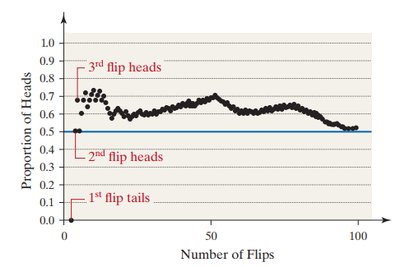
Example: The graph above shows how the proportion of heads approaches 0.5 as the number of coin flips increases, illustrating the Law of Large Numbers.
Basic Rules of Probability
The probability of any event is between 0 and 1:
The sum of probabilities of all possible outcomes in the sample space is 1:
An unusual event is one with a low probability, typically less than 0.05.
Example: Rolling a fair six-sided die, each outcome has probability .
Probability Models
A probability model lists all possible outcomes and the probability assigned to each outcome. Valid models must satisfy the basic rules above.
Methods to Determine Probabilities
Empirical Method
The empirical method estimates probability based on observed data (relative frequency):
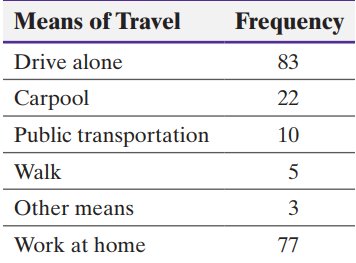
Example: The table above shows survey data on means of travel to work. Probabilities can be estimated by dividing each frequency by the total number of responses (200).
Means of Travel | Frequency | Estimated Probability |
|---|---|---|
Drive alone | 83 | 0.415 |
Carpool | 22 | 0.110 |
Public transportation | 10 | 0.050 |
Walk | 5 | 0.025 |
Other means | 3 | 0.015 |
Work at home | 77 | 0.385 |
Interpretation: The probability that a randomly selected individual carpools to work is 0.11.
Classical Method
The classical method is used when all outcomes are equally likely. Probability is calculated as:
Example: Flipping a fair coin twice, the sample space is {HH, HT, TH, TT}. The probability of two heads is .
Subjective Method
Subjective probability is based on personal judgment or experience when empirical or classical methods are not applicable. For example, estimating the probability of a recession next year.
Addition Rule and Complements
Addition Rule for Disjoint Events
Two events are disjoint (mutually exclusive) if they cannot occur at the same time. For disjoint events E and F:
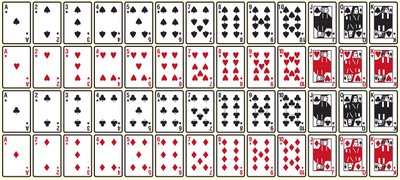
Example: Drawing a king or a queen from a standard deck of cards. Since these events are disjoint, add their probabilities.
General Addition Rule
For any two events E and F (not necessarily disjoint):
Using Contingency Tables
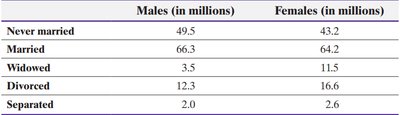
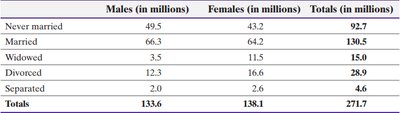
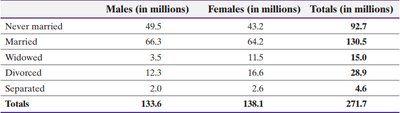
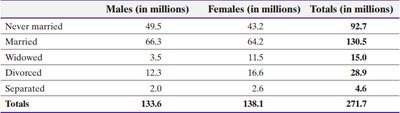
Contingency tables display the frequency distribution of variables and are useful for calculating probabilities involving two categories.
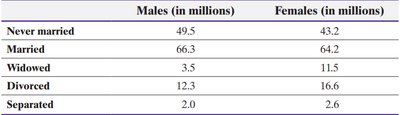
Males (millions) | Females (millions) | |
|---|---|---|
Never married | 49.5 | 43.2 |
Married | 66.3 | 64.2 |
Widowed | 3.5 | 11.5 |
Divorced | 12.3 | 16.6 |
Separated | 2.0 | 2.6 |
Example: The probability that a randomly selected U.S. resident is widowed is .
Complement of an Event
The complement of an event E, denoted , is the event that E does not occur. The probability of the complement is:
Example: If 52% of Americans have played state lotteries, the probability that a randomly selected American has not played is .
Independence and the Multiplication Rule
Independent Events
Two events E and F are independent if the occurrence of one does not affect the probability of the other. For independent events:
Example: Flipping a coin and rolling a die are independent events.
Multiplication Rule for Independent Events
For n independent events :
Computing At-Least Probabilities
To find the probability of "at least one" event occurring, use the complement rule:
Conditional Probability and the General Multiplication Rule
Conditional Probability
The probability of event F given that event E has occurred is called conditional probability:
General Multiplication Rule
For any two events E and F:
Determining Independence
Events E and F are independent if . For small samples from large populations (less than 5%), independence can be assumed.
Counting Techniques
General Counting Principle (Multiplication Rule of Counting)
If a task consists of a sequence of choices, the total number of outcomes is the product of the number of choices at each stage:
Total outcomes =
Factorial Notation
The factorial of n, denoted , is the product of all positive integers up to n:
Permutations
A permutation is an ordered arrangement of r objects chosen from n distinct objects (no repetition):
Combinations
A combination is a selection of r objects from n distinct objects where order does not matter:
Using Counting Methods in Probability Calculations
Counting techniques are used to determine the number of possible outcomes for probability calculations. For example, the probability of winning a lottery or drawing certain cards from a deck can be found using combinations or permutations.
Determining Which Method to Use
Choosing the correct probability or counting technique depends on the structure of the problem. Flowcharts can help guide the selection of the appropriate rule or formula.
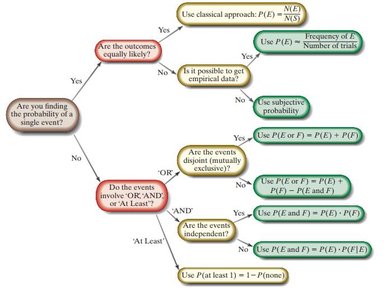
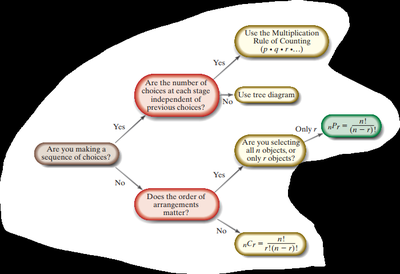
Summary of Key Formulas
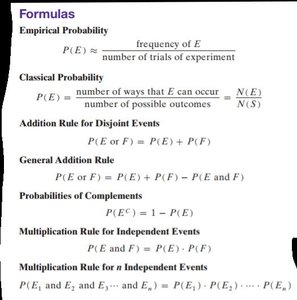
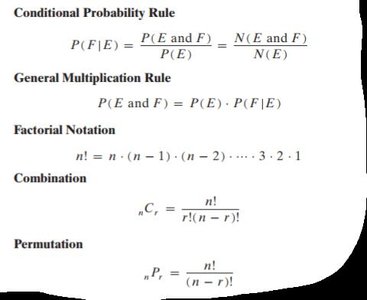
Additional info: These notes provide a comprehensive overview of probability rules and counting techniques, including definitions, examples, and key formulas. The included tables and flowcharts help clarify the application of these concepts in practical problems.
