 Back
BackReal Applications of the Normal Distribution
Study Guide - Smart Notes
 Tailored notes based on your materials, expanded with key definitions, examples, and context.
Normal Probability Distributions
Introduction to the Normal Distribution
The normal distribution, also known as the Gaussian distribution, is one of the most important probability distributions in statistics. It is widely used because many real-world phenomena are approximately normally distributed. The distribution is named after the mathematician Johann Carl Friedrich Gauss.
Symmetric bell-shaped curve: The normal distribution is perfectly symmetric about its mean.
Unimodal: It has a single peak (mode).
Mean, median, and mode are equal: All are located at the center of the distribution.
Total area under the curve: Equals 1 (or 100%).
Spread determined by standard deviation (σ): Larger σ means a wider, flatter curve.
Notation: , where is the mean and is the standard deviation.
Empirical Rule: The normal distribution follows the 68-95-99.7 rule for data within 1, 2, and 3 standard deviations from the mean.

The Normal Probability Density Function (PDF)
The probability density function (PDF) for a normal distribution is given by:
However, in practice, probabilities are found using technology (such as calculators or software) rather than by direct calculation from the PDF.
The Standard Normal Distribution and Z-Scores
A standard normal distribution is a normal distribution with mean and standard deviation . The variable is used to denote a standard normal random variable, written as . A z-score indicates how many standard deviations a value is from the mean:
Probabilities for the standard normal distribution are found using -scores.
Applications of the Normal Distribution
Finding Probabilities Using Technology
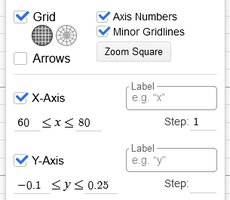
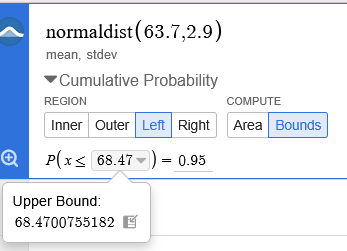
Modern statistical practice uses technology (such as Desmos or statistical calculators) to find areas under the normal curve, which correspond to probabilities. The general format for finding probabilities in Desmos is:
normaldist(mean, standard deviation) for the normal distribution
Specify the region of interest (e.g., between two values, left of a value, right of a value)
Example 1: Proportion of Men Taller Than 72 Inches
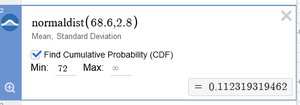
Suppose heights of men are normally distributed with mean in. and standard deviation in. What proportion of men are taller than 72 in.?
Find using Desmos or similar technology.
Result: (or 11.23%)
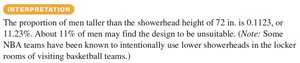
Interpretation: About 11% of men may find the showerhead design unsuitable if it is set at 72 inches.
Example 2: Air Force Height Requirement
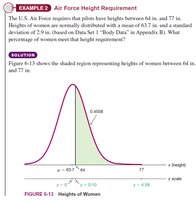
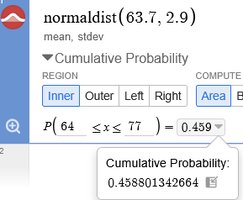
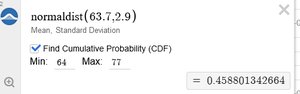
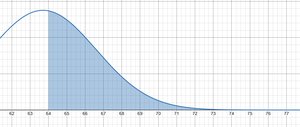
The U.S. Air Force requires that pilots have heights between 64 in. and 77 in. Heights of women are normally distributed with mean in. and standard deviation in. What percentage of women meet this height requirement?
Find using technology.
Result: (or 45.9%)
Finding Percentiles and Cutoff Values
Percentiles indicate the value below which a given percentage of observations fall. The inverse cumulative distribution function (inverse CDF) is used to find percentiles.
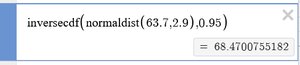
Desmos format: inversecdf(normaldist(mean, std dev), percentile)
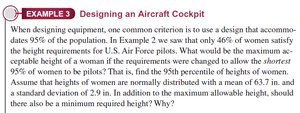
Example 3: Designing an Aircraft Cockpit
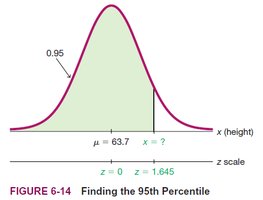
To accommodate the shortest 95% of women, find the 95th percentile of heights (mean , standard deviation ).
Find such that
Result: in.
Identifying Significantly Low or High Values
Values that are in the extreme tails of the normal distribution (e.g., below the 5th percentile or above the 95th percentile) are considered significantly low or high.
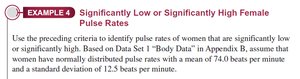
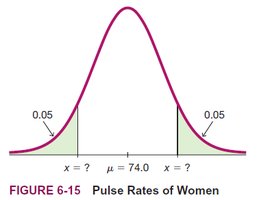
Example 4: Female Pulse Rates
Assume women's pulse rates are normally distributed with mean beats per minute and standard deviation beats per minute. Find the pulse rates that are significantly low (below the 5th percentile) and significantly high (above the 95th percentile).
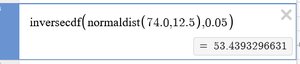
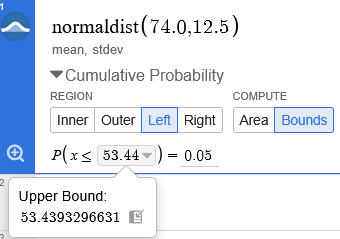
Low cutoff:
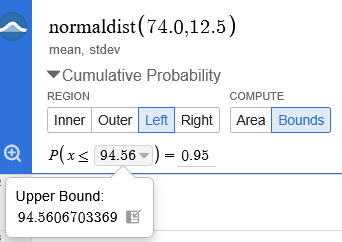
High cutoff:
Results: Low = 53.44 bpm, High = 94.56 bpm
Assessing Normality: Normal Probability Plots
Normal Quantile (Probability) Plots
A normal quantile plot (or normal probability plot) is used to assess whether a dataset is approximately normally distributed. The plot graphs each data value against its corresponding z-score.
All points should lie roughly on a straight line if the data are normally distributed.
No S-shaped pattern should be present.
Outliers appear as points far from the overall pattern.
Example: Tylenol Weights (Bell-shaped)
Example: Electricity Data (Not Bell-shaped)
Summary Table: Properties of the Normal Distribution
Property | Description |
|---|---|
Shape | Symmetric, bell-shaped |
Center | Mean = Median = Mode |
Spread | Determined by standard deviation () |
Total Area | 1 (or 100%) |
Notation | |
Empirical Rule | 68-95-99.7% within 1, 2, 3 |
Additional info: The use of technology such as Desmos streamlines the calculation of probabilities and percentiles for the normal distribution, making manual table lookups unnecessary in modern statistics courses.
