 Back
BackSampling Distributions of Sample Proportions
Study Guide - Smart Notes
 Tailored notes based on your materials, expanded with key definitions, examples, and context.
Sampling Distributions
Introduction to Sampling Distributions
The concept of a sampling distribution is fundamental in statistics, describing how a statistic (such as a sample proportion) varies from sample to sample. Understanding sampling distributions allows us to make probabilistic statements about how likely it is to observe certain values of a statistic, given a known population parameter.
How Sample Proportions Vary Around the Population Proportion
Population Proportion
Population proportion (p): The true proportion of individuals in a population with a certain characteristic.
In practice, the population proportion is often unknown and must be estimated from sample data.
Example: If we are interested in the proportion of students who live off-campus, p represents the true proportion in the entire student population.
Sample Proportion
Sample proportion (\( \hat{p} \)): The proportion of individuals with a certain characteristic in a sample, used as an estimate of the population proportion.
Calculated as: where x is the number of individuals in the sample with the characteristic, and n is the sample size.
Example: If 60 out of 100 surveyed students live off-campus, .
Sampling Proportion as a Random Variable
The sample proportion is a random variable because its value changes with different random samples.
The sampling distribution of describes the distribution of all possible values of $ \hat{p} $ for samples of size n from the population.
Describing the Sampling Distribution of a Sample Proportion
Shape: As the sample size increases, the sampling distribution of becomes approximately normal (bell-shaped), provided certain conditions are met.
Center: The mean of the sampling distribution is equal to the population proportion:
Variability: The standard deviation (also called the standard error) of the sampling distribution is:
Normal Approximation Conditions: The sampling distribution of is approximately normal if both and .
Computing Probabilities for Sample Proportions
Using the Normal Approximation
When the normal approximation conditions are met, probabilities involving can be computed using the standard normal (z) distribution.
To find the probability that is less than or equal to a certain value, convert $ \hat{p} $ to a z-score:
Use the standard normal table or technology to find the probability corresponding to the calculated z-score.
Example: Probability Calculation
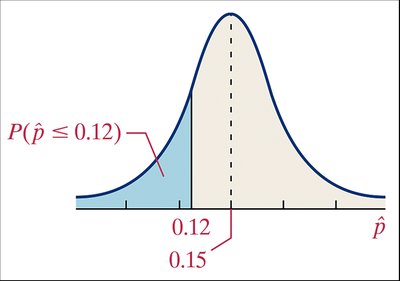
Suppose 15% of all Americans have hearing trouble (). In a random sample of 120 Americans (), what is the probability that at most 12% have hearing trouble ()?
Check normal approximation conditions: , (both ≥ 15).
Mean:
Standard deviation:
Convert to a z-score:
Probability:
Interpretation: There is about a 17.88% chance that at most 12% of a random sample of 120 Americans will have hearing trouble.
Example: Interpreting Unusual Results
Suppose a sample of 120 Americans who regularly listen to music with headphones yields 26 with hearing trouble ().
To determine if this is unusual, compute under the assumption .
Convert to a z-score:
Probability: , so
Interpretation: There is about a 1.97% chance of observing a sample proportion of 0.217 or higher if the true population proportion is 0.15. This is considered unusual (less than 5%).
Drawing Conclusions
If the probability of observing a sample proportion as extreme as the one obtained is very low, we may suspect that the true population proportion is different from the assumed value.
In the example, it is more plausible that the population proportion of Americans with hearing trouble who regularly listen to music with headphones is higher than 0.15.
Summary Table: Key Quantities for Sampling Distribution of Sample Proportion
Quantity | Symbol | Formula | Description |
|---|---|---|---|
Population Proportion | p | — | True proportion in the population |
Sample Proportion | \( \hat{p} \) | Proportion in the sample | |
Mean of Sampling Distribution | Expected value of | ||
Standard Deviation of Sampling Distribution | Variability of | ||
Normal Approximation Conditions | — | and | When sampling distribution is approximately normal |
