 Back
BackSampling Methods in Statistics: Concepts, Bias, and Applications
Study Guide - Smart Notes
 Tailored notes based on your materials, expanded with key definitions, examples, and context.
Sampling in Statistics
Introduction to Sampling
Sampling is a fundamental concept in statistics, allowing researchers to draw conclusions about a population without examining every member. Because conducting a census (collecting data from every member of a population) is often impractical, sampling provides a practical alternative. The accuracy of statistical inferences depends on the representativeness of the sample.
Key Concepts in Sampling
Census and Sample
Census: A collection of data from every member of a population. While it provides complete information, it is often too costly, time-consuming, or disruptive to conduct.
Sample: A subset of the population from which data are actually collected. The goal is to use sample statistics to make inferences about population parameters.
Representative Sample
Definition: A sample in which the relevant characteristics of the sample members are generally the same as those of the population.
Importance: Only representative samples allow for valid inferences about the population.
Example: The mean height of students in a statistics class is more likely to represent the mean height of all students than the mean height of the men's basketball team.
Bias in Sampling
Definition: A statistical study suffers from bias if its design or conduct tends to favor certain results.
Sources of Bias:
Sample selection (e.g., only late-night workers in a TV survey)
Researcher bias (personal stake in outcome)
Data collection methods
Reporting bias (e.g., misleading graphs or selective publication)
Impact: Biased samples lead to untrustworthy conclusions.
Example: If a TV network conducted its own ratings, advertisers would not trust the results due to potential bias.
Sampling Methods
Simple Random Sampling
Every member of the population has an equal chance of being selected. This method is likely to produce a representative sample if the sample size is large enough.
Procedure: Assign numbers to each member and select randomly (e.g., using a random number generator).
Example: Drawing 100 student numbers from a hat to select a sample.
Systematic Sampling
Members are selected using a fixed, periodic interval (e.g., every 50th item). This method is efficient but can introduce bias if there is a hidden pattern in the population.
Example: Testing every 50th microchip on an assembly line.
Potential Pitfall: If the interval aligns with a pattern (e.g., odd/even room numbers in a dorm), the sample may not be representative.
Convenience Sampling
Samples are chosen based on ease of access. This method is prone to bias and should be used with caution.
Example: Surveying students in your own class or shoppers who volunteer for a taste test.
Self-Selected Sample: A type of convenience sample where participants choose themselves.
Cluster Sampling
The population is divided into groups (clusters), some clusters are randomly selected, and all members of chosen clusters are surveyed. Useful when populations are spread out geographically.
Example: Selecting random counties and surveying all farmers in those counties.
Stratified Sampling
The population is divided into subgroups (strata) based on a characteristic, and random samples are taken from each stratum. This ensures representation from all subgroups.
Example: Surveying voters by randomly sampling within each state.
Application: The U.S. Labor Department surveys households within geographic regions to ensure all areas are represented.
Summary Table: Common Sampling Methods
Sampling Method | Description | Example |
|---|---|---|
Simple Random Sampling | Every sample of the same size has an equal chance of being selected. | Randomly selecting ticket numbers in a stadium. |
Systematic Sampling | Selecting every nth member of the population. | Testing every 50th microchip. |
Convenience Sampling | Using samples that are easy to obtain. | Surveying students in your class. |
Cluster Sampling | Randomly selecting groups (clusters) and surveying all members within them. | Checking every apple in randomly selected baskets. |
Stratified Sampling | Dividing the population into strata and sampling from each stratum. | Surveying both athletes and nonathletes separately. |
Key Takeaways
A study can be successful only if the sample is representative of the population.
A biased sample is unlikely to be representative.
Even well-chosen samples may be unrepresentative due to random chance.
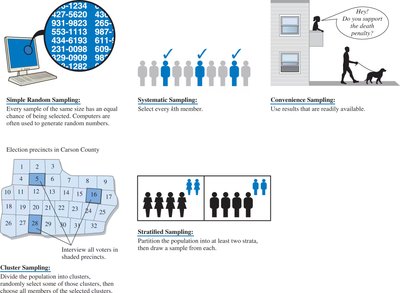
Additional info: The image above visually summarizes the five main sampling methods discussed, reinforcing the distinctions and applications of each method.
