 Back
Sampling Methods in Statistics: Section 1.2 Study Guide
Study Guide - Smart Notes
 Tailored notes based on your materials, expanded with key definitions, examples, and context.
Sampling Methods in Statistics
Introduction to Sampling
Sampling is a fundamental concept in statistics, used to draw conclusions about a population based on a subset of its members. The choice of sampling method affects the reliability and representativeness of statistical results.
Census and Representative Samples
A census is the collection of data from every member of a population. In contrast, a representative sample is a subset of the population whose relevant characteristics closely match those of the entire population. Representative samples are crucial for making valid inferences about the population.
Census: Complete enumeration of all individuals in the population.
Representative Sample: Sample with characteristics similar to the population.
Example: Surveying all students (census) vs. surveying a randomly selected group that reflects the student body (representative sample).
Bias in Sampling
Bias occurs when a study's design or conduct favors certain outcomes, making the sample unrepresentative. Biased studies cannot be trusted for accurate conclusions.
Sources of Bias:
Sample differs from the population in a specific way.
Researcher has a personal stake in the outcome.
Data collection is flawed or misleading.
Results are reported in a misleading manner.
Example: Surveying only night-shift workers to estimate late-night TV viewership introduces bias.
Simple Random Sample (SRS)
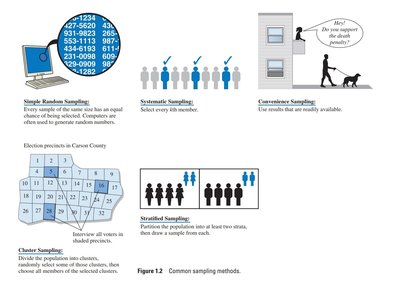
A simple random sample is one in which every member of the population has an equal chance of being selected. An SRS ensures that every possible sample of a given size has an equal chance of being chosen, often using random number generators or drawing names from a hat.
Techniques:
Random number generators
Drawing names or numbers from a hat
Example: Numbering all individuals and randomly selecting 100 for the sample.
Systematic Sampling
Systematic sampling involves selecting every nth member of the population using a fixed system. This method is efficient but may not always yield a representative sample if there is an underlying pattern in the population.
Example: Interviewing every 15th visitor to a museum exhibit.
Potential Issue: If the population is ordered in a way that correlates with the variable of interest, systematic sampling may introduce bias.
Convenience Sampling
Convenience sampling selects individuals who are easiest to reach. This method is quick and inexpensive but often results in a biased sample that is not representative of the population.
Example: Surveying shoppers at a supermarket stand.
Limitation: Results may not generalize to all shoppers.
Cluster Sampling
Cluster sampling involves dividing the population into groups (clusters), randomly selecting some clusters, and including all members of the selected clusters in the sample. This method is useful when populations are naturally divided into groups.
Example: Selecting several airports and surveying all gas stations within a mile of each airport.
Stratified Sampling
Stratified sampling divides the population into strata (groups) based on a characteristic, then randomly selects individuals from each stratum. This ensures representation from each subgroup.
Example: Grouping households by geographic area and randomly selecting households within each area for a survey.
Comparison of Sampling Methods
The following table summarizes the main sampling methods, their characteristics, and typical applications:
Sampling Method | How It Works | Advantages | Disadvantages |
|---|---|---|---|
Simple Random Sample | Every member has equal chance | Unbiased, easy to analyze | May be impractical for large populations |
Systematic Sample | Select every nth member | Efficient, easy to implement | Can introduce bias if population has patterns |
Convenience Sample | Choose easiest members | Quick, inexpensive | Often biased, not representative |
Cluster Sample | Randomly select groups, sample all in group | Useful for large, grouped populations | Clusters may not be representative |
Stratified Sample | Divide into strata, sample from each | Ensures subgroup representation | Requires knowledge of strata |
Practice: Identifying Sampling Methods
Apply your understanding by identifying the sampling method used in each scenario:
Cluster Sampling: Randomly select baskets and check every apple in each basket.
Stratified Sampling: Interview randomly selected athletes and nonathletes.
Simple Random Sampling: Randomly select ticket numbers for prize winners.
Systematic Sampling: Select every 100th chicken breast for testing.
Convenience Sampling: Surveying the first people to visit a store.
Choosing the Most Representative Sample
To obtain the most representative sample, use methods that minimize bias and ensure all population members have an equal chance of selection. Simple random and stratified sampling are generally preferred for representativeness.
Example: Randomly selecting phone numbers from a complete list yields a more representative sample than surveying volunteers or convenience samples.
Key Points to Remember
A representative sample is essential for valid statistical inference.
Biased samples lead to unreliable results.
Sampling methods should be chosen carefully to match the study's goals and population structure.
Even well-chosen samples may differ due to random variation.
Formulas and Equations
While sampling methods do not require complex formulas, the concept of probability is central to random sampling:
Probability of selection in SRS:
Where: = sample size = population size
Additional info: Academic context and examples were expanded for clarity and completeness. The included image directly illustrates the main sampling methods discussed and is highly relevant to the explanations above.
