 Back
Simple Random Sampling in Introductory Statistics
Study Guide - Smart Notes
 Tailored notes based on your materials, expanded with key definitions, examples, and context.
Simple Random Sampling
Definition and Importance
Simple random sampling is a fundamental method in statistics for selecting a representative group from a larger population. It ensures that every possible sample of a given size has an equal chance of being chosen, which is crucial for unbiased statistical inference.
Random Sampling: The process of using chance to select individuals from a population for inclusion in a sample.
Representative Sample: The sample should reflect the characteristics of the population to ensure valid results.
Avoiding Bias: Samples chosen by convenience may not represent the population and can lead to meaningless results.
Example: The Gallup Organization surveys about 1,000 adults out of 259 million in the U.S. to estimate opinions, using random sampling to ensure representativeness.
Simple Random Sample: Definition and Properties
A sample of size n from a population of size N is a simple random sample if every possible sample of size n has an equally likely chance of occurring. This is analogous to drawing names from a hat.
Without Replacement: Once an individual is selected, they are not returned to the pool for further selection.
Probability: If there are 5 students and we select 2, each pair has a probability of 1/10 of being chosen.
Example: For a group of five students (Bob, Patricia, Nancy, Jan, Maria), there are 10 possible samples of size 2, each equally likely.
Sampling Frame and Steps for Simple Random Sampling
A frame is a list of all individuals in the population. For example, a list of all registered voters in a city.
Obtain a frame listing all individuals in the population.
Assign a unique number (1 to N) to each individual.
Use statistical software or a random number table to select n individuals.
Example: An accounting firm with 30 clients wants to select a simple random sample of 10 clients. Each client is assigned a number from 1 to 30.

Using Statistical Software: StatCrunch Example
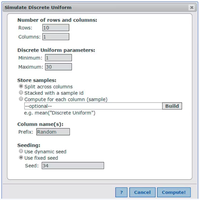
Statistical software can automate the process of generating random samples. In StatCrunch, the Discrete Uniform simulation can be used to select random numbers corresponding to individuals in the frame.
Set the number of rows to the desired sample size (e.g., 10).
Set the minimum and maximum to the range of assigned numbers (e.g., 1 to 30).
Choose a seed for reproducibility or use a dynamic seed for randomness.
Using a Table of Random Numbers
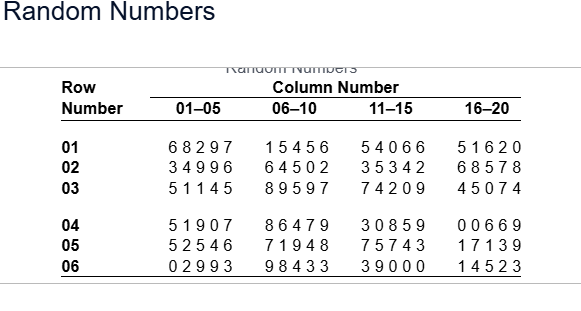
Random number tables are another tool for selecting a simple random sample. Each number in the table corresponds to an individual in the frame.
Start at a random position in the table.
Read numbers in a consistent direction (e.g., left to right, top to bottom).
Select individuals whose assigned numbers match the random numbers, skipping repeats.
Application Example: Sampling U.S. Presidents
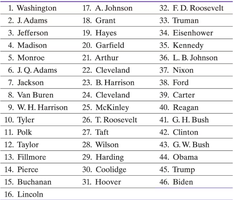
Suppose we want to select a simple random sample of 8 U.S. Presidents from a list of 46. Assign each president a number from 1 to 46, then use software or a random number table to select 8 unique numbers.
Summary Table: Steps for Simple Random Sampling
Step | Description |
|---|---|
1. Define Population | Identify the group you want to study. |
2. Create Frame | List all individuals in the population. |
3. Assign Numbers | Number each individual from 1 to N. |
4. Select Random Sample | Use software or a random number table to select n unique numbers. |
5. Collect Data | Survey or measure the selected individuals. |
Key Points to Remember
Simple random sampling eliminates selection bias and ensures each sample is equally likely.
Random selection can be performed manually (drawing from a hat), with software, or using random number tables.
Proper sampling is essential for valid statistical inference and generalization to the population.
