 Back
BackSTA 2023 Elementary Statistics – Syllabus and Course Structure Study Guide
Study Guide - Smart Notes
 Tailored notes based on your materials, expanded with key definitions, examples, and context.
STA 2023 Elementary Statistics – Syllabus and Course Structure Study Guide
Course Overview
This course, STA 2023 Elementary Statistics, provides an introduction to the fundamental concepts and methods of statistics. Students will learn to collect, analyze, interpret, and present data using both descriptive and inferential statistical techniques. The course is designed for students from a variety of disciplines and fulfills the Mathematics General Education Core requirement.
Course Objectives
Visualize and summarize data using descriptive statistics, including graphical displays and measures of central tendency, dispersion, and relative standing.
Apply probability concepts to draw reasonable conclusions, including basic terminology, rules, and calculation of probabilities for simple and compound events.
Employ concepts of random variables, sampling distributions, and the Central Limit Theorem to analyze and interpret data representations.
Choose and apply inferential statistical methods such as confidence intervals and hypothesis testing to make decisions based on sample data.
Model linear relationships between quantitative variables using correlation and regression analysis.
Course Curriculum and Topics
The course is structured into modules that align with the following key chapters and topics:
Ch. 1 – Introduction to Statistics
Statistical and critical thinking
Types of data
Collecting sample data
Ch. 2 – Exploring Data with Tables and Graphs
Frequency distributions
Histograms
Graphical representations (scatterplots, misleading graphs)
Correlation and regression basics
Ch. 3 – Describing, Exploring, and Comparing Data
Measures of center (mean, median, mode)
Measures of variation (range, variance, standard deviation)
Measures of relative standing (z-scores, percentiles, boxplots)
Ch. 4 – Probability
Basic probability concepts
Addition and multiplication rules
Complements, conditional probability, Bayes' Theorem
Counting principles
Ch. 5 – Discrete Probability Distributions
Probability distributions
Binomial probability distributions
Ch. 6 – Normal Probability Distributions
The standard normal distribution
Applications of normal distributions
Sampling distributions and estimators
The Central Limit Theorem
Ch. 7 – Estimating Parameters and Determining Sample Sizes
Estimating population proportions and means
Ch. 8 – Hypothesis Testing
Basics of hypothesis testing
Testing claims about proportions and means
Ch. 10 – Correlation and Regression
Correlation analysis
Simple linear regression
Ch. 11 – Chi-Square and Analysis of Variance
Goodness-of-fit tests
Contingency tables
Course Materials and Technology
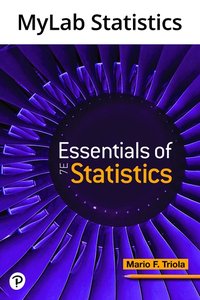
Required Textbook: Essentials of Statistics (7th Edition) by Mario F. Triola, Pearson (2023). Access is provided via MyLab Statistics with Pearson eText.
Calculator: A basic scientific calculator is required (e.g., TI-30+), but a TI-83 or TI-84 with statistical functions is preferred. CAS calculators (e.g., TI-89, TI-Nspire) and smartphone apps are not allowed.
Technology: Consistent access to a computer with webcam and microphone, high-speed internet, and the ability to use MyLab Statistics and Canvas is required.
Assessment and Grading
Grading Components:
Lecture Preparation, Video Lecture Quizzes, Attendance, In-Class Problem Sets, Homework, Quizzes, Tests, Reviews, Practice Exams, and Proctored Exams.
Proctored Exams (Midterm and Final) constitute the majority of the grade (70%).
Grading Scale: A (90+), B (80–89.99), C (70–79.99), D (60–69.99), F (≤59.99).
Policies:
No extra credit assignments.
Partial credit may be awarded for corrected errors with explanation.
Late work and extensions are governed by documented policies (see syllabus for details).
Course Structure and Assignments
Textbook Readings and PowerPoints: Prepare students for homework and quizzes.
Lecture Preparation: Due before class to encourage engagement.
Problem Sets: In-class assignments to reinforce lecture material.
Homework: Weekly assignments with multiple attempts allowed.
Quizzes: Timed, two attempts per quiz, closed book/notes.
Tests and Exams: One attempt per test/exam, proctored, closed book/notes, formula sheets provided.
Study Plan: Supplemental resource for additional practice and mastery.
Academic Integrity and Conduct
Academic Honesty: Cheating, plagiarism, collusion, and improper use of electronic devices are strictly prohibited. Violations may result in severe sanctions, including course failure.
Generative AI Policy: Use of AI tools (e.g., ChatGPT) is not permitted for any coursework.
Code of Conduct: Students are expected to maintain professionalism, respect, and courtesy in all communications and classroom interactions.
Support and Resources
Instructor and Department Contacts: Provided for academic and administrative support.
Learner Support: Free tutoring, accessibility services, academic support, and student services are available.
Technology Support: Technical assistance is available through the SPC Technical Support Center.
Course Schedule and Participation
Assignment Release: Assignments are released weekly; due dates are specified in the Course Assignment Schedule.
Attendance: Active participation is required. Excessive unexcused absences or incomplete assignments may result in withdrawal.
Withdrawal Policy: Students are responsible for understanding the impact of withdrawal on academic standing and financial aid.
Summary Table: Major Course Topics and Assessment Alignment
Chapter/Module | Main Topics | Assessment Types |
|---|---|---|
Ch. 1 | Introduction to Statistics, Types of Data, Collecting Data | Lecture Prep, Homework, Quiz |
Ch. 2 | Tables, Graphs, Scatterplots, Correlation | Lecture Prep, Homework, Quiz |
Ch. 3 | Describing and Comparing Data | Lecture Prep, Homework, Quiz |
Ch. 4 | Probability Concepts and Rules | Lecture Prep, Homework, Quiz |
Ch. 5 | Discrete Probability Distributions | Lecture Prep, Homework, Quiz |
Ch. 6 | Normal Distributions, Central Limit Theorem | Lecture Prep, Homework, Quiz |
Ch. 7 | Estimating Parameters, Sample Sizes | Lecture Prep, Homework, Quiz |
Ch. 8 | Hypothesis Testing | Lecture Prep, Homework, Quiz |
Ch. 10 | Correlation and Regression | Lecture Prep, Homework, Quiz |
Ch. 11 | Chi-Square, ANOVA | Lecture Prep, Homework, Quiz |
Key Formulas and Concepts (Examples)
Mean:
Standard Deviation:
Binomial Probability:
Normal Distribution (Z-score):
Confidence Interval for Mean (\(\sigma\) known):
Hypothesis Test Statistic (for mean):
Tips for Success
Attend all classes and participate actively.
Complete assignments ahead of deadlines to allow time for questions and review.
Utilize all available resources, including tutoring and instructor office hours.
Practice academic honesty and integrity in all coursework.
Familiarize yourself with the technology and tools required for the course.
