 Back
BackSTAT 101 24 – Winter 2026: Course Syllabus and Overview
Study Guide - Smart Notes
 Tailored notes based on your materials, expanded with key definitions, examples, and context.
Course Overview
Introduction to STAT 101
STAT 101 is an introductory statistics course designed for undergraduate students. The course covers both descriptive and inferential statistics, providing foundational knowledge for analyzing and interpreting data. Students will learn to use statistical software tools, organize and summarize data, make inferences, and test the significance of results. The course is delivered synchronously via Moodle, with assignments, a term test, and a final exam as key evaluation components.
Descriptive Statistics: Methods for summarizing and organizing data.
Inferential Statistics: Techniques for making predictions and testing hypotheses based on sample data.
Statistical Software: Application of tools for data analysis.
Regression Analysis: Exploring relationships between variables.
Probability Distributions: Understanding random variables and their distributions.
Example: Using a dataset of student test scores to calculate the mean, median, and standard deviation, and then testing whether the average score differs significantly from a national benchmark.
Course Structure and Evaluation
Assessment Components
The course includes weekly assignments, a term test, and a final exam. Assignments are submitted online, and the lowest grade is dropped (excluding missed assignments without permission). The term test is open book and online, while the final exam is in person or remotely proctored for students living more than 100 km from campus.
Assignments: 15% of final grade
Term Test: 35% of final grade
Final Exam: 50% of final grade
Passing Requirement: Students must achieve at least 40% on the final exam to pass the course.
Course Schedule
Weekly Topics and Chapters
The course is structured by week, with each week focusing on specific topics aligned with textbook chapters. The schedule ensures coverage of key statistical concepts and methods.
Week | Topic | Chapter |
|---|---|---|
1 | Introduction, the Who and the What | Chapters 1 and 2 |
2 | Describing Quantitative Variables | Chapter 2 |
3 | Associations Between Quantitative Variables | Chapter 4 |
4 | Simple Linear Regression | Chapters 4 and 5 |
5 | Probability | Chapters 5 and 6 |
6 | Binomial and Normal Probability | Chapters 6 and 7 |
7 | Sampling Distribution for One Proportion | Chapters 7 and 8 |
8 | Hypothesis Testing for One Proportion | Chapter 8 |
9 | Sampling Distribution of One Mean | Chapter 9 |
10 | Hypothesis Testing for One Mean | Chapter 9 |
11 | Inference for Two Means | Chapter 9 |
12 | Inference for Paired Means | Chapter 9 |
Additional info: The schedule aligns with standard introductory statistics topics, including data visualization, regression, probability, sampling, and hypothesis testing.
Learning Objectives
Skills and Competencies
By the end of the course, students will be able to:
Use statistical software tools for data analysis.
Organize and summarize data using descriptive statistics.
Make inferences from sample data to populations.
Test the significance of statistical results.
Recommended Textbook
Reference Material
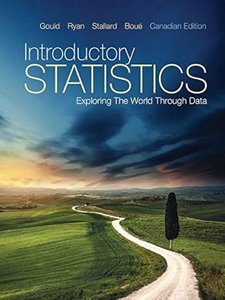
The recommended textbook for the course is Introductory Statistics: Exploring the World Through Data, Canadian Edition by Gould, Ryan, Stallard, and Boué (2016). While not required, it serves as a useful reference for students.
Support and Policies
Student Support Services
Students have access to a range of support services, including academic advising, health and wellness resources, accessible learning, and career services. The course also emphasizes professional courtesy and sensitivity regarding personal identities and backgrounds.
Academic Integrity: Students must adhere to university policies on academic honesty.
Copyright: Course materials are protected and may not be distributed without permission.
Electronic Devices: Restrictions apply during exams unless accommodations are granted.
Accessible Learning: Support is available for students with documented disabilities.
Health and Wellness: On-campus resources are provided for student well-being.
Example: Students needing exam accommodations should contact the Tramble Center for Accessible Learning at least two weeks before the end of classes.
Method of Instruction
Class Format
Classes include review sessions, introduction of new methods, and interactive exercises. Weekly assignments reinforce learning and are submitted online. The course is designed to be engaging and supportive, with opportunities for individual and group meetings with the instructor.
Interactive Exercises: Students practice statistical methods through word problems and assignments.
Assignment Submission: Assignments are completed on paper and uploaded to Moodle.
Instructor Availability: Office hours and online meetings are available for additional support.
