 Back
BackSTAT 243Z Exam 1 Review: Foundations of Statistics
Study Guide - Smart Notes
 Tailored notes based on your materials, expanded with key definitions, examples, and context.
Ch. 1: Introduction to Statistics
Key Definitions
Statistics is the science of collecting, analyzing, interpreting, and presenting data. Understanding basic terminology is essential for interpreting statistical results.
Population: The entire group of individuals or items of interest.
Parameter: A numerical summary describing a characteristic of a population.
Sample: A subset of the population selected for study.
Statistic: A numerical summary describing a characteristic of a sample.
Census: A study that collects data from every member of the population.
Sampling Methods and Bias
Random Sample: Each member of the population has an equal chance of being selected.
Simple Random Sample: Every possible sample of a given size has an equal chance of being chosen.
Bias: Systematic error that skews results; eliminated by randomization and careful sampling.
Sampling Error: Difference between sample statistic and population parameter due to random chance.
Nonsampling Error: Errors not related to sampling, such as measurement or data entry mistakes.
Voluntary Response Sample: Participants self-select; often leads to bias.
Convenience Sampling: Selecting individuals easiest to reach; may not represent the population.
Types of Data
Categorical Data: Data that can be grouped by categories (e.g., gender, color).
Quantitative Data: Numerical data; can be discrete (countable) or continuous (measurable).
Discrete Data: Countable values (e.g., number of students).
Continuous Data: Measurable values (e.g., height, weight).
Study Designs
Experiment: Researcher manipulates variables to observe effects.
Observational Study: Researcher observes without intervention.
Practical vs. Statistical Significance: Statistical significance means results are unlikely due to chance; practical significance means results are meaningful in real-world context.
Ch. 2: Exploring Data with Tables and Graphs
Frequency Tables and Histograms
Frequency tables and histograms are foundational tools for summarizing and visualizing quantitative data.
Class Width: The difference between consecutive lower class limits.
Class Limits: The smallest and largest values in each class.
Relative Frequency: The proportion of data values in each class.
Histogram: A bar graph representing frequency distribution; x-axis should be labeled with class boundaries, not both upper and lower limits.
Other Graphs
Stem & Leaf Plots: Show individual data values; similar to histograms but preserve original data.
Dotplots: Display each data point as a dot; useful for small datasets.
Pie Charts: Represent categorical data; show proportions. Advantages: Easy to interpret proportions. Disadvantages: Not suitable for quantitative data.
Bar Charts: Used for nominal or ordinal data; bars represent frequency or proportion.
Time Series Charts: Line graphs showing data trends over time.
Ch. 3: Describing, Exploring, and Comparing Data
Measures of Center
Measures of center describe the typical value in a dataset.
Mean: Arithmetic average; sensitive to outliers.
Median: Middle value; resistant to outliers.
Mode: Most frequent value.
Midrange: Average of the maximum and minimum values.
Weighted Mean: Used when values have different weights (e.g., GPA calculation).
10% Trimmed Mean: Mean calculated after removing the lowest and highest 10% of values.
Skewed Distribution: In a skewed distribution, mean, median, mode, and midrange differ. Median is most resistant to outliers.
Measures of Variation
Variation measures describe the spread of data values.
Range: Difference between maximum and minimum values.
Variance: Average squared deviation from the mean. For a sample:
Standard Deviation: Square root of variance; measures average distance from the mean.
Symbols: (population standard deviation), (population mean), (sample standard deviation), (sample mean)
Why Standard Deviation? Standard deviation is in the same units as the data, making it easier to interpret than variance.
Resistant Measures: Range and variance are not resistant to outliers; interquartile range (IQR) is more robust.
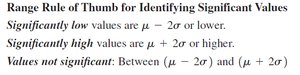
Range Rule of Thumb for Estimating Standard Deviation
The Range Rule of Thumb helps identify significant values in a dataset:
Significantly low values: or lower
Significantly high values: or higher
Values not significant: Between and
Empirical Rule
For bell-shaped (normal) distributions:
About 68% of values fall within 1 standard deviation of the mean.
About 95% within 2 standard deviations.
About 99.7% within 3 standard deviations.
Chebychev's Theorem
Applies to any data distribution, not just normal:
At least of values lie within standard deviations of the mean (for ).
Comparison: The Empirical Rule is specific to normal distributions, while Chebychev's Theorem applies to all distributions.
Measures of Relative Standing (Position)
These measures describe the position of a value within a dataset.
Standard Scores (z-scores): ; measures how many standard deviations a value is from the mean.
Percentile: The percentage of values below a given value . Formula:
Finding x given Percentile Rank:
Quartiles: Divide data into four equal parts.
Five-Number Summary: Minimum, Q1, Median, Q3, Maximum.
Boxplots: Visual representation of the five-number summary; modified boxplots highlight outliers.
Outliers: Values more than 1.5 IQRs away from Q1 or Q3.
Example: If Q1 = 10, Q3 = 20, IQR = 10, then any value below or above is an outlier.
