 Back
BackStatistics Exam 1 Review: Step-by-Step Study Guidance
Study Guide - Smart Notes
 Tailored notes based on your materials, expanded with key definitions, examples, and context.
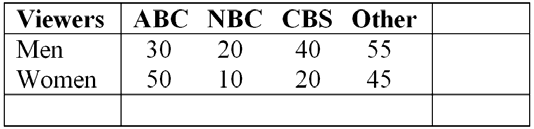
Q24. The following table represents the results of 270 individuals who are asked which evening news they watch most often. If one of these individuals is selected at random, find the probability that the person watches:
a) ABC.
b) a station other than ABC.
c) ABC or NBC.
d) ABC, given that the individual is a woman.
Background
Topic: Probability and Contingency Tables
This question tests your ability to calculate probabilities from a contingency table, including marginal, joint, and conditional probabilities.
Key Terms and Formulas:
Probability:
Conditional Probability:
Marginal Probability: Probability of a single event occurring.
Joint Probability: Probability of two events occurring together.
Step-by-Step Guidance
First, find the total number of viewers for each category by summing the values in the table. The total number of viewers is .
For part (a), calculate the probability that a randomly selected individual watches ABC. Add the number of men and women who watch ABC, then divide by the total number of viewers.
For part (b), calculate the probability that a randomly selected individual watches a station other than ABC. Add the viewers for NBC, CBS, and Other, then divide by the total number of viewers.
For part (c), calculate the probability that a randomly selected individual watches ABC or NBC. Add the viewers for ABC and NBC, then divide by the total number of viewers.
For part (d), calculate the conditional probability that a randomly selected individual watches ABC, given that the individual is a woman. Use the formula .
Try solving on your own before revealing the answer!
Final Answer:
a)
b)
c)
d)
Each probability is calculated by dividing the relevant count by the total number of viewers. For part (d), the conditional probability uses only the women viewers as the denominator.
