Back
BackStep-by-Step Guidance for College Statistics Exam Questions
Study Guide - Smart Notes
 Tailored notes based on your materials, expanded with key definitions, examples, and context.
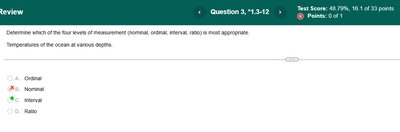
Q1. Which level of measurement is most appropriate for temperatures of the ocean at various depths?
Background
Topic: Levels of Measurement
This question tests your understanding of the four levels of measurement in statistics: nominal, ordinal, interval, and ratio. You need to determine which level best describes temperature data.
Key Terms:
Nominal: Categories without order (e.g., colors, names).
Ordinal: Ordered categories, but differences are not meaningful (e.g., rankings).
Interval: Ordered, meaningful differences, but no true zero (e.g., temperature in Celsius or Fahrenheit).
Ratio: Ordered, meaningful differences, and a true zero (e.g., height, weight).
Step-by-Step Guidance
Consider what type of data temperature represents. Is it categorical or numerical?
Think about whether temperature values can be ordered and if the differences between values are meaningful.
Ask yourself if there is a true zero point for temperature (e.g., does zero mean 'no temperature'?).
Compare the characteristics of interval and ratio levels to temperature data.
Try solving on your own before revealing the answer!
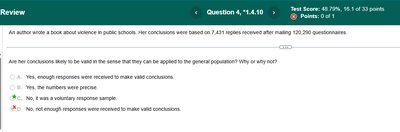
Q2. Are the author's conclusions likely to be valid for the general population? Why or why not?
Background
Topic: Sampling Methods and Validity
This question tests your understanding of sampling methods, specifically voluntary response samples, and their impact on the validity of statistical conclusions.
Key Terms:
Voluntary Response Sample: Participants choose to respond, often leading to bias.
Generalizability: Whether results can be applied to the broader population.
Step-by-Step Guidance
Identify how the sample was collected (voluntary response, random, etc.).
Consider whether the sample is likely to represent the general population.
Think about potential biases introduced by the sampling method.
Reflect on whether the sample size alone is enough to ensure validity.
Try solving on your own before revealing the answer!
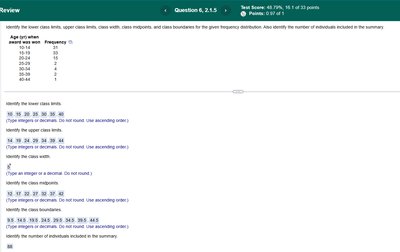
Q3. Identify class limits, class width, class midpoints, and class boundaries for the given frequency distribution. Also, identify the number of individuals included in the summary.
Background
Topic: Frequency Distributions
This question tests your ability to interpret and construct frequency distributions, including identifying class limits, class width, midpoints, boundaries, and total frequency.
Key Terms and Formulas:
Class Limits: The smallest and largest values in each class.
Class Width:
Class Midpoint:
Class Boundaries: Values that separate classes, often halfway between upper limit of one class and lower limit of the next.
Step-by-Step Guidance
List the lower and upper class limits for each class interval.
Calculate the class width using the formula above.
Find the class midpoints for each interval.
Determine the class boundaries by averaging adjacent class limits.
Add up the frequencies to find the total number of individuals.
Try solving on your own before revealing the answer!
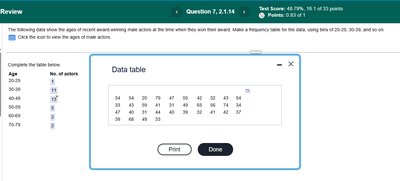
Q4. Make a frequency table for the ages of award-winning male actors using class intervals of 20-29, 30-39, and so on.
Background
Topic: Frequency Tables and Grouped Data
This question tests your ability to organize raw data into a frequency table using specified class intervals.
Key Terms:
Frequency Table: A table that shows how many data points fall into each class interval.
Class Interval: A range of values grouped together (e.g., 20-29).
Step-by-Step Guidance
List the class intervals as specified (e.g., 20-29, 30-39, etc.).
Count how many ages fall into each interval.
Record the frequency for each interval in the table.
Check your counts to ensure all data points are included.
Try solving on your own before revealing the answer!
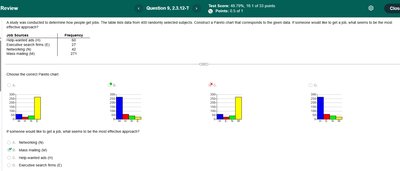
Q5. Construct a Pareto chart for the given data and determine the most effective approach for gift-giving.
Background
Topic: Pareto Charts and Data Visualization
This question tests your ability to construct and interpret Pareto charts, which are bar graphs that display frequencies in descending order.
Key Terms:
Pareto Chart: A bar graph where categories are ordered by frequency from highest to lowest.
Frequency: The number of occurrences for each category.
Step-by-Step Guidance
List the categories and their frequencies.
Order the categories from highest to lowest frequency.
Draw bars for each category, with height representing frequency.
Interpret the chart to determine which approach is most effective.
Try solving on your own before revealing the answer!