Back
Step-by-Step Guidance for Introductory Statistics: Probability Review
Study Guide - Smart Notes
 Tailored notes based on your materials, expanded with key definitions, examples, and context.
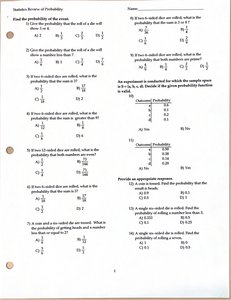
Q1. What is the probability that the roll of a die will show a 3?
Background
Topic: Basic Probability (Discrete Uniform Distribution)
This question tests your understanding of calculating the probability of a single outcome when rolling a fair six-sided die.
Key Terms and Formulas
Probability (): The likelihood of an event occurring.
Sample Space: All possible outcomes (for a die: 1, 2, 3, 4, 5, 6).
Formula:
Step-by-Step Guidance
List all possible outcomes for a single roll of a die (numbers 1 through 6).
Identify the favorable outcome (rolling a 3).
Count the number of favorable outcomes (just one: 3).
Count the total number of possible outcomes (six).
Set up the probability formula using these counts.
Try solving on your own before revealing the answer!
Final Answer:
There is only one way to roll a 3 out of six possible outcomes, so the probability is .
Q2. What is the probability that the roll of a die will show a number less than 4?
Background
Topic: Probability of Multiple Outcomes
This question tests your ability to find the probability of an event that includes several outcomes (rolling a 1, 2, or 3).
Key Terms and Formulas
Favorable outcomes: Numbers less than 4 (1, 2, 3).
Formula:
Step-by-Step Guidance
List the numbers less than 4 on a die (1, 2, 3).
Count the number of favorable outcomes (three).
Count the total number of possible outcomes (six).
Set up the probability formula using these counts.
Try solving on your own before revealing the answer!
Final Answer:
There are three numbers less than 4 out of six possible outcomes, so the probability is .
Q3. If you roll a six-sided die once, what is the probability that the outcome will be an even number?
Background
Topic: Probability of Even Outcomes
This question tests your ability to identify and count even numbers in the sample space of a die roll.
Key Terms and Formulas
Even numbers on a die: 2, 4, 6.
Formula:
Step-by-Step Guidance
List the even numbers on a six-sided die (2, 4, 6).
Count the number of favorable outcomes (three).
Count the total number of possible outcomes (six).
Set up the probability formula using these counts.
Try solving on your own before revealing the answer!
Final Answer:
There are three even numbers out of six possible outcomes, so the probability is .
Q4. If you roll a six-sided die once, what is the probability that the outcome will be a number greater than 4?
Background
Topic: Probability of Outcomes Greater Than a Value
This question tests your ability to identify numbers greater than 4 in the sample space of a die roll.
Key Terms and Formulas
Numbers greater than 4: 5, 6.
Formula:
Step-by-Step Guidance
List the numbers greater than 4 on a six-sided die (5, 6).
Count the number of favorable outcomes (two).
Count the total number of possible outcomes (six).
Set up the probability formula using these counts.
Try solving on your own before revealing the answer!
Final Answer:
There are two numbers greater than 4 out of six possible outcomes, so the probability is .
Q5. If you roll a six-sided die once, what is the probability that the outcome will be a number less than 2?
Background
Topic: Probability of Outcomes Less Than a Value
This question tests your ability to identify numbers less than 2 in the sample space of a die roll.
Key Terms and Formulas
Numbers less than 2: 1.
Formula:
Step-by-Step Guidance
List the numbers less than 2 on a six-sided die (1).
Count the number of favorable outcomes (one).
Count the total number of possible outcomes (six).
Set up the probability formula using these counts.
Try solving on your own before revealing the answer!
Final Answer:
There is only one number less than 2 out of six possible outcomes, so the probability is .
Q6. If you roll a six-sided die once, what is the probability that the outcome will be a number greater than 6?
Background
Topic: Probability of Impossible Events
This question tests your understanding of impossible events in probability (no numbers greater than 6 on a six-sided die).
Key Terms and Formulas
Numbers greater than 6: None.
Formula:
Step-by-Step Guidance
List the numbers greater than 6 on a six-sided die (none).
Count the number of favorable outcomes (zero).
Count the total number of possible outcomes (six).
Set up the probability formula using these counts.
Try solving on your own before revealing the answer!
Final Answer: $0$
There are no numbers greater than 6 on a six-sided die, so the probability is 0.
Q7. If you roll a six-sided die once, what is the probability that the outcome will be a number less than 7?
Background
Topic: Probability of Certain Events
This question tests your understanding of certain events in probability (all numbers on a die are less than 7).
Key Terms and Formulas
Numbers less than 7: 1, 2, 3, 4, 5, 6.
Formula:
Step-by-Step Guidance
List the numbers less than 7 on a six-sided die (all numbers: 1, 2, 3, 4, 5, 6).
Count the number of favorable outcomes (six).
Count the total number of possible outcomes (six).
Set up the probability formula using these counts.
Try solving on your own before revealing the answer!
Final Answer: $1$
All numbers on a six-sided die are less than 7, so the probability is 1 (a certain event).
Q8. An experiment is conducted for which the sample space is {1, 2, 3, 4, 5, 6}. Describe the given probability function and decide if it is a probability function.
Background
Topic: Probability Functions
This question tests your understanding of what makes a valid probability function (all probabilities must be between 0 and 1, and their sum must equal 1).
Key Terms and Formulas
Probability Function: Assigns probabilities to each outcome in the sample space.
Requirements: for all , and .
Step-by-Step Guidance
Check that each assigned probability is between 0 and 1.
Add up all the assigned probabilities to see if they sum to 1.
Determine if both conditions are satisfied.
Try solving on your own before revealing the answer!
Final Answer: Yes, it is a probability function.
All probabilities are between 0 and 1, and their sum is 1, so it is a valid probability function.