 Back
BackSTT 2810 Final Exam Study Guide: Key Concepts and Formulas
Study Guide - Smart Notes
 Tailored notes based on your materials, expanded with key definitions, examples, and context.
Symbols and Formulas in Statistics
Sample and Population Symbols
Understanding the notation for sample and population statistics is fundamental in statistics. These symbols are used to distinguish between values calculated from a sample and those from the entire population.
Sample Mean: \( \bar{x} \)
Population Mean: \( \mu \)
Sample Standard Deviation: \( s \)
Population Standard Deviation: \( \sigma \)
Example: If a sample of exam scores has a mean of 75, it is denoted as \( \bar{x} = 75 \). If the population mean is 80, it is \( \mu = 80 \).
Least Squares Regression Line
The least squares regression line is used to model the relationship between two quantitative variables. The formula is:
\( \hat{y} = b_0 + b_1x \)
\( b_0 \): y-intercept
\( b_1 \): slope
\( \hat{y} \): predicted y value
R2: Represents the percentage of variation in y explained by changes in x.
Confidence Intervals and Sampling Distributions
Confidence Interval for One Population Mean (Sigma Unknown)
When the population standard deviation is unknown, use the t-distribution:
\( \bar{x} \pm t^* \frac{s}{\sqrt{n}} \)
t*: Critical value from t-distribution
Standard Error: \( \frac{s}{\sqrt{n}} \)
Confidence Interval for One Population Proportion
For proportions, use the z-distribution:
\( \hat{p} \pm z^* \sqrt{\frac{\hat{p}(1-\hat{p})}{n}} \)
z*: Critical value from z-distribution
Standard Error: \( \sqrt{\frac{\hat{p}(1-\hat{p})}{n}} \)
Sampling Distribution of Sample Means
The sampling distribution of sample means describes how the mean of samples varies:
\( \bar{x} \sim N\left(\mu, \frac{\sigma}{\sqrt{n}}\right) \)
Mean: \( \mu \)
Standard Deviation: \( \frac{\sigma}{\sqrt{n}} \)
Sampling Distribution of Sample Proportions
Describes the distribution of sample proportions:
\( \hat{p} \sim N\left(p, \sqrt{\frac{p(1-p)}{n}}\right) \)
Mean: \( p \)
Standard Deviation: \( \sqrt{\frac{p(1-p)}{n}} \)
Margin of Error for Difference in Two Population Proportions
Used to construct a confidence interval for the difference between two proportions:
\( (\hat{p}_1 - \hat{p}_2) \pm z^* \sqrt{\frac{\hat{p}_1(1-\hat{p}_1)}{n_1} + \frac{\hat{p}_2(1-\hat{p}_2)}{n_2}} \)
Errors in Hypothesis Testing
Type I and Type II Errors
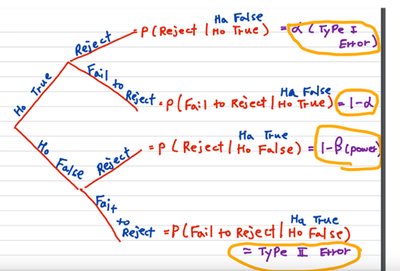
In hypothesis testing, errors can occur when making decisions about the null hypothesis (H0) and alternative hypothesis (Ha). The following table summarizes the conditional probabilities associated with these errors:
Decision | Truth | Probability | Term |
|---|---|---|---|
Reject H0 | H0 True | \( \alpha \) | Type I Error |
Fail to Reject H0 | H0 True | \( 1-\alpha \) | Correct Decision |
Reject H0 | H0 False | \( 1-\beta \) | Power |
Fail to Reject H0 | H0 False | \( \beta \) | Type II Error |
Type I Error (\( \alpha \)): Rejecting H0 when it is true. Type II Error (\( \beta \)): Failing to reject H0 when it is false. Power (\( 1-\beta \)): Probability of correctly rejecting H0 when it is false.
Describing and Displaying Data
5 W's and 1 H
To fully describe a dataset, answer the following:
Who: The subjects or cases
What: The variables measured
When: The time of data collection
Where: The location of data collection
Why: The purpose of the study
How: The method of data collection
Marginal Distributions and Contingency Tables
Marginal distributions summarize the totals for each category in a contingency table:
Formula: Row or column total / overall total
Application: Used when interested in one group out of everyone
Dot Plots and Skewness
Dot plots help visualize the distribution of data:
Skewed: Use median and IQR
Symmetric: Use mean and standard deviation
Skewed Left: Mean < Median
Skewed Right: Mean > Median
Summary Statistics and Boxplots
Summary statistics include mean, standard deviation, IQR, quartiles, min, max, and median. Boxplots visually compare medians, ranges, and IQRs.
5 Number Summary: Min, Q1, Median, Q3, Max
Boxplot Comparison: Consider context; a lower median may imply faster/slower times depending on the variable.
Shift/Scale Data
Scaling (multiplying/dividing) changes all values in a dataset. For example, reducing speed by 9% means multiplying by 0.91.
Normal Model and Z-Scores
Normal Calculator and Percentiles
Use a normal calculator to find probabilities or percentiles by adjusting mean and standard deviation.
Z-score: Tells how many standard deviations a value is from the mean.
Formula: \( z = \frac{x - \mu}{\sigma} \)
Scatterplots, Correlation, and Regression
Scatterplot Description
Describe form, direction, and strength:
Form: Linear or nonlinear
Direction: Positive or negative
Strength: Strong, moderate, weak
Correlation (r)
Correlation measures linear association:
\( r \) ranges from -1 to 1
\( r = 0 \): No linear relationship
\( r = 1 \): Perfect positive linear
\( r = -1 \): Perfect negative linear
Correlation has no units and is unaffected by shifting/scaling
Residual Plots
A residual plot is appropriate if it is not curved or does not show changing spread. The least squares regression line minimizes the sum of squared residuals.
Regression Line Interpretation
The slope indicates the average change in y for each unit increase in x.
Interpretation: For every one unit increase in x, y increases/decreases by the slope.
R2 Interpretation
R2 is the percent of variation in y explained by x.
Finding Actual y Value
Given predicted y and residual:
\( \text{Residual} = \text{Actual y} - \text{Predicted y} \)
\( \text{Actual y} = \text{Residual} + \text{Predicted y} \)
Sampling and Surveys
Sample, Sampling Frame, and Population
Definitions:
Sample: Subset of the population
Sampling Frame: List from which the sample is drawn
Population: Entire group of interest
Sampling Methods
Random: Stratified, Cluster, Systematic, Simple Random Sample
Not Random: Voluntary Response, Convenience Sampling
Bias
Voluntary response bias occurs when participants self-select into the sample.
Probability and Random Variables
Sample Space and Probability Models
Sample space lists all possible outcomes. A probability model is legitimate if probabilities sum to 1.
Probability Rules
Complement Rule: \( P(A^c) = 1 - P(A) \)
Multiplication Rule (Independent Events): \( P(A \text{ and } B) = P(A)P(B) \)
General Addition Rule: \( P(A \text{ or } B) = P(A) + P(B) - P(A \text{ and } B) \)
Conditional Probability
Probability of an event given another event has occurred.
Tree Diagrams
Tree diagrams help visualize conditional probabilities and sample spaces.
Random Variables
Define random variables, assign probabilities, and calculate expected value and standard deviation.
Expected Value: \( E(X) = \sum x_i P(x_i) \)
Standard Deviation: \( \sqrt{\sum (x_i - E(X))^2 P(x_i)} \)
Mean and Standard Deviation of X - Y
Mean: \( \mu_{X-Y} = \mu_X - \mu_Y \)
Standard Deviation: \( \sigma_{X-Y} = \sqrt{\sigma_X^2 + \sigma_Y^2} \)
Sampling Distribution for Proportions and Means
Conditions for Normal Model (Sample Proportions)
Random
10% Condition
Success/Failure Condition
Sample Size for Confidence Interval
Use \( p = 0.5 \) if not given. Find z* using normal calculator.
Hypothesis Testing and Confidence Intervals
Null and Alternative Hypotheses
Null: Always has an equal sign
Alternative: Not equal, greater, or less
Interpreting Type I and II Errors
Type I: False positive; Type II: False negative.
Confidence Interval for Difference in Two Proportions
Use sample proportions and sizes to find successes.
Interpreting p-value
If null is true, p-value is the chance of seeing the observed difference or larger by natural sampling variation.
Confidence Interval for One Mean
Use t-distribution; compute lower and upper limits.
Critical Value of t
Find using t-distribution calculator with appropriate degrees of freedom.
Interpreting Confidence Interval for Difference in Means
(-, -): Second group larger
(+, +): First group larger
(-, +): Mixed
Additional info: These notes expand on brief exam review points, providing definitions, formulas, and context for each topic. The included tree diagram visually clarifies conditional probabilities and error types in hypothesis testing.
