 Back
BackTECH-4025 (Applied Statistics) – Course Timeline and Chapter Overview
Study Guide - Smart Notes
 Tailored notes based on your materials, expanded with key definitions, examples, and context.
Course Overview: TECH-4025 (Applied Statistics)
Introduction
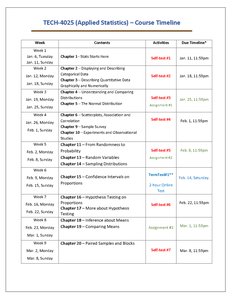
This course timeline outlines the structure and content coverage for a college-level Applied Statistics course. The schedule is organized by week, with each week focusing on a specific chapter or set of chapters from a statistics textbook. The chapters align closely with foundational and advanced topics in statistics, providing a comprehensive roadmap for students to follow throughout the term.
Course Timeline and Chapter Topics
Week | Chapter(s) | Main Topic |
|---|---|---|
1 | Chapter 1 | Stats Starts Here |
2 | Chapter 2 | Displaying and Describing Categorical Data |
3 | Chapter 3 | Displaying and Summarizing Quantitative Data |
4 | Chapter 4 | Understanding and Comparing Distributions |
5 | Chapter 5 | The Standard Deviation as a Ruler and the Normal Model |
6 | Chapters 6, 7, 8 | Scatterplots, Association, Correlation, and Linear Regression |
7 | Chapter 9 | Sample Surveys |
8 | Chapter 10 | Experiments and Observational Studies |
9 | Chapters 11, 12 | From Randomness to Probability and Probability Rules |
10 | Chapter 13 | Random Variables |
11 | Chapter 14 | Sampling Distribution Models |
12 | Chapter 15 | Confidence Intervals for Proportion |
13 | Chapters 16, 17 | Testing Hypotheses About Proportions and More About Tests |
14 | Chapter 18 | Inferences about Means |
15 | Chapters 19, 20 | Comparing Means & Paired Samples and Blocks |
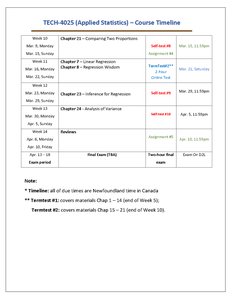
16 | Chapter 21 | Comparing Two Proportions |
17 | Chapters 23, 24 | Inferences for Regression and Analysis of Variance |
18 | Chapter 25 | Multifactor Analysis of Variance |
19 | Chapter 26 | Multiple Regression |
20 | Chapter 27 | Multiple Regression Wisdom |
21 | Chapter 28 | Nonparametric Tests |
22 | Chapter 29 | The Bootstrap |
23 | Chapter 30 | Introduction to Statistical Learning and Data Science |
Key Features of the Course Timeline
Sequential Learning: The course is structured to build foundational knowledge before advancing to more complex statistical methods.
Assessment Integration: Self-tests, assignments, and quizzes are interspersed to reinforce learning and assess understanding.
Comprehensive Coverage: Topics range from basic descriptive statistics to advanced inferential techniques, regression, ANOVA, and modern data science concepts.
Example: Chapter Progression and Academic Context
Chapter 1 – Stats Starts Here: Introduction to statistics, types of data, and the role of statistics in research and decision-making.
Chapter 2 – Displaying and Describing Categorical Data: Methods for summarizing categorical variables, including frequency tables and bar charts.
Chapter 5 – The Standard Deviation as a Ruler and the Normal Model: Understanding variability, standard deviation, and the properties of the normal distribution. Formula:
Chapters 6, 7, 8 – Scatterplots, Association, Correlation, and Linear Regression: Visualizing relationships between variables, measuring correlation, and fitting linear models. Formula (Correlation Coefficient):
Chapters 11, 12 – Probability: Introduction to probability concepts, rules, and their application in statistical inference.
Chapters 15–17 – Inference for Proportions: Constructing confidence intervals and hypothesis tests for population proportions. Formula (Confidence Interval for Proportion):
Chapters 18–20 – Inference for Means and Comparing Groups: Techniques for comparing means, including paired and independent samples.
Chapters 23–27 – Regression and ANOVA: Advanced modeling techniques for analyzing relationships among variables and comparing group means.
Chapters 28–30 – Nonparametric Tests, Bootstrap, and Data Science: Modern statistical methods for situations where traditional assumptions do not hold, and an introduction to statistical learning.
Assessment and Review
Regular self-tests and assignments are scheduled to reinforce learning.
Midterm and final exams assess cumulative understanding of the material.
Additional info: This timeline provides a week-by-week guide for students, ensuring systematic coverage of all major topics in a typical college statistics course. The structure supports both foundational learning and advanced application, preparing students for further study or professional application of statistical methods.
