 Back
BackTest 2 Review: Step-by-Step Statistics Guidance
Study Guide - Smart Notes
 Tailored notes based on your materials, expanded with key definitions, examples, and context.
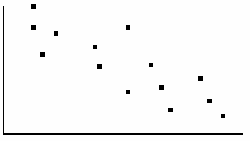
Q1. Determine the type of correlation between test scores (y) and the amount of loose pocket change (x) for a group of students. State whether the correlation is due to coincidence, a common underlying cause, or a direct cause.
Background
Topic: Correlation and Causation
This question tests your ability to interpret scatter diagrams, identify the type of correlation (positive, negative, or none), and reason about the possible cause of the relationship between two variables.
Key Terms:
Correlation: A statistical measure that describes the direction and strength of a relationship between two variables.
Positive Correlation: As one variable increases, the other also increases.
Negative Correlation: As one variable increases, the other decreases.
No Correlation: No apparent relationship between the variables.
Causation: Indicates whether one variable directly affects the other, or if the relationship is coincidental or due to a third variable.
Step-by-Step Guidance
Examine the scatter plot to determine the overall trend of the data points. Are they moving upward, downward, or scattered randomly?
If the points generally move from the upper left to the lower right, this suggests a negative correlation. If they move from the lower left to the upper right, this suggests a positive correlation. If there is no clear pattern, there may be no correlation.
Consider the context: Is it likely that having more pocket change directly causes higher or lower test scores, or could the relationship be coincidental or due to a third factor?
Think about possible underlying causes or confounding variables that might explain the observed relationship.
Try solving on your own before revealing the answer!
Q2. Construct a scatter diagram for the data and state whether sales and profits for these companies have no correlation, a positive correlation, or a negative correlation.
Background
Topic: Scatter Plots and Correlation
This question tests your ability to plot data points on a scatter diagram and visually assess the type of correlation between two quantitative variables.
Key Terms and Steps:
Scatter Diagram: A graph that shows the relationship between two variables using dots to represent data points.
Correlation: As above, look for positive, negative, or no correlation.
Step-by-Step Guidance
List the pairs of values for Total Sales (x-axis) and Profits (y-axis) for each company.
Plot each company as a point on the scatter diagram, with sales on the horizontal axis and profits on the vertical axis.
Observe the overall pattern of the points: Do they trend upward, downward, or show no clear pattern?
Based on the pattern, decide if the correlation is positive, negative, or none.
Try solving on your own before revealing the answer!
Q3. Does the correlation coefficient remain unchanged if interchanging the variables x and y?
Background
Topic: Properties of the Correlation Coefficient
This question tests your understanding of the mathematical properties of the correlation coefficient () and how it behaves when the variables are switched.
Key Terms:
Correlation Coefficient (): A measure of the strength and direction of the linear relationship between two variables.
Step-by-Step Guidance
Recall the formula for the correlation coefficient :
Consider what happens to the formula if you swap and in all terms.
Think about whether the numerator and denominator change when the variables are interchanged.
Try solving on your own before revealing the answer!
Q4. Given a correlation coefficient, , for a scatter diagram comparing the prices of a stock () and U.S. employment (), determine how much of the variation in the stock price can be accounted for by the best-fit line.
Background
Topic: Coefficient of Determination ()
This question tests your ability to interpret the meaning of the correlation coefficient and calculate the proportion of variance explained by the regression line.
Key Terms and Formula:
Correlation Coefficient (): Measures the strength and direction of a linear relationship.
Coefficient of Determination (): Represents the proportion of the variance in the dependent variable that is predictable from the independent variable.
Step-by-Step Guidance
Recall that the coefficient of determination is calculated as .
Substitute the given value of into the formula: .
Interpret the result as the percentage of variation in the stock price explained by the best-fit line.
Try solving on your own before revealing the answer!
Q5. Given a correlation coefficient, , for a scatter diagram comparing the prices of an item () and the availability of that item (), determine how much of the variation in the stock price can be accounted for by the best-fit line.
Background
Topic: Coefficient of Determination ()
This question is similar to Q4, but with a negative correlation. The process for finding the explained variation is the same.
Key Terms and Formula:
Correlation Coefficient (): Can be positive or negative, but is always positive.
Coefficient of Determination (): As above.
Step-by-Step Guidance
Calculate using the given value: .
Interpret the result as the percentage of variation in the stock price explained by the best-fit line.
Try solving on your own before revealing the answer!
Q6. Given a data set with correlation coefficient , determine how much of the variation can be accounted for by the best-fit line.
Background
Topic: Coefficient of Determination ()
This question is a general application of the concept to any data set.
Key Terms and Formula:
Correlation Coefficient (): As above.
Coefficient of Determination (): As above.
Step-by-Step Guidance
Calculate using the given value: .
Interpret the result as the percentage of variation explained by the best-fit line.
Try solving on your own before revealing the answer!
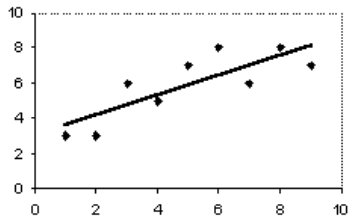
Q7. The scatter diagram and best-fit line show the data for the price of a stock () and U.S. Employment (). The correlation coefficient is 0.8. Predict the stock price for an employment value of 5.
Background
Topic: Linear Regression Prediction
This question tests your ability to use a regression line to make predictions based on a given value.
Key Terms and Formula:
Regression Line Equation: , where is the slope and is the intercept.
Prediction: Substitute the given value into the regression equation to estimate .
Step-by-Step Guidance
Identify the equation of the best-fit line from the scatter plot (if given, or estimate from the graph).
Substitute into the regression equation to solve for .
Calculate the predicted value for using the equation.
Try solving on your own before revealing the answer!
