Back
BackUsing Bayes’ Theorem to Find the Probability of Disease Given a Positive Test
Study Guide - Smart Notes
 Tailored notes based on your materials, expanded with key definitions, examples, and context.
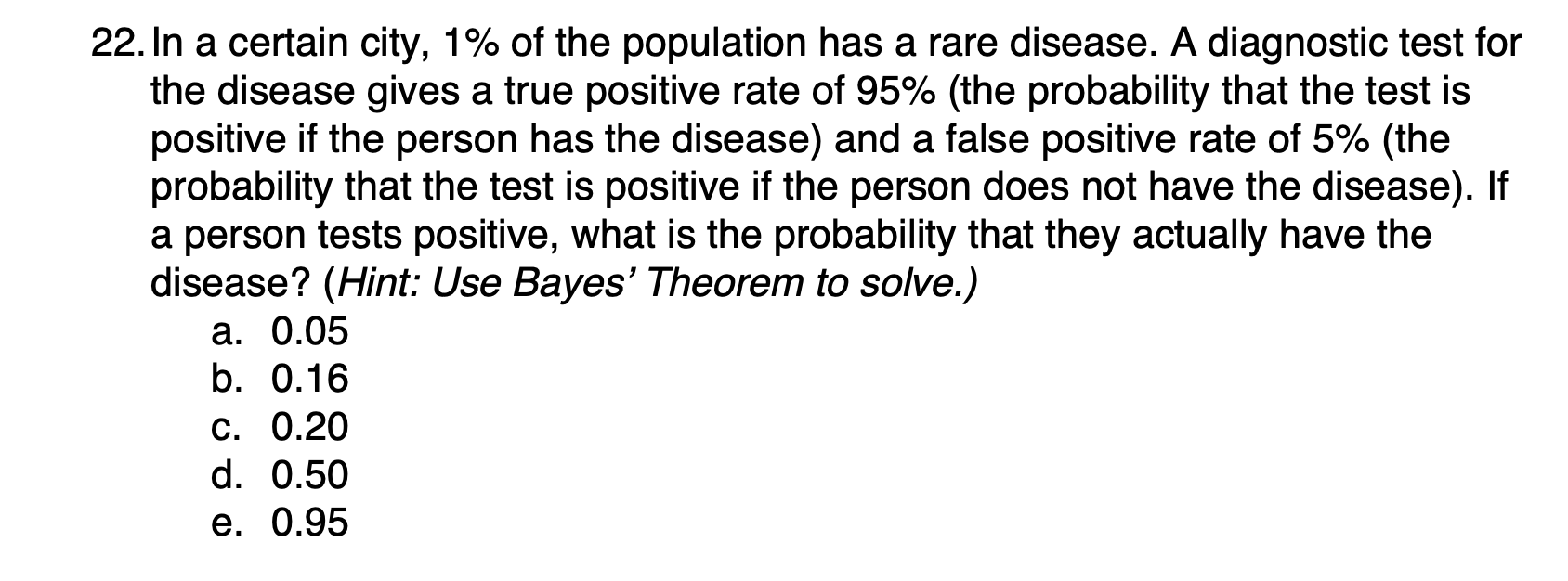
Q22. In a certain city, 1% of the population has a rare disease. A diagnostic test for the disease gives a true positive rate of 95% (the probability that the test is positive if the person has the disease) and a false positive rate of 5% (the probability that the test is positive if the person does not have the disease). If a person tests positive, what is the probability that they actually have the disease? (Hint: Use Bayes’ Theorem to solve.)
Background
Topic: Conditional Probability & Bayes’ Theorem
This question tests your understanding of how to use Bayes’ Theorem to update probabilities based on new evidence—in this case, the probability that a person actually has a disease given a positive test result.
Key Terms and Formulas
Prevalence (Prior Probability): = Probability a person has the disease = 0.01
True Positive Rate (Sensitivity): = Probability test is positive given disease = 0.95
False Positive Rate: = Probability test is positive given no disease = 0.05
Bayes’ Theorem:
= Probability of disease given a positive test
= Probability a person does not have the disease = 1 - P(D)$
Step-by-Step Guidance
Identify and write down all the given probabilities:
Write out Bayes’ Theorem for this context:
Substitute the known values into the formula:
Calculate the numerator:
Calculate the denominator:
Try solving on your own before revealing the answer!