What is the value of cos(45°) using the common values of trigonometric functions for special angles?
The value of cos(45°) is √2/2.
What is the value of sin(45°) using the common values of trigonometric functions for special angles?
The value of sin(45°) is √2/2.
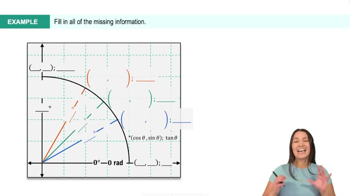
What do the x and y coordinates of a point on the unit circle represent in trigonometry?
The x coordinate represents the cosine of the angle, and the y coordinate represents the sine of the angle. This relationship helps connect angles to their trigonometric values.
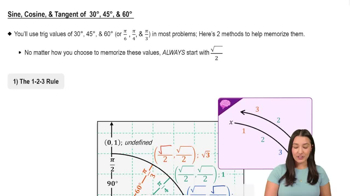
How does the '123 rule' help you memorize trig values for 30°, 45°, and 60°?
The '123 rule' involves counting 1, 2, 3 clockwise for x values (cosine) and 1, 2, 3 counterclockwise for y values (sine) around the unit circle. Each value is then placed under a square root and divided by 2.
What is the simplified value of cos(60°) using the square root property?
Cos(60°) simplifies to 1/2 because the square root of 1 is 1. This is derived from the '123 rule' method.
How do you calculate the tangent of 30° using sine and cosine values?
You divide the sine value (1/2) by the cosine value (√3/2) to get 1/√3. Rationalizing the denominator gives √3/3.
In the left hand rule, which finger represents 0° and which represents 90°?
The pinky represents 0°, and the thumb represents 90°. The other three fingers correspond to 30°, 45°, and 60°.
Using the left hand rule, how do you find the cosine of 30°?
Count the number of fingers above the folded 30° finger, which is 3, and use √3/2 for cosine. This method visually connects finger positions to trig values.
How is the tangent of an angle determined using the left hand rule?
Divide the square root of the number of fingers below the folded finger by the square root of the number above. For 30°, this results in 1/√3, or √3/3 when rationalized.
What is the general formula for sine and cosine values of common angles using these memorization methods?
Both methods use the formula: square root of a specific number (based on counting) divided by 2. The number under the square root depends on the angle and the counting direction.
What is the value of sin 60 degrees?
The value of sin 60 degrees is √3/2.
What is the value of tan(π/3)?
The value of tan(π/3) is √3.
What is the value of cos 60 degrees?
The value of cos 60 degrees is 1/2.
What is the value of sin 30 degrees?
The value of sin 30 degrees is 1/2.
How can you find the tangent of a common angle using sine and cosine values?
The tangent of a common angle can be found by dividing the sine value by the cosine value: tan(θ) = sin(θ)/cos(θ).
 Back
Back
 6:04
6:04