Which angle is coterminal with 135° among 45°, 90°, 495°, and 585°?
495° is coterminal with 135° because 495° - 360° = 135°, and coterminal angles differ by multiples of 360°.
How can you determine if an angle is coterminal with a 135° angle?
An angle is coterminal with 135° if it differs from 135° by a multiple of 360°, that is, if the angle equals 135° plus or minus any integer multiple of 360°.
What expression can be used to find an angle coterminal with a 126° angle?
An angle coterminal with 126° can be found using the expression 126° + 360°k, where k is any integer.
What expression can be used to find an angle coterminal with a 45° angle?
An angle coterminal with 45° can be found using the expression 45° + 360°k, where k is any integer.
What best describes two coterminal angles?
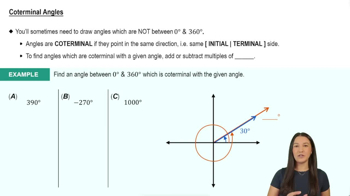
Two coterminal angles are angles that share the same terminal side, meaning they point in the same direction, even if their degree measurements differ by multiples of 360°.
How can you describe coterminal angles in terms of their terminal sides?
Coterminal angles have the same terminal side because their measures differ by integer multiples of 360°.
What is the terminal side of any angle always initially aligned with when graphing angles in standard position?
The initial side of any angle in standard position is always aligned with the x-axis. This helps establish a reference for measuring the angle's rotation.
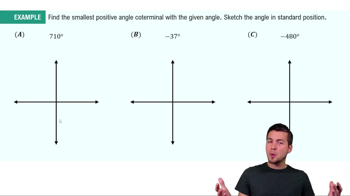
How do you find a positive coterminal angle for a negative angle such as -270°?
You add 360° to the negative angle to obtain a positive coterminal angle. For example, -270° + 360° equals 90°, which is coterminal with -270°.
What process should you follow to find the coterminal angle of a large angle like 1000° within the range 0° to 360°?
You repeatedly subtract 360° from the large angle until the result falls between 0° and 360°. For 1000°, subtracting 360° twice gives 280°, which is coterminal with 1000°.
When graphing 390°, why does it point in the same direction as 30°?
390° is one full rotation plus 30°, so it ends up at the same terminal side as 30°. This means both angles are coterminal and point in the same direction.
 Back
Back
 04:46
04:46