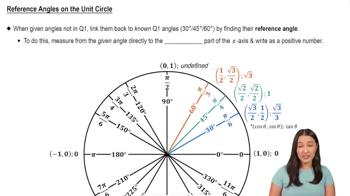
The reference angle for a 240° angle is 60°, since 240° is in the third quadrant and the reference angle is found by subtracting 180° from the angle: 240° - 180° = 60°.
Which general expression can be used to determine the reference angle for an angle in standard position?
The reference angle is the positive acute angle formed between the terminal side of the given angle and the nearest x-axis. The expression depends on the quadrant: Quadrant II: 180° - θ; Quadrant III: θ - 180°; Quadrant IV: 360° - θ.
Which equation can be used to determine the reference angle for an angle θ in degrees?
The equation to determine the reference angle r for an angle θ in degrees is: If θ is in Quadrant II: r = 180° - θ; If θ is in Quadrant III: r = θ - 180°; If θ is in Quadrant IV: r = 360° - θ.
The angle measures associated with which set of ordered pairs share the same reference angle?
Angles that are the same distance from the nearest x-axis in different quadrants share the same reference angle. For example, 30°, 150°, 210°, and 330° all have a reference angle of 30°.
Which values for θ have the same reference angles?
Angles that differ by a multiple of 180° but are the same distance from the nearest x-axis have the same reference angle. For example, θ, 180° - θ, 180° + θ, and 360° - θ all have the same reference angle.
Which values for an angle have the same reference angles?
Angles that are coterminal or that are symmetrically located in different quadrants with respect to the x-axis have the same reference angle. For example, 45°, 135°, 225°, and 315° all have a reference angle of 45°.
Which equation can be used to determine the reference angle, r, for an angle θ in degrees?
The reference angle r for an angle θ in degrees is given by: Quadrant II: r = 180° - θ; Quadrant III: r = θ - 180°; Quadrant IV: r = 360° - θ.
How can you use the denominator of a radian measure to quickly identify the reference angle for common angles?
Angles with a denominator of 6 in radians have a reference angle of 30°, those with 4 have 45°, and those with 3 have 60°. This pattern helps match radian measures to their corresponding reference angles.
What is the relationship between the sign of trigonometric functions and the quadrant in which the angle lies?
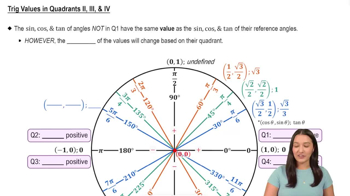
The sign of sine, cosine, and tangent depends on the quadrant: all are positive in quadrant I, only sine in II, only tangent in III, and only cosine in IV. This can be remembered using the mnemonic ASTC (All Students Take Calculus).
How do you find the coterminal angle of a given angle in degrees or radians?
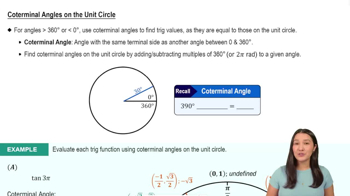
You find a coterminal angle by adding or subtracting multiples of 360° (or 2π radians) until the angle falls within one full rotation. Coterminal angles share the same terminal side and thus have identical trigonometric values.
How do you find the exact value of sin(345°) using reference angles and quadrant rules?
First, find the reference angle by subtracting 345° from 360°, which gives 15°. The reference angle is 15°. Since 345° is in quadrant IV, where sine is negative, sin(345°) = -sin(15°). The exact value is -sin(15°) = -[sin(45° - 30°)] = -[sin(45°)cos(30°) - cos(45°)sin(30°)] = -[(√2/2)(√3/2) - (√2/2)(1/2)] = -[(√6/4) - (√2/4)] = (√2/4) - (√6/4).
How do you find the exact value of tan(195°) using reference angles and quadrant rules?
First, find the reference angle by subtracting 180° from 195°, which gives 15°. The reference angle is 15°. Since 195° is in quadrant III, where tangent is positive, tan(195°) = tan(15°). The exact value is tan(15°) = tan(45° - 30°) = [tan(45°) - tan(30°)] / [1 + tan(45°)tan(30°)] = [1 - (1/√3)] / [1 + 1*(1/√3)] = [(√3 - 1)/√3] / [(√3 + 1)/√3] = (√3 - 1)/(√3 + 1).
 Back
Back
 5:30
5:30