What are the coordinates of a point (x, y) after a reflection across the line y = -x?
After a reflection across the line y = -x, the coordinates (x, y) become (-y, -x).
What is the rule for rotating a point (x, y) 90 degrees about the origin?
Rotating a point (x, y) 90 degrees about the origin results in the new coordinates (-y, x).
How do you determine the scale factor of a dilation transformation?
The scale factor of a dilation is the constant by which all coordinates are multiplied, changing the size of the figure while preserving its shape.
What is the effect on the y-coordinate of a point after a translation by (h, k)?
After a translation by (h, k), the y-coordinate of a point increases by k, resulting in a new y-coordinate of y + k.
What type of translation moves a figure to the right on the coordinate plane?
A translation that moves a figure to the right is a horizontal shift, represented by adding a positive value to the x-coordinate.
What is the mapping rule for a 180 degree rotation about the origin?
A 180 degree rotation about the origin maps (x, y) to (-x, -y).
How can you identify a translation among different transformations?
A translation is identified by a consistent shift of all points in the same direction, represented by adding constants to the x and/or y coordinates.
What type of transformation maps one triangle to another if all corresponding sides and angles are congruent and the position is changed?
A translation maps one triangle to another if all corresponding sides and angles are congruent and only the position is changed.
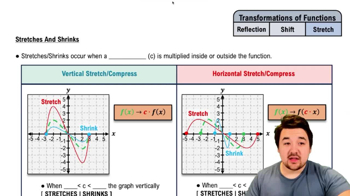
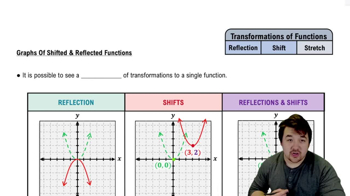
What sequence of transformations is needed to graph f(x) = -2sin(x) + 3 from the parent sine function?
To graph f(x) = -2sin(x) + 3 from the parent sine function, apply a reflection over the x-axis, a vertical stretch by a factor of 2, and a vertical shift up by 3 units.
What are the coordinates of a point (x, y) after reflecting across the line x = a?
After reflecting across the line x = a, the new x-coordinate is 2a - x, and the y-coordinate remains the same.
What set of reflections and rotations would carry a rectangle onto itself?
A rectangle can be mapped onto itself by a reflection over its axes of symmetry or by a 180 degree rotation about its center.
What are the coordinates of a point (x, y) after a 90 degree rotation about the origin?
After a 90 degree rotation about the origin, the coordinates (x, y) become (-y, x).
How can you identify which triangle on a coordinate grid is a translation of another triangle?
A triangle is a translation of another if all corresponding vertices are shifted by the same amount in the same direction.
What is the rule for rotating triangle ABC to create the image A'B'C'?
The rule for rotating triangle ABC to create A'B'C' depends on the angle and direction; for a 90 degree rotation about the origin, (x, y) maps to (-y, x).
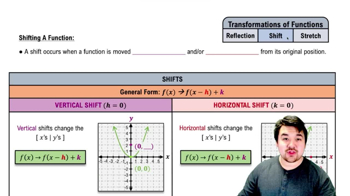
How do you determine the vertical shift (k) and phase shift (h) in a transformed function f(x-h)+k?
The vertical shift k is the constant added outside the function, and the phase shift h is the constant subtracted inside the function argument.
How can you determine if two triangles can be mapped to each other using a single translation?
Two triangles can be mapped to each other using a single translation if all corresponding vertices are shifted by the same vector.
If a vertex of a polygon is at (a, b) and after a rotation it is at (c, d), what type of rotation could have occurred?
The type of rotation can be determined by comparing the original and new coordinates; for example, a 90 degree rotation about the origin maps (a, b) to (-b, a).
If triangle XYZ is reflected across the x-axis and X = (x, y), what are the coordinates of X'?
After reflection across the x-axis, the coordinates of X' are (x, -y).
What is the function that represents the reflection over the x-axis of f(x)?
The reflection over the x-axis of f(x) is represented by -f(x).
If point T is at (x, y), what are the coordinates of T' after reflecting over the y-axis and then the x-axis?
After reflecting over the y-axis and then the x-axis, the coordinates of T' are (-x, -y).
What types of transformations can be applied to triangle PQR to change its position or orientation?
Triangle PQR can be transformed by translations, reflections, rotations, or dilations to change its position or orientation.
What is the rule for a 90-degree clockwise rotation of a point (x, y) in the coordinate plane?
A 90-degree clockwise rotation of a point (x, y) results in the new coordinates (y, -x).
What is the rule for a 180-degree rotation of a point (x, y) in the coordinate plane?
A 180-degree rotation of a point (x, y) results in the new coordinates (-x, -y).
 Back
Back

 5:34
5:34