Which trigonometric functions are undefined when x = 0 on the unit circle?
Tangent and secant are undefined when x = 0, which occurs at 90° and 270° (or π/2 and 3π/2 radians), because division by zero occurs in their definitions.
Which point on the unit circle would map onto itself after a reflection across the line y = -x?
A point on the unit circle maps onto itself after reflection across y = -x if its coordinates satisfy x = -y, such as (0,0), but on the unit circle, the points (1/√2, -1/√2) and (-1/√2, 1/√2) satisfy this condition.
For an angle measured in radians, at what point does its terminal side intersect the unit circle?
The terminal side of an angle θ in radians intersects the unit circle at the point (cos θ, sin θ).
Which expression is equivalent to cos(120°)?
cos(120°) is equivalent to -1/2.
Which expression is equivalent to cos(120°) among cos(240°), cos(300°), and cos(420°)?
Only cos(240°) shares the same value as cos(120°), which is -1/2.
How do you determine the amplitude and period of a sinusoidal function?
The amplitude is the maximum distance from the midline to the peak (half the vertical distance between maximum and minimum values), and the period is the horizontal length required for the function to complete one full cycle.
How do you find the amplitude of a sinusoidal function?
The amplitude is the absolute value of the coefficient in front of the sine or cosine function, representing the maximum distance from the midline to the peak.
On the unit circle, how many radius lengths is the terminal point to the right of the circle's vertical diameter?
The terminal point's x-coordinate gives the horizontal distance from the vertical diameter, which is cos(θ) radius lengths to the right.
For which values of θ is sec²θ·cos(2θ) defined?
sec²θ·cos(2θ) is defined for all θ where cos(θ) ≠ 0 and cos(2θ) ≠ 0, i.e., θ ≠ (2n+1)π/2 and 2θ ≠ (2m+1)π/2 for integers n, m.
Where does the helix r(t) = cos(t) lie on the unit circle?
The function r(t) = cos(t) traces the x-coordinate of a point moving around the unit circle as t varies.
What is a central angle and its intercepted arc on a circle?
A central angle is an angle whose vertex is at the center of the circle, and its intercepted arc is the portion of the circle between the angle's sides.
Which expression is equivalent to sin(7π/6)?
sin(7π/6) is equivalent to -1/2.
How do you find the measure of an arc on the unit circle given a central angle?
The measure of an arc is equal to the measure of its central angle in degrees or radians.
In which quadrant are both cosine and cotangent negative?
Both cosine and cotangent are negative in the second quadrant.
How do you find the minimum value of a sinusoidal function?
The minimum value is the midline minus the amplitude.
What relationship do the ratios of sin(x°) and cos(y°) share on the unit circle?
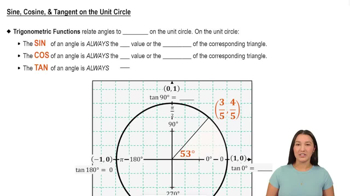
On the unit circle, sin(x°) and cos(y°) are the y- and x-coordinates, respectively, and for complementary angles, sin(x°) = cos(90° - x°).
Which expression has the same value as tan(-45°)?
tan(-45°) = -1, which is also the value of -tan(45°).
How does the unit circle explain why cos(60°) = sin(30°)?
On the unit circle, cos(60°) and sin(30°) both correspond to the value 1/2 because 60° and 30° are complementary angles.
How do you find the exact value of sin(570°)?
Subtract multiples of 360° until the angle is between 0° and 360°: 570° - 360° = 210°, so sin(570°) = sin(210°) = -1/2.
The angles that share the same tangent value as tan(45°) have terminal sides in which quadrants?
Angles coterminal with 45° and 225° (quadrants I and III) share the same tangent value.
What is the value of tan(π/3)?
tan(π/3) = √3.
What is an inscribed angle on a circle?
An inscribed angle is an angle with its vertex on the circle and its sides containing chords of the circle.
If the period of a function is P, how many cycles occur in a horizontal length of L?
The number of cycles is L divided by P, or L/P.
How do you find the x-coordinate of a point on the unit circle corresponding to an angle θ?
The x-coordinate is cos(θ).
If an angle is in quadrant II, what can be said about the sign of its sine and cosine?
In quadrant II, sine is positive and cosine is negative.
If the radius of a circle intersects the unit circle at a point, how do you find the y-coordinate?
The y-coordinate is sin(θ), where θ is the angle formed with the positive x-axis.
How do you find the measure of an arc on the unit circle?
The measure of an arc is equal to the measure of its central angle.
Which expression is equivalent to sin(22°)?
sin(22°) is already in simplest form; it is the y-coordinate of the point on the unit circle at 22°.
If the point (x, y) is in quadrant III on the unit circle, what must be true about x and y?
Both x and y are negative in quadrant III.
On the unit circle, for 0 < θ < π, when is tan(θ) undefined?
tan(θ) is undefined when cos(θ) = 0, which occurs at θ = π/2.
What is the value of sec(π/6)?
sec(π/6) = 1/cos(π/6) = 2/√3.
For the curve r² = sin(2θ), what does this represent in polar coordinates?
The curve r² = sin(2θ) represents a polar equation that traces a lemniscate (figure-eight shape) in the plane.
How do you write a complex exponential function as a sum of its real and imaginary parts?
A complex exponential function e^{iθ} can be written as cos(θ) + i·sin(θ).
List the first five terms of the sequence a_n = cos(nθ).
The first five terms are cos(θ), cos(2θ), cos(3θ), cos(4θ), and cos(5θ).
What is the exact value of tan(7π/6) using the unit circle?
To find tan(7π/6), use the unit circle coordinates for 7π/6. In the third quadrant, both sine and cosine are negative. The tangent is the ratio of sine to cosine, so tan(7π/6) = sin(7π/6)/cos(7π/6) = (–1/2)/(–√3/2) = 1/√3 = √3/3.
What is the exact value of tan(300°) using the unit circle?
Tan(300°) is found by dividing the sine of 300° by the cosine of 300°. On the unit circle, 300° is in the fourth quadrant, where sine is negative and cosine is positive. The coordinates are (1/2, –√3/2), so tan(300°) = (–√3/2)/(1/2) = –√3.
Which expression is equivalent to tan(–45°) using trigonometric identities?
Tan(–45°) is equivalent to –tan(45°) because tangent is an odd function. Since tan(45°) = 1, tan(–45°) = –1.
Which expression is equivalent to sin(7π/6) using the unit circle?
Sin(7π/6) is equivalent to –1/2, since 7π/6 is in the third quadrant where sine is negative and its reference angle is π/6.
 Back
Back
 6:34
6:34