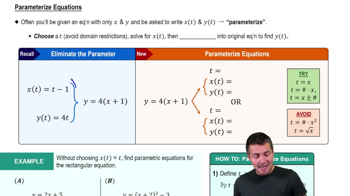
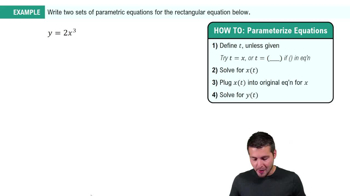
What is the first step in writing parametric equations from a rectangular equation?
The first step is to choose an expression for the parameter t, often involving x or y.
Why is it common to set t equal to x when parameterizing an equation?
Setting t equal to x is simple and avoids domain restrictions, making it a reliable choice for most problems.
After defining t, what is the next step in finding parametric equations?
Solve for x in terms of t to get x(t), then substitute this into the original equation to find y(t).
What should you avoid when choosing t to prevent domain restrictions?
Avoid choosing t as even powers of x, like x^2, because this can lead to imaginary numbers for some values of t.
How do you check if your parametric equations are correct?
Eliminate the parameter t from your parametric equations to see if you return to the original rectangular equation.
What is a good strategy for choosing t when the equation has a parenthesis, like y = 2(x + 1)?
Set t equal to the expression inside the parenthesis, such as t = x + 1.
How do you find x(t) if t = x + 1?
Solve for x to get x(t) = t - 1.
Once you have x(t), how do you find y(t) for y = 2x + 5?
Substitute x(t) into the equation to get y(t) = 2(t - 1) + 5, which simplifies to y(t) = 2t + 3.
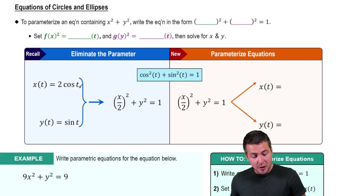
What is the process for parameterizing equations involving x^2 + y^2?
Use the Pythagorean identity by setting x = cos(t) and y = sin(t) or similar expressions.
How do you parameterize the equation x^2 + y^2 = 1?
Set x(t) = cos(t) and y(t) = sin(t).
How do you handle equations like 9x^2 + y^2 = 9 when parameterizing?
First, divide both sides by 9 to get x^2 + (y^2)/9 = 1, then set x = cos(t) and y = 3sin(t).
Why is it important to write the equation in the form f(x)^2 + g(y)^2 = 1 before parameterizing?
This form allows you to directly use cosine and sine functions for parameterization.
What is a quick way to check your parameterization for equations like y = (x + 2)^2 - 3?
Eliminate t by expressing x and y in terms of each other and verify you get back the original equation.
What parametric equations result from setting t = x + 2 for y = (x + 2)^2 - 3?
x(t) = t - 2 and y(t) = t^2 - 3.
What is the general approach to parameterizing equations involving ellipses or circles?
Rewrite the equation in the form of squared terms adding to 1, then set each squared term equal to cosine squared or sine squared of t and solve for x(t) and y(t).
 Back
Back
 04:26
04:26