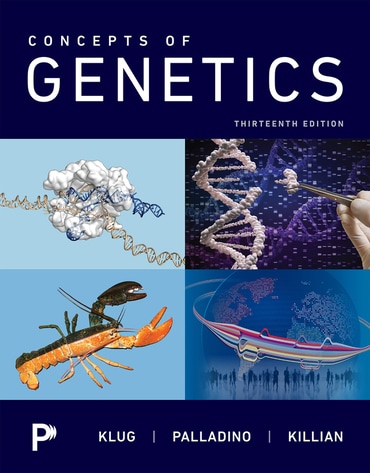

Concepts of Genetics, 13th edition

Published by Pearson (July 17, 2025) © 2026

  • William S Klug The College of New Jersey
  • Michael A Palladino Stockton University
  • Darrell Killian Colorado College
eTextbook in Pearson+

In this eTextbook — More ways to learn

  • More flexible. Start learning right away, on any device.
  • More supportive. Get AI explanations and practice questions (select titles).
  • More interactive. Bring learning to life with audio, videos, and diagrams.
  • More memorable. Make concepts stick with highlights, search, notes, and flashcards.
  • More understandable. Translate text into 100+ languages with one tap.
Products list

In this eTextbook — More ways to learn

  • More flexible. Start learning right away, on any device.
  • More supportive. Get AI explanations and practice questions (select titles).
  • More interactive. Bring learning to life with audio, videos, and diagrams.
  • More memorable. Make concepts stick with highlights, search, notes, and flashcards.
  • More understandable. Translate text into 100+ languages with one tap.

Title overview

Concepts of Genetics helps you understand the core concepts of genetics while exploring modern techniques and applications of genetic analysis. It offers digestible explanations of complex, analytical topics and focuses on helping you become an effective problem solver.

The 13th Edition has been updated to cover cutting-edge genetics content such as the first-ever gene therapy using genome-editing technology, the use of artificial intelligence in bioinformatical analysis, advances in the field of synthetic biology, and the latest research on human genomic diversity. It includes a new Special Topics Chapter on genetic testing, refined coverage on biological sex and gender identity, enhanced coverage on gene-edited food, and significant updates on genetic techniques and genomic analyses. A new Extra Spicy Question appears in each chapter to bolster the emphasis on problem solving. Additionally, significant revisions embrace diversity and inclusivity.

Table of contents

I: Genes, Chromosomes, and Heredity

  • 1: Introduction to Genetics
  • 2: Mitosis and Meiosis
  • 3: Mendelian Genetics
  • 4: Extensions of Mendelian Genetics 
  • 5: Chromosome Mapping in Eukaryotes
  • 6: Genetic Analysis and Mapping in Bacteria and Bacteriophages
  • 7: Sex Determination and Sex Chromosomes
  • 8: Chromosomal Mutations: Variation in Number and Arrangement
  • 9: Extranuclear Inheritance

II: DNA: Structure, Replication, and Organization

  • 10: DNA Structure and Analysis
  • 11: DNA Replication and Recombination
  • 12: DNA Organization in Chromosomes

III: Gene Expression and its Regulation

  • 13: The Genetic Code and Transcription
  • 14: Translation and Proteins
  • 15: Gene Mutation, DNA Repair, and Transposition
  • 16: Regulation of Gene Expression in Bacteria
  • 17: Transcriptional Regulation in Eukaryotes
  • 18: Posttranscriptional Regulation in Eukaryotes
  • 19: Epigenetic Regulation of Gene Expression

IV: Genetic Technology and Genomics

  • 20: Recombinant DNA Technology
  • 21: Genomic Analysis
  • 22: Applications of Recombinant DNA Technology and Genomics

V: Genetic Analysis of Organisms and Populations

  • 23: Developmental Genetics
  • 24: Cancer Genetics
  • 25: Quantitative Genetics and Multifactorial Traits
  • 26: Population and Evolutionary Genetics

Special Topics in Modern Genetics

  • ST 1: CRISPR-Cas and Genome Editing
  • ST 2: DNA Forensics
  • ST 3: Genetic Testing
  • ST 4: Genetic Technology and Food
  • ST 5: Gene Therapy
  • ST 6: Advances in Neurogenetics: The Study of Huntington Disease

Need help?Get in touch