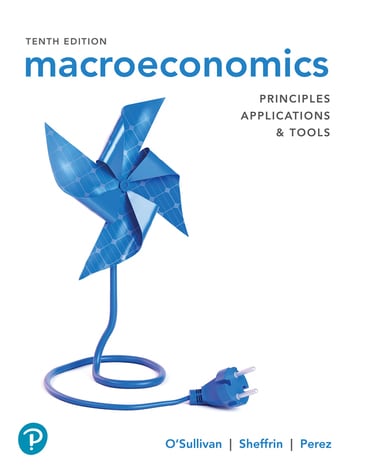

Macroeconomics: Principles, Applications, and Tools, 10th edition

Published by Pearson (15 September 2020) © 2021

  • Arthur O'Sullivan Oregon State University
  • Steven Sheffrin Tulane University
  • Stephen Perez California State University, Sacramento

Purchasing Instructions

This form contains two groups of radio buttons, one for Exam Pack purchasing options, and one for standard purchasing options. Only one option can be chosen for purchase. Any option that is selected will deselect any previously selected purchase option.

Online exclusive offer

Macroeconomics: Principles, Applications, and Tools+ subscription to Study & Exam Prep

Macroeconomics: Principles, Applications, and Tools

Access details

  • Instant access once purchased
  • Anytime, anywhere learning with the Pearson+ app

Features

  • Search, highlight and take notes
  • Watch embedded videos with select titles
  • Easily create flashcards
Requires a Course ID, a link from your instructor or an LMS link (Blackboard™, Canvas™, Moodle or D2L®)

Title overview

Students enter their first economics course hoping to gain a better understanding of the world around them, but often leave with their questions unanswered. Macroeconomics: Principles, Applications, and Tools is built upon the authors' philosophy of using basic concepts of economics to explain a wide variety of relevant, current and engaging economic applications.

The 10th Edition incorporates the latest economic developments throughout. By making every chapter relevant and applied, you'll develop an understanding of core principles that you'll use as a citizen and consumer, now and in your career.

Table of contents

PART 1: INTRODUCTION AND KEY PRINCIPLES

  1. Introduction: What Is Economics?
  2. Key Principles of Economics
  3. Exchange and Markets
  4. Demand, Supply, and Market Equilibrium

PART 2: THE BASIC CONCEPTS IN MACROECONOMICS

  1. Measuring a Nation's Production and Income
  2. Unemployment and Inflation

PART 3: THE ECONOMY IN THE LONG RUN

  1. The Economy at Full Employment
  2. Why Do Economies Grow?

PART 4: ECONOMIC FLUCTUATIONS AND FISCAL POLICY

  1. Aggregate Demand and Aggregate Supply
  2. Fiscal Policy
  3. The Income Expenditure Model
  4. Investment and Financial Markets

PART 5: MONEY, BANKING, AND MONETARY POLICY

  1. Money and the Banking System
  2. The Federal Reserve and Monetary Policy

PART 6: INFLATION, UNEMPLOYMENT, AND ECONOMIC POLICY

  1. Modern Macroeconomics: From the Short Run to the Long Run
  2. The Dynamics of Inflation and Unemployment
  3. Macroeconomic Policy Debates

PART 7: THE INTERNATIONAL ECONOMY

  1. International Trade and Public Policy
  2. The World of International Finance

Author bios

This publication contains markup to enable structural navigation and compatibility with assistive technologies. Images in the publication are fully described. The publication supports text reflow, is screen-reader friendly, and contains no content hazards known to cause adverse physical reactions.

Need help?Get in touch