
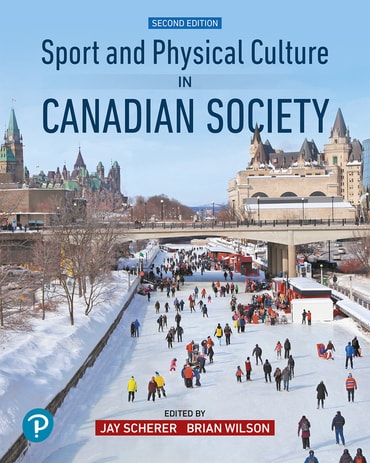
Sport and Physical Culture in Canadian Society, 2nd edition
Published by Pearson Canada (2 August 2019) © 2020
- Jay Scherer University of Alberta
- Brian Wilson University of British Columbia
Title overview
For courses in the Sociology of Sport
Sport and Physical Culture in Canadian Society is based on the idea that historical, comparative, and critical reflection is needed if we are to better understand, and indeed work towards improving, relationships between and in sport, physical culture, and society. Students learn, for example, that the opportunities to participate in various sports in Canada are by no means equitable, and that significant and enduring issues and problems remain in contemporary sport and physical culture. More importantly, they learn that the personal troubles that individuals experience along these lines are intimately connected to public issues of social structure and historical relations.
Each chapter in this contributed text is written by experts in their field, using both Canadian and international perspectives to address contemporary sociological issues.
Hallmark features of this title
Sport and Physical Culture in Canadian Society contains 16 chapters. Because the chapter sequence has been purposely coordinated, we recommend that the chapters be read consecutively. However, since the content of each chapter is distinctive, it is certainly possible to read the chapters in an altered order, or as standalone contributions. Each chapter concludes with relevant Critical Thinking Questions, Suggested Readings, and References.
The 2nd edition of Scherer will retire on June 1, 2026. Please speak to your rep about updating your course to the new 3rd edition.
New and updated features of this title
- In a revised Chapter 5, a new lineup of scholars Drs. Victoria Paraschak, Matias Golob, Janice Forsyth, and Audrey Giles critically explore a host of issues associated with race and ethnicity in sport and physical culture in Canada against the backdrop of unequal power relations. They demonstrate how sport has historically been structured to privilege certain racial and ethnic groups over others, and that many of these issues endure in contemporary Canadian society. In a crucial addition to the chapter, the authors have included a new section, Indigenous Peoples and Sport, with specific reference to the findings of the Truth and Reconciliation Commission of Canada (2015) and, in particular, its sport-related Calls to Action.
- In a revised sixth chapter, Drs. Mary Louise Adams and Sarah Barnes critically examine a range of contemporary issues and debates relevant to gender, sexuality, and sport. Adams and Barnes do not shy away from controversial topics such as separate sporting events for men and women, sex testing in sport, and sport typing (e.g., why certain sports are “male only”). They have also included, in this edition, an expanded discussion of the impact of the #MeToo movement in sport, and an analysis of the questions that surround the inclusion of transgender athletes in various sports and physical cultures against the backdrop of a changing sex/gender system.
- Chapter 7 is an exciting new addition to the textbook. In underlining some of the most recent and troubling issues in youth sport and physical culture, Jesse Couture and Dr. Jason Laurendeau hold up the concept of “prolympism” as a dominant structure and ideology for critical reflection, especially in light of high dropout rates across various sports. So, too, do they address the ongoing concerns about sexual harassment and abuse in youth sport. They also explore the emergence of alternative youth sport opportunities, including those driven by young people themselves trends that will continue to alter and challenge the dominant sports culture in the years to come.
Table of contents
- Sport and Physical Culture in Canadian Society
- Thinking Sociologically: Sport, Physical Culture, and Critical Theory
- Sport and Physical Culture in Historical Perspective
- Sport and Social Stratification
- Physical Culture, Sport, Ethnicity, and Race in Canada
- Sex, Gender, and Sexuality
- Youth Sport and Physical Culture
- Deviance, Sport, and Physical Culture
- Violence and Sport
- Sport and Health
- Sport, Media, and Ideology
- Sport, Politics, and Policy
- The Business of Sport
- Globalization, Sport, and International Development
- Sport and the Environment
- Sport and the Future
Author bios
EDITORS
Dr. Jay Scherer is a professor in the Faculty of Kinesiology, Sport, and Recreation at the University of Alberta, where he has taught a variety of sociology of sport courses over the past 15 years. His research interests include the political debates over the construction of publicly financed major league sports facilities and entertainment districts, and the uneven impacts of these developments on pre-existing community members. His most recent book (with David Mills and Linda Sloan McCulloch) is entitled, Power Play: Professional Hockey and the Politics of Urban Development (2019). Jay is an avid fiction reader and music listener, and enjoys being active on bikes and skis in Edmonton's river valley with family and friends.
Dr. Brian Wilson is a sociologist and professor in the School of Kinesiology at the University of British Columbia (UBC), and director of UBC's Centre for Sport and Sustainability. He is author of The Greening of Golf: Sport, Globalization and the Environment (2016, with Brad Millington), Sport & Peace: A Sociological Perspective (2012), and Fight, Flight or Chill: Subcultures, Youth and Rave into the Twenty-First Century (2006), as well as articles on sport, social inequality, environmental issues, media, social movements, and youth culture. His most recent work focuses on the role of sport in peace-promotion, responses to golf-related environmental concerns, and media coverage of sport-related conflicts and environmental issues. Brian is currently principal investigator on a Social Sciences and Humanities Research Council of Canada—funded Insight Grant entitled “Real Utopian Experiments in Environmentalist Sport: A Focus on Golf.”
CONTRIBUTORS
Dr. Carly Adams is a Board of Governors Research Chair (Tier II) and an associate professor in the Department of Kinesiology and Physical Education at the University of Lethbridge, Alberta. As a social historian and an advocate for oral history, her research explores community, identity, and gender with a focus on sport, recreation, and leisure experiences. She is the author of Queens of the Ice (Lorimer, 2011). Her work has appeared in, among others, Journal of Sport History, Journal of Canadian Studies, and International Review for the Sociology of Sport. Dr. Adams is the editor of Sport History Review.
Dr. Mary Louise Adams is a professor in the School of Kinesiology and Health Studies and the Department of Sociology at Queen's University, where she teaches courses on sport and culture, the sociology of fitness and the body, and contemporary issues in sexuality. She is the author of Artistic Impressions: Figure Skating, Masculinity and the Limits of Sport (2011) and The Trouble with Normal: Postwar Youth and the Making of Heterosexuality (1997). She has written on issues related to the history of sexuality, queer and feminist social movements, and on gender and sexuality in sport and physical activity. She is currently studying the legacies of feminism in contemporary women's sport and trying to think philosophically about embodiment, walking, and digital fitness tracking.
Dr. Sarah Barnes is a postdoctoral fellow in the School of History and Sociology at the Georgia Institute of Technology. She teaches courses related to sport, technology, science, and culture. She recently defended her dissertation, a project that examined changing ideas about the role of sleep in athletic training. Her research interests include issues related to the history and politics of athlete health and welfare, as well as debates about science and technology in sport. Her future work will investigate how a variety of sleep enhancing products and technologies are taken up in high performance sport settings.
Dr. Rob Beamish has taught at Queen's University for 35 years, serving as an associate dean (1995−2002) and head of sociology (2004−09, 2011−17). His research centres on high performance sport and specific themes in social theory. His published work includes Marx, Method and the Division of Labor; Fastest, Highest, Strongest: The Critique of High-Performance Sport (with Ian Ritchie); The Promise of Sociology: The Classical Tradition and Contemporary Sociological Thinking and Steroids: A New Look at Performance-Enhancing Drugs.
Dr. David Black is Lester B. Pearson Professor of International Development Studies, and professor and chair of political science at Dalhousie University. His research has focused primarily on Canada's involvement in sub-Saharan Africa, human rights and identity in South African foreign policy, and sport in world politics and development—notably, the politics of sport mega-events and sport for development. His publications concerning sport include two co-edited special issues of Third World Quarterly, on “Mainstreaming sport into international development studies” (with Simon Darnell, 2011), and “Going global: the promises and pitfalls of hosting global games” (with Janis van der Westhuizen, 2004), as well as articles in Third World Thematics, International Journal of Sport Policy and Politics, Sport in Society, International Journal of the History of Sport, and Politikon. Other recent publications include: Canada and Africa in the New Millennium: The Politics of Consistent Inconsistency (2015); Rethinking Canadian Aid, 2nd edition (2016, co-edited with Stephen Brown and Molly den Heyer); and South African Foreign Policy: Identities, Intentions, and Directions (2017, co-edited with David Hornsby).
Jesse Couture is a SSHRC-funded doctoral candidate in the School of Kinesiology at the University of British Columbia. He completed a bachelor's degree in social sciences and earned a master's degree in kinesiology at the University of Lethbridge. Both his undergraduate thesis and master's thesis work are published in the Sociology of Sport Journal. Jesse is a graduate student representative for the North American Society for the Sociology of Sport (NASSS) and the research and information coordinator for the Centre for Sport and Sustainability at UBC. His research interests include digital health technologies, urban running cultures, social and discursive constructions of risk, and child and youth sport. An avid runner, swimmer, and cyclist, Jesse enjoys spending time playing outdoors with his partner and their two dogs.
Dr. Jane Crossman is a professor emerita at Lakehead University where she held several administrative positions throughout her career including chair and graduate coordinator of the School of Kinesiology. She taught graduate and undergraduate courses in sport sociology, research methods, and mental training. Jane's research, which pertains to the newspaper coverage of sporting events and the psychosocial dimensions of sports injuries, has been published in a number of scholarly journals. She has edited three books: Coping with Sports Injuries: Psychological Strategies for Rehabilitation (2001) and Canadian Sport Sociology (2003; 2007).
Dr. Simon C. Darnell is an assistant professor in the Faculty of Kinesiology and Physical Education at the University of Toronto. He conducts research across the field of Sport for Development and Peace (SDP), including the role of international volunteers and NGOs in SDP; SDP and south-south development cooperation; the political economy of SDP; the history of SDP; the connections between SDP and sports mega-events; and most recently, SDP in relation to environmental sustainability and climate change. He is the author of several books on SDP, including Sport for Development and Peace: A Critical Sociology (Bloomsbury Academic, 2012) and The History and Politics of Sport for Development: Activists, Ideologues and Reformers (Palgrave MacMillan, in press, with Russell Field and Bruce Kidd). He is also the co-editor of the Routledge Handbook on Sport for Development and Peace (2019), and has edited special issues of Third World Quarterly and Qualitative Research in Sport, Exercise and Health on the topic of sport for development. He is currently the principle investigator on a SSHRC Insight Grant examining the policy challenges of addressing climate change through SDP. Previously, he was a co-investigator on an ESRC (UK) grant that comparatively analyzed SDP practices across five countries (Jamaica, Kosovo, Rwanda, Sri Lanka, Zambia). He has conducted fieldwork across Latin America, the Caribbean, and southern Africa, and made policy recommendations to various SDP organizations and stakeholders, including the Commonwealth Secretariat and the Laureus Sport for Good Foundation. His experience and expertise in history, politics, social theory, and ethnographic research methods facilitate analyses of SDP that are critically informed and theoretically grounded.
Dr. Janice Forsyth (Fisher River Cree Nation) is an associate professor in sociology in the Faculty of Social Science at Western University, where she is also the director of First Nations studies. Working at the intersection of history and sociology, her research seeks to better understand the ideological and structural constraints that limit Indigenous involvement in sports, as well as how Indigenous people use sports to revitalize their cultures and foster community wellbeing.
Dr. Audrey R. Giles is a professor in the School of Human Kinetics, Faculty of Health Sciences, University of Ottawa. She conducts research with Indigenous communities in northern Canada that examines the nexus of culture/gender/place and how it relates to injury prevention (particularly drowning) and sport for development.
Dr. Matias Golob is a social entrepreneur dedicated to addressing the health and wellness needs of ethnic minorities and immigrant populations. His published works explore, among other things, the links between immigrant entrepreneurship, multiculturalism, and physical culture in Canadian society. A passionate outdoor adventurer, Matias enjoys hiking, biking, climbing, and paddling through the most remote areas of the world.
Dr. Lyndsay Hayhurst is an assistant professor in the School of Kinesiology and Health Science at York University. Her research interests include Sport for Development and Peace (SDP), gender-based violence and sexual and reproductive health in/ through SDP, cultural studies of girlhood, postcolonial feminist theory, global governance, international relations, and corporate social responsibility. She is a co-editor (with Tess Kay and Megan Chawansky) of Beyond Sport for Development and Peace: Transnational Perspectives on Theory, Policy and Practice, and her publications have appeared in Women's Studies International Forum; Gender, Place & Culture; Third World Quarterly; and Sociology of Sport Journal. Her current research focuses on: (1) the use of non-human objects and technologies in sport for development and peace—in particular, the bicycle—as possible catalysts for development; and (2) Indigenous-focused sport for development in Canada and Australia. She has previously worked for the United Nations and Right to Play. Maya Hibbeln earned an honours BA in political science at Dalhousie University, where she specialized in the politics of sport at both national and international levels. She is now continuing her studies in sport and policy as an MA candidate at the University of Edinburgh.
Dr. Brad R. Humphreys is professor of economics in the Department of Economics, John T. Chambers College of Business and Economics at West Virginia University. He received his PhD in economics from Johns Hopkins University. He previously held faculty positions at the University of Illinois at Urbana-Champaign and the University of Alberta. His research on the economics and financing of professional sports and the economics of gambling has been published in academic journals in economics and policy analysis, including the Journal of Urban Economics, the Journal of Policy Analysis and Management, the Journal of Regional Science, the Journal of Economic Behavior and Organization, and Regional Science and Urban Economics. He has published more than 100 papers in peer-reviewed journals in economics and public policy. He is editor-in-chief of Contemporary Economic Policy, a general interest economics journal, and serves on the editorial boards of the Journal of Sports Economics, the International Journal of Sport Finance, the International Journal of Sport Management and Marketing, and International Gambling Studies. He is the 2017−2018 Benedum Distinguished Scholar in Behavioral and Social Sciences at West Virginia University.
Dr. Jason Laurendeau is an associate professor in the Department of Sociology at the University of Lethbridge. His research explores intersections of gender, risk, embodiment, and childhood, and his published work has appeared in such venues as Sociological Perspectives, the Sociology of Sport Journal, the Journal of Sport & Social Issues, and Emotion, Space & Society. Jason enjoys a number of sport and leisure pursuits, including cross-country skiing, hiking, backcountry camping, cycling, and swimming. He is also active in his local community.
Dr. Stacy L. Lorenz is a professor of physical education and history at the University of Alberta, Augustana Campus. He teaches in the areas of sport history, sociocultural aspects of sport and physical activity, sport and social issues, and sport and popular culture. Stacy's research interests include newspaper coverage of sport, media experiences of sport, sport and local and national identities, violence and masculinity, and hockey and Canadian culture. He is the author of Media, Culture, and the Meanings of Hockey: Constructing a Canadian Hockey World, 1896−1907 (2017). He has written several book chapters and published articles in such journals as the Canadian Journal of History of Sport, Journal of Sport History, Sport History Review, Journal of Canadian Studies, Journal of Sport & Social Issues, The International Journal of the History of Sport, and Journal of Historical Sociology. He is also a frequent media commentator on issues related to sport, society, and culture.
Dr. Brad Millington is an associate professor (senior lecturer) at the University of Bath in the Department for Health. His research focuses predominantly on the relationship between sport and the environment and on health and fitness technologies. He is the author of two books: The Greening of Golf: Sport, Globalization and the Environment (2016, with Brian Wilson, Manchester University Press); and Fitness, Technology and Society: Amusing Ourselves to Life (2018, Routledge).
Dr. Mark Norman is a postdoctoral fellow in the Department of Health, Aging and Society at McMaster University. He completed his PhD in the Department of Exercise Sciences at University of Toronto in 2015. His research on digital media and the production and consumption of sport has been published in venues such as Sociology of Sport Journal, Journal of Sport and Social Issues, and the edited collection Digital Leisure Cultures: Critical Perspectives. His other research interests include sport in prisons and Sport for Development and Peace. In addition to his research, Dr. Norman has taught undergraduate courses at University of Toronto (Faculty of Kinesiology and Physical Education), Ryerson University (Department of Sociology), and McMaster University (Department of Sociology and Department of Health, Aging and Society).
Dr. Victoria Paraschak is a Professor of Kinesiology at the University of Windsor, where she teaches sociology of sport, social construction of leisure, and outdoor recreation. She received a bachelor's degree from McMaster University in 1977, a master's from the University of Windsor in 1978, and a PhD from the University of Alberta in 1983. The primary focus of her research is Indigenous peoples in sport and in physical cultural practices more broadly. Following the release of the Truth and Reconciliation Commission final report in 2015, she has focused her research and teaching efforts on addressing Call to Action #87, which focuses on enhancing “public education that tells the national story of Aboriginal athletes in history.” These efforts have included working with others to enhance Wikipedia entries on elite Indigenous athletes, now numbering over 180, which are organized into three easily accessible categories: First Nations, Métis, and Canadian Inuit sportspeople, as well as creating the indigenoussporthistory.ca website. Her work focuses on power relations, social construction, and the creation, reproduction, or reshaping of cultural practices through the duality of structure. She is currently drawing on a strengths and hope perspective, which builds on strengths rather than a deficit perspective, and incorporates a social understanding of hope that enables individuals to work together to achieve broader collective goals.
Dr. Danielle Peers is a queer, disabled white settler artist, activist, and academic who is interested in how movement cultures of all kinds—including dance, recreation, and parasport—can deepen or challenge social inequalities. Danielle's work revolves around social structures that disable, and how these structures interact with other forms of structural oppression. Danielle works as an assistant professor in the Faculty of Kinesiology, Sport and Recreation at the University of Alberta.
Dr. Ian Ritchie is associate professor in the Department of Kinesiology at Brock University in St. Catharines, Ontario. Ian received his PhD in sociology from Bowling Green State University, Ohio, where he studied classical and contemporary sociological theory. He teaches courses in sport sociology, social theory, and sociology of the modern Olympic Games. Ian's research interests include performance enhancing drug use in sport, the history of anti-doping rules and policies, Canadian anti-doping policy, gender and sex determination policies, the history of the Olympic Games, and social theory as it applies to sport and physical culture. His publications have been included in several journals, including the International Review for the Sociology of Sport, Sport History Review, The International Journal of the History of Sport, the International Journal of Sport Management and Marketing, the International Journal of Sport Policy and Politics, in addition to numerous chapters in edited volumes; he is also co-author of the book Fastest, Highest, Strongest: A Critique of High-Performance Sport (Routledge, 2006, with Rob Beamish). Ian is currently writing a manuscript on the history of anti-doping policies in the modern Olympic Games. Ian lives in Fenwick, Ontario, with his wife and three children.
Dr. Parissa Safai is an associate professor in the School of Kinesiology and Health Science in the Faculty of Health at York University. Her research interests focus on the critical study of sport at the intersection of risk, health, and healthcare. This includes research on sports' “culture of risk,” the development and social organization of sport and exercise medicine, as well as the social determinants of athletes' health. Her research and teaching interests also centre on sport and social inequality with focused attention paid to the impact of gender, socioeconomic, and ethnocultural inequities on accessible physical activity for all.
Dr. Brian Soebbing is an associate professor in the Faculty of Kinesiology, Sport, and Recreation at the University of Alberta. His primary research interest focuses on the strategic behaviour of sports organizations and their constituents. Brian has published over 50 peer-reviewed articles in the research areas of sport management, economics, gambling studies, and urban studies. He currently serves on eight editorial boards and is the associate editor for Sport & Entertainment Review and the International Journal of Sport Finance.
Need help?Get in touch
 Play
Play
Pearson eTextbook: What’s on the inside just might surprise you
They say you can’t judge a book by its cover. It’s the same with your students. Meet each one right where they are with an engaging, interactive, personalized learning experience that goes beyond the textbook to fit any schedule, any budget, and any lifestyle.