 Back
Angles, Radian Measure, and Trigonometric Functions: Structured Study Notes
Study Guide - Smart Notes
 Tailored notes based on your materials, expanded with key definitions, examples, and context.
Angles and Radian Measure
Definition and Structure of Angles
An angle is formed by two rays sharing a common endpoint, called the vertex. The ray that remains fixed is called the initial side, while the ray that rotates is called the terminal side. Angles are often denoted by Greek letters such as θ, α, β, and γ.
Vertex: The common endpoint of the two rays.
Initial Side: The starting ray of the angle.
Terminal Side: The ray that rotates to form the angle.
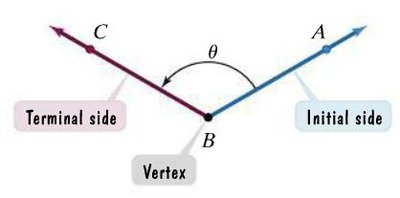
Angles in Standard Position
An angle is in standard position if its vertex is at the origin of a rectangular coordinate system and its initial side lies along the positive x-axis. Angles can be generated by two types of rotation:
Positive angles: Generated by counterclockwise rotation.
Negative angles: Generated by clockwise rotation.
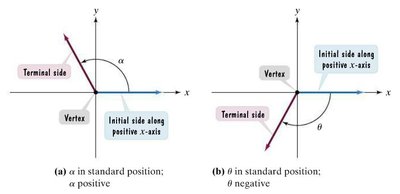
Classification of Angles by Degree Measure
Angles are classified based on their degree measure:
Acute angle:
Right angle:
Obtuse angle:
Straight angle:
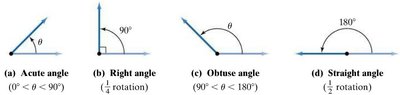
Measuring Angles: Degrees and Radians
Angles can be measured in degrees or radians. One full rotation is or radians.
Degree: is of a complete rotation.
Radian: One radian is the angle subtended by an arc equal in length to the radius of the circle.
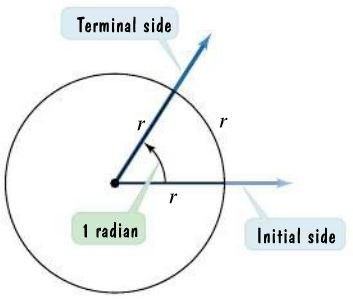
Relationship Between Degrees and Radians
The circumference of a circle is , which corresponds to or radians. The conversion formulas are:
radians
radians
To convert degrees to radians: multiply degrees by
To convert radians to degrees: multiply radians by
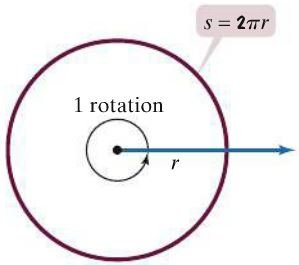
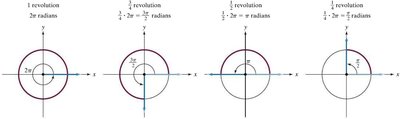
Common Radian Measures
Understanding radian measures in terms of fractions of a full revolution is essential for trigonometry.
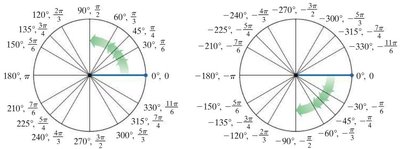
Common Angles in Degrees and Radians
Angles commonly used in trigonometry are shown in both degree and radian measures.
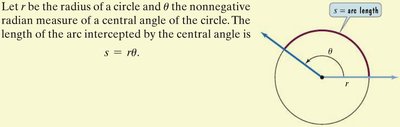
Arc Length Formula
The length of an arc intercepted by a central angle (in radians) in a circle of radius is:
Linear and Angular Speed
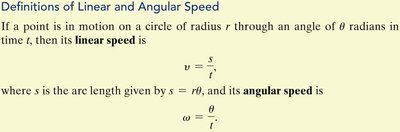
Linear speed () and angular speed () describe motion along a circular path:
Linear speed: , where is arc length and is time.
Angular speed: , where is angle in radians.
Linear speed in terms of angular speed:

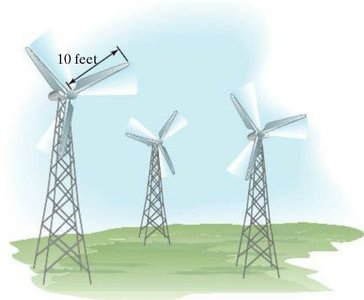
Application Example: Wind Turbine
To find the linear speed of the tip of a wind turbine blade, use the blade length as radius and the angular speed in radians per second.
Right Triangle Trigonometry
The Six Trigonometric Functions
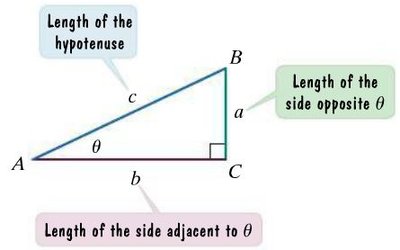
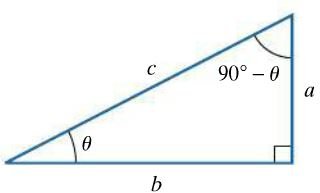
Trigonometric functions relate the angles of a right triangle to the ratios of its sides. For an acute angle :
Sine:
Cosine:
Tangent:
Cosecant:
Secant:
Cotangent:
Example: Calculating Trigonometric Functions
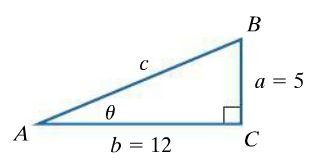
Given a right triangle with , , and hypotenuse , use the Pythagorean Theorem to find and then calculate all six trigonometric functions.
Special Right Triangles
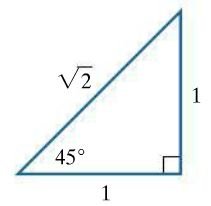
45-45-90 and 30-60-90 triangles are used to find exact values for trigonometric functions of special angles.
45-45-90 triangle: sides $1,
30-60-90 triangle: sides $1\sqrt{3}
Cofunction Identities and Complements
Two angles are complements if their sum is or radians. Sine and cosine are cofunctions:
Applications of Trigonometry
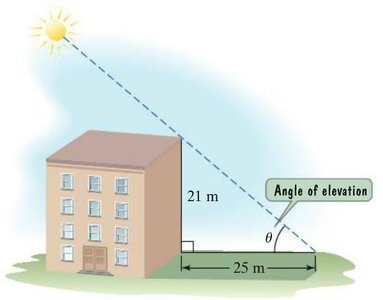
Angles of Elevation and Depression
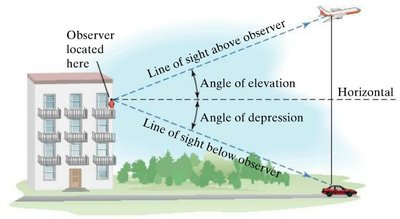
Angles of elevation and depression are used in real-world applications to measure heights and distances indirectly.
Angle of elevation: Angle above the horizontal line of sight.
Angle of depression: Angle below the horizontal line of sight.
Example: Measuring Building Height
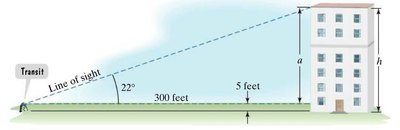
Using trigonometric functions and the angle of elevation, the height of a building can be calculated from a known distance and angle.
Example: Angle of Elevation of the Sun
Given the height of a building and the length of its shadow, the angle of elevation of the sun can be found using the tangent function.
Trigonometric Functions of Any Angle
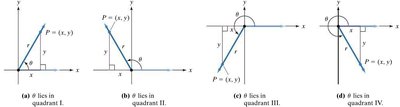
Trigonometric Functions in the Coordinate Plane
For any angle in standard position, the point on the terminal side is units from the origin, where . The trigonometric functions are defined as:
Signs of Trigonometric Functions by Quadrant
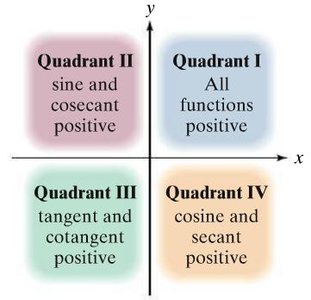
The sign of each trigonometric function depends on the quadrant in which the terminal side of the angle lies:
Quadrant I: All functions positive
Quadrant II: Sine and cosecant positive
Quadrant III: Tangent and cotangent positive
Quadrant IV: Cosine and secant positive
Reference Angles
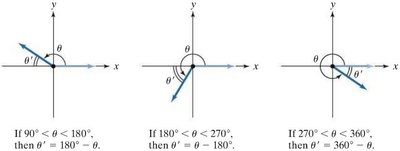
The reference angle is the positive acute angle formed by the terminal side of and the x-axis. Reference angles are used to evaluate trigonometric functions for any angle.
Trigonometric Functions of Real Numbers; Periodic Functions
The Unit Circle
The unit circle has radius $1x^2 + y^2 = 1$. The radian measure of the central angle equals the length of the intercepted arc.
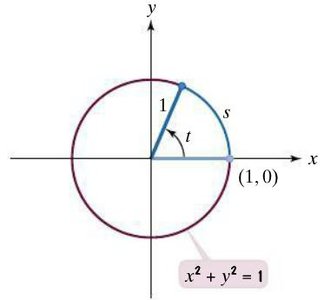
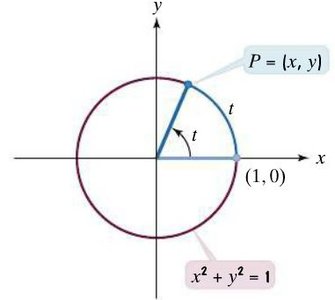
Trigonometric Functions on the Unit Circle
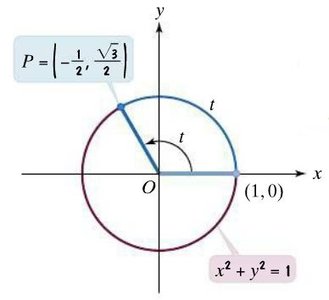
For any real number , the point on the unit circle corresponds to:
Graphs of Sine and Cosine Functions
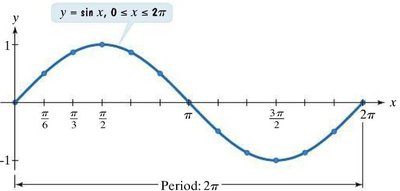
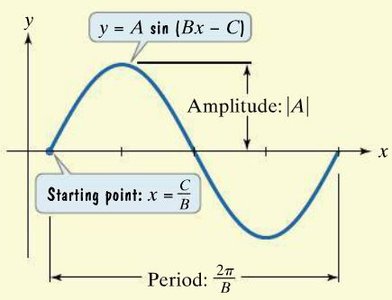
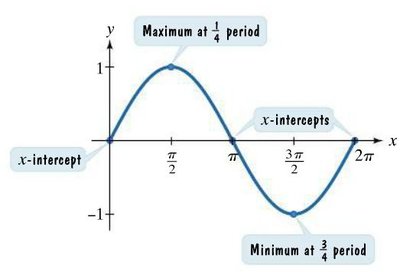
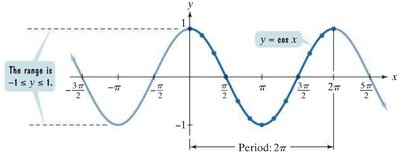
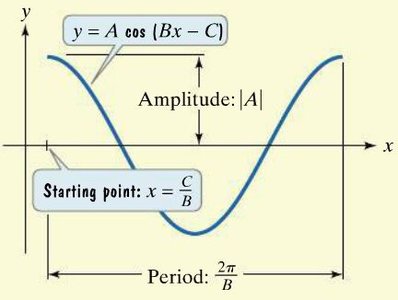
The sine and cosine functions are periodic with period . Their graphs oscillate between and $1$.
Amplitude:
Period:
Phase shift:
Graphs of Other Trigonometric Functions
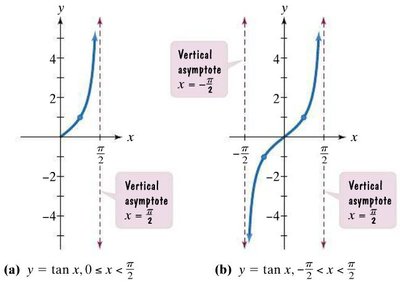
Graph of y = tan x
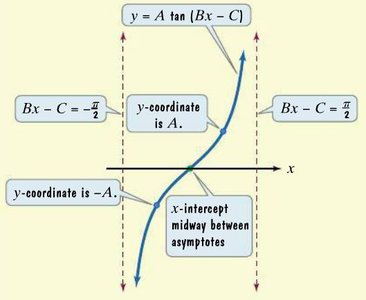
The tangent function has period and vertical asymptotes at . The graph is symmetric about the origin.
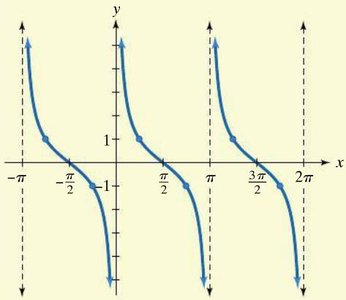
Graph of y = cot x
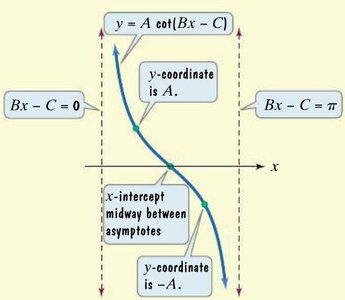
The cotangent function is the reciprocal of tangent and is shifted horizontally by units. It has vertical asymptotes at .
Graphs of y = csc x and y = sec x
Cosecant and secant functions are reciprocals of sine and cosine, respectively. Their graphs have vertical asymptotes where sine or cosine is zero.
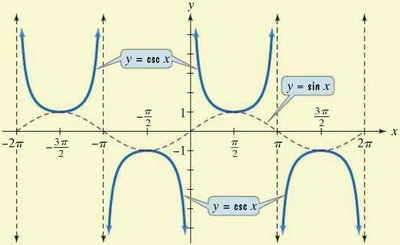
Summary Table: Trigonometric Function Properties
The following table summarizes the domain, range, and period of the six trigonometric functions:
Function | Domain | Range | Period |
|---|---|---|---|
sin x | All real numbers | [-1, 1] | |
cos x | All real numbers | [-1, 1] | |
tan x | All real numbers | ||
cot x | All real numbers | ||
csc x | |||
sec x |
