 Back
College Trigonometry Syllabus and Study Guide: Owens Community College
Study Guide - Smart Notes
 Tailored notes based on your materials, expanded with key definitions, examples, and context.
Course Overview
Introduction
This syllabus outlines the structure, requirements, and learning outcomes for College Trigonometry (MTH173-225) at Owens Community College. The course is designed as a prerequisite for Calculus I and covers essential topics in algebra and trigonometry, including real and complex numbers, functions, graphs, trigonometric identities, equations, and applications.

Course Structure and Requirements
Textbook and Materials
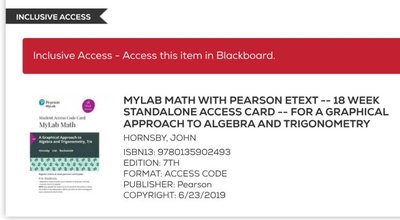
Textbook: MyLab Math with Pearson eText – A Graphical Approach to Algebra and Trigonometry, 7th Edition by John Hornsby.
Calculator: TI-84 or TI-84 PLUS Graphics Calculator required.
Technology: Regular access to a computer, internet, webcam, and microphone is mandatory. Assignments and quizzes are completed online via Blackboard and MyMathLab.
Grading Scheme
Video Assignments and Homework: 20%
Quizzes: 60% (Three quizzes covering chapters 9 and 10)
Comprehensive Final Exam: 20%
Grading Scale:
A: 90% and above
B: 80% to less than 90%
C: 70% to less than 80%
D: 60% to less than 70%
F: Less than 60%
Course Topics and Weekly Schedule
Sequenced Material
The course is organized by weekly modules, each focusing on specific sections and topics. Assignments are due every Saturday by 11:59 pm.
Week 1: 9.1 Angles, Arcs, and Their Measures
Week 2: 9.2 Trigonometric Functions and Fundamental Identities
Week 3: 9.3 Right Triangles and Evaluating Trigonometric Functions
Week 4: 9.4 Applications of Right Triangles
Week 5: 9.5 The Circular Functions
Week 6: 9.6 Graphs of the Sine and Cosine Functions
Week 7: 9.7 Graphs of the Other Circular Functions
Week 8: 10.1 Trigonometric Identities
Week 9: 10.2 Sum and Difference Identities
Week 10: 10.3 Further Identities
Week 11: 10.4 The Inverse Circular Functions
Week 12: 10.5 Trigonometric Equations and Inequalities (I)
Week 13: 10.6 Trigonometric Equations and Inequalities (II)
Week 14: Quiz 3 – Review of Chapter 10
Week 15: Comprehensive Final Exam
Key Learning Outcomes
Trigonometric Functions and Applications
Students will develop a deep understanding of trigonometric functions, their properties, and applications. This includes:
Analyzing Functions: Domain, range, zeros, periodicity, amplitude, and phase shift.
Converting Representations: Switching between algebraic, graphical, and numerical forms.
Operations with Functions: Addition, subtraction, multiplication, division, composition, and inversion.
Angle Analysis: Measurement units (degrees, radians), arithmetic, and conversions.
Right and General Triangles: Solving triangles using trigonometric ratios and the Pythagorean Theorem.
Trigonometric Identities: Fundamental, sum/difference, double angle, and Euler’s Formula.
Solving Equations and Inequalities: Exact and approximate solutions, domain restrictions, and solution methodologies.
Modeling: Creating and interpreting linear and periodic models from data.
Technology Use: Utilizing graphing calculators and software to verify and obtain solutions.
Examples and Applications
Example 1: Converting an angle from degrees to radians:
Example 2: Fundamental trigonometric identity:
Example 3: Solving a right triangle using the sine function:
Example 4: Graphing the sine function: where is amplitude, is frequency, is phase shift, and is vertical shift.
Student Responsibilities and Academic Integrity
Assignments and Quizzes
Complete all video and homework assignments by the due date.
Quizzes and final exam require LockDown Browser and webcam monitoring.
Academic honesty is strictly enforced; plagiarism or unauthorized assistance results in a zero grade.
Support Services
Math Learning Center available for tutoring.
TRIO program for eligible adult learners and veterans.
General Policies
Attendance, Accommodations, and Conduct
Follow Owens Community College’s Student Code of Conduct and Anti-Discrimination policies.
Religious accommodations available upon written request within 14 days of course start.
Health and safety protocols may affect course delivery; communication will be provided as needed.
Conclusion
This syllabus provides a comprehensive guide to the College Trigonometry course, ensuring students are prepared for advanced mathematics and calculus. Mastery of trigonometric concepts, identities, and applications is essential for success in STEM fields.
