 Back
The Law of Sines and Area of Oblique Triangles
Study Guide - Smart Notes
 Tailored notes based on your materials, expanded with key definitions, examples, and context.
Oblique Triangles
Definition and Classification
An oblique triangle is a triangle that does not contain a right angle. Unlike right triangles, oblique triangles can be either acute (all angles less than 90°) or obtuse (one angle greater than 90°). The absence of a right angle means there is no hypotenuse, and the Pythagorean Theorem does not apply. However, the sum of the interior angles remains 180°.
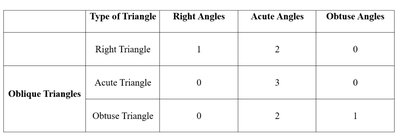
Right Triangle: Contains one right angle (90°), two acute angles, and no obtuse angles.
Acute Triangle: All three angles are acute (less than 90°).
Obtuse Triangle: Contains one obtuse angle (greater than 90°) and two acute angles.
Type of Triangle | Right Angles | Acute Angles | Obtuse Angles |
|---|---|---|---|
Right Triangle | 1 | 2 | 0 |
Acute Triangle | 0 | 3 | 0 |
Obtuse Triangle | 0 | 2 | 1 |
The Law of Sines
Statement and Application
The Law of Sines is a fundamental relationship used to solve for unknown sides or angles in oblique triangles. It is especially useful when given either two angles and one side (AAS or ASA) or two sides and a non-included angle (SSA). The Law of Sines states that the ratios of the lengths of sides of a triangle to the sines of their opposite angles are equal:
Let triangle ABC have sides a, b, and c opposite angles A, B, and C respectively.
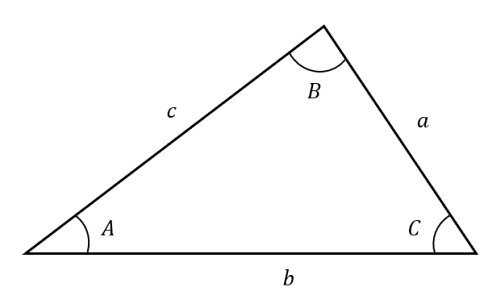
The Law of Sines formula is:
To solve for an unknown side, rearrange the formula and solve for the desired variable.
To solve for an unknown angle, use the inverse sine function after isolating the sine of the angle.
Example: Given , , and , find .
Solving Oblique Triangles Using the Law of Sines
When applying the Law of Sines, follow these steps:
Identify known values: Determine which sides and angles are given.
Apply the Law of Sines: Set up the proportion using the known values.
Solve for unknowns: Use algebraic manipulation and the inverse sine function as needed.
Check for ambiguous cases: In SSA cases, there may be two possible solutions (the "ambiguous case").
Verify triangle validity: Ensure the sum of angles is less than 180° and all sides are positive.
Example: Given , , , find .
Then (check if a solution exists and if a second solution is possible).
Area of an Oblique Triangle
General Area Formula
The area of any triangle can be found using the formula involving two sides and the sine of their included angle:
This formula is especially useful for oblique triangles where the height is not easily determined.
Area is always measured in square units.
Example: Given , , , find the area.
Summary Table: Triangle Area Formulas
Given | Area Formula |
|---|---|
Two sides and included angle (SAS) | |
All three sides (use Heron's Formula) | where |
Practice Problems
Solve for all unknown sides and angles in a triangle given , , .
Find the area of a triangle with , , .
