Skip to main content
Analytical Chemistry
My Course
Learn
Exam Prep
AI Tutor
Study Guides
Flashcards
Explore
Try the app
My Course
Learn
Exam Prep
AI Tutor
Study Guides
Flashcards
Explore
Try the app
Back
Analyte Oxidation State quiz
You can tap to flip the card.
Why must the analyte be in a single oxidation state before a redox titration?
You can tap to flip the card.
👆
Why must the analyte be in a single oxidation state before a redox titration?
Having the analyte in a single oxidation state ensures accurate quantitative analysis during the redox titration.
Track progress
Control buttons has been changed to "navigation" mode.
1/15
Related flashcards
Related practice
Recommended videos
Analyte Oxidation State definitions
Analyte Oxidation State
15 Terms
Analyte Oxidation State
15. Redox Titrations
5 problems
Topic
Oxidizing Agents
15. Redox Titrations
5 problems
Topic
15. Redox Titrations
4 topics
12 problems
Chapter
Guided course
05:08
Analyte Oxidation State
338
views
2
rank
Guided course
05:01
Analyte Oxidation State
283
views
1
rank
Guided course
06:03
Analyte Oxidation State Calculations
241
views
Terms in this set (15)
Hide definitions
Why must the analyte be in a single oxidation state before a redox titration?
Having the analyte in a single oxidation state ensures accurate quantitative analysis during the redox titration.
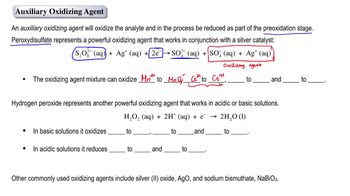
What is the role of an auxiliary oxidizing agent in redox titrations?
An auxiliary oxidizing agent converts all forms of the analyte to a higher oxidation state, ensuring only one oxidation state is present.
What is the function of an auxiliary reducing agent in redox titrations?
An auxiliary reducing agent reduces all forms of the analyte to a lower oxidation state, leaving only one oxidation state for analysis.
Which ion is commonly used as a strong oxidizing agent to convert Fe2+ to Fe3+?
Cerium(IV) ion (Ce4+) is commonly used to oxidize Fe2+ to Fe3+.
What is the Jones reductor and what does it contain?
The Jones reductor is a reduction column filled with zinc amalgam (zinc bonded to mercury) used to reduce analytes.
What is the Walden reductor and what metal does it use?
The Walden reductor is a reduction column filled with solid silver metal granules used to reduce analytes.
How does a reducing agent function in preparing an analyte for titration?
A reducing agent donates electrons to the analyte, converting it to a single, lower oxidation state.
What is the main purpose of the pre-oxidation or pre-reduction step in redox titrations?
The pre-oxidation or pre-reduction step ensures the analyte is present in only one oxidation state for accurate titration.
What powerful oxidizing agent can oxidize Mn2+ to MnO4- and Ce3+ to Ce4+?
Peroxydisulfate (S2O8^2-) is a powerful oxidizing agent capable of these oxidations.
How does hydrogen peroxide act differently in acidic and basic solutions?
In acidic or basic solutions, hydrogen peroxide acts as an oxidizing agent, but in acidic solutions, it can also act as a reducing agent.
What happens to the auxiliary oxidizing agent during the oxidation of the analyte?
The auxiliary oxidizing agent is reduced as it oxidizes the analyte.
Name two metals commonly used as auxiliary reducing agents in reduction columns.
Zinc and silver are commonly used as auxiliary reducing agents.
What is the role of silver ions in the peroxydisulfate oxidation process?
Silver ions act as a catalyst, helping peroxydisulfate oxidize other ions.
What is the effect of using an auxiliary reducing agent on the analyte's oxidation state?
It reduces all forms of the analyte to a single, lower oxidation state.
Why is hydrogen peroxide considered more versatile than peroxydisulfate as an auxiliary agent?
Hydrogen peroxide can act as both an oxidizing and reducing agent depending on the solution's pH, making it more versatile.
 BackBack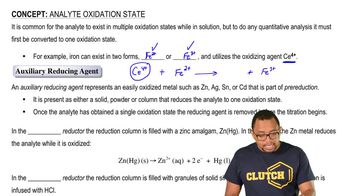
 05:08
05:08