Back

Arrhenius Acids and Bases quiz

Control buttons has been changed to "navigation" mode.
1/15
  • What is the main criterion for a substance to be classified as an Arrhenius acid?

    It must increase the concentration of hydrogen ions (H+) or hydronium ions (H3O+) when dissolved in water.
  • According to Arrhenius, what defines a base?

    A base increases the concentration of hydroxide ions (OH-) when dissolved in water.
  • Why is the Arrhenius model limited in its definition of acids and bases?

    It only describes acidic and basic behavior in aqueous (water-based) solutions and does not account for acids without H+ or bases without OH-.
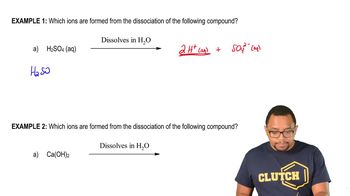
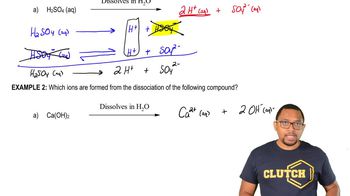
  • What happens when HCl is dissolved in water according to the Arrhenius model?

    HCl dissociates to produce H+ and Cl- ions in solution.
  • What is the actual process when HCl dissolves in water?

    HCl donates an H+ to water, forming the hydronium ion (H3O+) and chloride ion (Cl-).
  • Are H+ and H3O+ considered the same in the context of Arrhenius acids?

    Yes, H+ and H3O+ are considered synonymous in aqueous solutions.
  • What is an example of an Arrhenius base?

    NaOH is an Arrhenius base because it dissociates in water to produce Na+ and OH- ions.
  • Why does NaOH qualify as an Arrhenius base?

    Because it increases the concentration of free OH- ions in solution when dissolved in water.
  • What type of solvent is required for the Arrhenius definition to apply?

    An aqueous (water-based) solvent is required.
  • Can the Arrhenius model explain acid-base behavior in non-aqueous solutions?

    No, it cannot explain acid-base behavior outside of aqueous solutions.
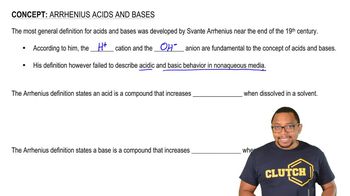
  • What ions are fundamental to the Arrhenius concept of acids and bases?

    The hydronium ion (H3O+) or hydrogen ion (H+) and the hydroxide ion (OH-).
  • What is a limitation of the Arrhenius definition regarding the composition of acids and bases?

    It does not account for acids that do not contain H+ or bases that do not contain OH-.
  • What is the general effect of an Arrhenius acid on a solution?

    It increases the amount of free-floating H+ (or H3O+) ions in the solution.
  • What is the general effect of an Arrhenius base on a solution?

    It increases the amount of free-floating OH- ions in the solution.
  • Who developed the Arrhenius acid-base model and when?

    Svante Arrhenius developed the model near the end of the 19th century.