Skip to main content
Analytical Chemistry
My Course
Learn
Exam Prep
AI Tutor
Study Guides
Flashcards
Explore
Try the app
My Course
Learn
Exam Prep
AI Tutor
Study Guides
Flashcards
Explore
Try the app
Back
Buoyancy definitions
You can tap to flip the card.
Buoyancy
You can tap to flip the card.
👆
Buoyancy
Upward force in a fluid or gas that opposes gravity, causing measured mass to differ from true mass on a balance.
Track progress
Control buttons has been changed to "navigation" mode.
1/15
Related flashcards
Related practice
Recommended videos
Buoyancy quiz
Buoyancy
15 Terms
Buoyancy
2. Tools of the Trade
5 problems
Topic
Thermal Dependency
2. Tools of the Trade
5 problems
Topic
2. Tools of the Trade - Part 1 of 2
4 topics
11 problems
Chapter
2. Tools of the Trade - Part 2 of 2
1 topic
3 problems
Chapter
Guided course
04:15
Buoyancy Calculations 2
286
views
1
comments
Guided course
03:02
Buoyancy in Air
689
views
3
rank
1
comments
Guided course
04:09
Buoyancy in Fluid
310
views
1
rank
1
comments
Terms in this set (15)
Hide definitions
Buoyancy
Upward force in a fluid or gas that opposes gravity, causing measured mass to differ from true mass on a balance.
Analytical Balance
Precision instrument used to measure mass with high accuracy, sensitive to environmental factors like airflow.
Apparent Mass
Value displayed by a balance, influenced by external factors such as air buoyancy, not the actual mass.
True Mass
Actual mass of an object as if measured in a vacuum, free from the effects of air or buoyancy.
Air Density
Mass per unit volume of air, typically 0.0012 g/mL at 1 bar and 25°C, used in buoyancy corrections.
Calibration Weight
Reference object with known density, used to adjust and verify the accuracy of balances.
Density
Ratio of mass to volume for a substance, crucial for correcting buoyancy effects in mass measurements.
Uncertainty
Degree of doubt in a measurement, increased by factors like airflow and minimized by corrections.
Gravity
Downward force acting on objects, counteracted by buoyancy when measuring mass in air.
Vacuum
Environment devoid of air, eliminating buoyancy and airflow, allowing for true mass determination.
Precision
Closeness of repeated measurements to each other, improved by accounting for buoyancy effects.
Accuracy
Closeness of a measured value to the true value, enhanced by correcting for air buoyancy.
Alloy
Mixture of metals, sometimes used for calibration weights, each with unique density affecting corrections.
Upward Force
Component of buoyancy that acts opposite to gravity, altering the measured mass on a balance.
Equation
Mathematical expression used to correct apparent mass for buoyancy, involving densities of air, weights, and object.
 BackBack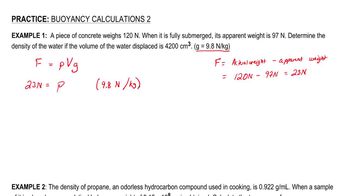
 04:15
04:15