Back

Detection of Gross Errors definitions

Control buttons has been changed to "navigation" mode.
1/15
  • Grubbs Test

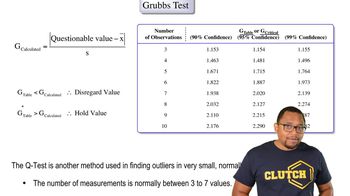
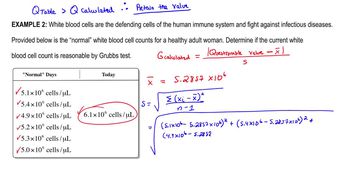
    Statistical method for identifying a single outlier in a normally distributed dataset by comparing a calculated value to a critical table value.
  • Q Test

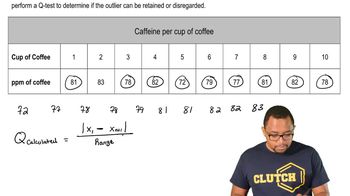
    Technique for detecting outliers in small datasets by comparing the ratio of the gap to the range against a critical value.
  • Outlier

    Data point that significantly deviates from the rest of the dataset, potentially indicating error or anomaly.
  • Normal Distribution

    Probability distribution where data is symmetrically distributed around the mean, forming a bell-shaped curve.
  • Standard Deviation

    Measure of data spread, indicating how much values deviate from the mean within a dataset.
  • Mean

    Average value of a dataset, calculated by summing all measurements and dividing by their count.
  • G Calculated

    Value obtained by dividing the absolute difference between a questionable value and the mean by the standard deviation.
  • G Table

    Reference chart providing critical values for the Grubbs test at various confidence levels and sample sizes.
  • Q Calculated

    Ratio of the gap between a suspected outlier and its nearest neighbor to the range of the dataset.
  • Q Table

    Table listing critical values for the Q test based on sample size and confidence level.
  • Confidence Level

    Probability that a statistical result is not due to random chance, commonly set at 90%, 95%, or 99%.
  • Range

    Difference between the largest and smallest values in a dataset, used in the Q test calculation.
  • Gap

    Absolute difference between a suspected outlier and its closest neighboring value in an ordered dataset.
  • Critical Value

    Threshold from a statistical table used to determine if a calculated value indicates an outlier.
  • Number of Measurements

    Total count of data points in a dataset, influencing the selection of critical values in outlier tests.