Skip to main content
Analytical Chemistry
My Course
Learn
Exam Prep
AI Tutor
Study Guides
Flashcards
Explore
Try the app
My Course
Learn
Exam Prep
AI Tutor
Study Guides
Flashcards
Explore
Try the app
Back
Diprotic Acid Titrations quiz
You can tap to flip the card.
How many equivalence points are there in the titration of a diprotic acid, and why?
You can tap to flip the card.
👆
How many equivalence points are there in the titration of a diprotic acid, and why?
There are two equivalence points because a diprotic acid can donate two protons, each requiring neutralization by the base.
Track progress
Control buttons has been changed to "navigation" mode.
1/15
Related flashcards
Related practice
Recommended videos
Diprotic Acid Titrations definitions
Diprotic Acid Titrations
15 Terms
Diprotic Acid Titrations
10. Acid-Base Titrations
5 problems
Topic
Polyprotic Titrations
10. Acid-Base Titrations
5 problems
Topic
10. Acid-Base Titrations - Part 1 of 2
4 topics
12 problems
Chapter
10. Acid-Base Titrations - Part 2 of 2
1 topic
3 problems
Chapter
Guided course
07:19
Diprotic Acid Titrations Calculations 2
279
views
1
rank
Guided course
02:55
Diprotic Acid Titrations
473
views
7
rank
Guided course
03:53
Diprotic Acid Titrations
343
views
3
rank
1
comments
Terms in this set (15)
Hide definitions
How many equivalence points are there in the titration of a diprotic acid, and why?
There are two equivalence points because a diprotic acid can donate two protons, each requiring neutralization by the base.
What equation is used to calculate the first equivalence volume in a diprotic acid titration?
The equation is: (molarity of acid) × (volume of acid) = (molarity of base) × (first equivalence volume).
Before any base is added to a diprotic acid, what type of calculation is used to find the pH?
An ICE chart and the equilibrium expression using Ka1 are used to calculate the pH.
Why can't the 'minus x' be ignored in the equilibrium calculation for the initial diprotic acid solution?
Because the ratio of initial concentration to Ka1 is not greater than 500, so the 5% approximation is not valid.
What is the pH of a 0.100 M sulfuric acid solution before titration begins, according to the transcript?
The pH is 1.48, calculated using the quadratic formula for the equilibrium expression.
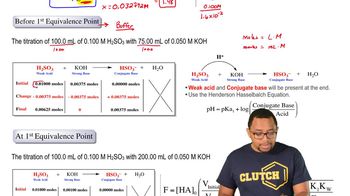
What forms when a strong base is added to a diprotic acid before the first equivalence point?
A buffer forms, consisting of the weak acid and its conjugate base.
Which equation is used to calculate pH in the buffer region before the first equivalence point?
The Henderson-Hasselbalch equation is used: pH = pKa1 + log([conjugate base]/[weak acid]).
What happens to the buffer at the first equivalence point?
The buffer is destroyed, resulting in a significant jump in pH.
How is the formal concentration of the conjugate base at the first equivalence point calculated?
It is calculated as (initial concentration of acid × volume of acid) / (total solution volume at equivalence).
After the first equivalence point, which dissociation constant is used for pH calculations?
Ka2 is used because the second proton is being removed from the intermediate form.
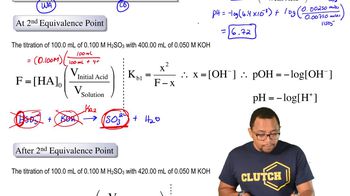
At the second equivalence point, what ion is present and which equilibrium constant is used for pH calculation?
The sulfite ion (conjugate base) is present, and Kb (calculated from Ka2 and Kw) is used.
How do you calculate Kb1 from Ka2 and Kw?
Kb1 = Kw / Ka2, where Kw is 1.0 × 10^-14.
What is the pH trend as more strong base is added beyond the second equivalence point?
The pH increases further because the excess strong base dominates the solution.
How is the concentration of excess strong base calculated after the second equivalence point?
It is calculated as (molarity of base × excess volume) / total solution volume.
Why is careful tracking of moles and concentrations important in diprotic acid titrations?
Because the titration involves multiple stages and species, accurate pH calculations depend on knowing the amounts present at each stage.
 BackBack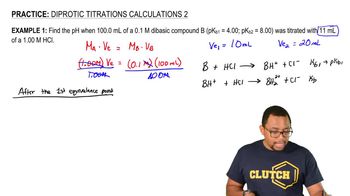
 07:19
07:19