Skip to main content
Analytical Chemistry
My Course
Learn
Exam Prep
AI Tutor
Study Guides
Flashcards
Explore
Try the app
My Course
Learn
Exam Prep
AI Tutor
Study Guides
Flashcards
Explore
Try the app
Back
EDTA Titration Curves definitions
You can tap to flip the card.
EDTA
You can tap to flip the card.
👆
EDTA
A chelating agent with a negative four charge in its basic form, used to bind metal ions during titrations.
Track progress
Control buttons has been changed to "navigation" mode.
1/15
Related flashcards
Related practice
Recommended videos
EDTA Titration Curves quiz
EDTA Titration Curves
15 Terms
EDTA Titration Curves
11. EDTA Titrations
5 problems
Topic
EDTA
11. EDTA Titrations
5 problems
Topic
11. EDTA Titrations
3 topics
9 problems
Chapter
Guided course
04:28
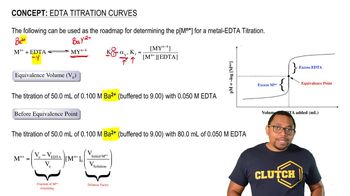
EDTA Titration Calculations
582
views
2
rank
Guided course
05:20
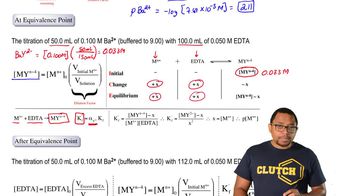
EDTA Titrations
722
views
7
rank
Guided course
06:02
EDTA Titrations
409
views
3
rank
1
comments
Terms in this set (15)
Hide definitions
EDTA
A chelating agent with a negative four charge in its basic form, used to bind metal ions during titrations.
Titrant
A solution of known concentration, added to react with analyte to determine its quantity in titrations.
Metal Ion
A positively charged atom or molecule that reacts with EDTA to form a stable complex during titration.
Complex
A stable species formed when a metal ion binds with EDTA, altering the net charge and solution composition.
Conditional Formation Constant
An equilibrium value reflecting the stability of a metal-EDTA complex at a specific pH, denoted as K'f.
Stability Constant
A measure of the inherent strength of the bond between a metal ion and EDTA, often expressed as log Kf.
Alpha Value
A fraction representing the proportion of EDTA in its basic, reactive form at a given pH.
pH
A scale indicating the acidity or basicity of the solution, crucial for determining EDTA's reactive form.
Equivalence Point
The stage in titration where the moles of metal ion and EDTA are exactly equal, marking a key calculation step.
ICE Chart
A tabular method for organizing initial, change, and equilibrium concentrations in titration calculations.
Dilution Factor
A ratio accounting for changes in concentration due to mixing different solution volumes during titration.
pM
The negative logarithm of the metal ion concentration, used to monitor changes during titration.
Quadratic Formula
A mathematical tool used to solve for unknown concentrations in equilibrium expressions at the equivalence point.
Buffer
A solution component that maintains a constant pH, ensuring EDTA remains in its reactive form during titration.
Excess EDTA
The amount of EDTA present after the equivalence point, used to determine remaining free metal ion concentration.
 BackBack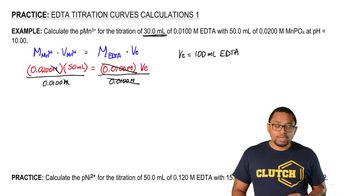
 04:28
04:28