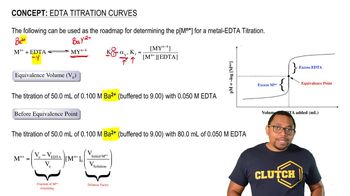
What is the general reaction formula for an EDTA titration involving a metal ion?
The general formula is M^n+ (metal ion) reacting with EDTA^4- to form a metal-EDTA complex, typically written as MY^(n-4)-.
How is the net charge of a metal-EDTA complex determined?
The net charge is the sum of the metal ion's charge and the -4 charge of EDTA; for example, Ba^2+ with EDTA^4- forms BaY^2-.
What is the conditional formation constant (K'f) in EDTA titrations?
K'f is the product of the fraction of EDTA in its basic form (α) and the stability constant (Kf) for the metal-EDTA complex.
How does pH affect the fraction of EDTA in its basic form?
As pH increases, the fraction of EDTA in its basic form (α) increases, making more EDTA available to bind metal ions.
What does the 'pM' value represent in EDTA titrations?
pM is the negative logarithm of the metal ion concentration, similar to pH but for metal ions.
At the equivalence point in an EDTA titration, what is true about the moles of metal ion and EDTA?
At the equivalence point, the moles of metal ion equal the moles of EDTA added.
How do you calculate the equivalence volume of EDTA in a titration?
Set the initial moles of metal ion equal to the moles of EDTA (M1V1 = M2V2) and solve for the volume of EDTA needed.
What is the main calculation step before the equivalence point in an EDTA titration?
Before the equivalence point, calculate the remaining free metal ion by considering the excess metal and the dilution factor.
How do you find the concentration of metal ion before the equivalence point?
Subtract the volume of EDTA added from the equivalence volume, divide by the equivalence volume, and multiply by the initial concentration adjusted for dilution.
What calculation is necessary at the equivalence point of an EDTA titration?
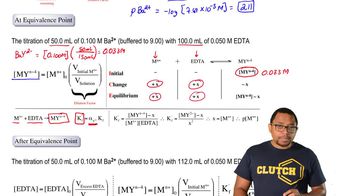
Set up an ICE chart and use the conditional formation constant to solve for the remaining metal ion concentration, often using the quadratic formula.
How is the conditional formation constant (K'f) calculated at a specific pH?
Multiply the fraction of EDTA in its basic form (from a chart or calculation) by the stability constant (Kf) for the metal-EDTA complex.
What happens to the concentration of free metal ion after the equivalence point?
After the equivalence point, there is excess EDTA, and the remaining metal ion concentration is calculated using the equilibrium expression with K'f.
How do you calculate the concentration of excess EDTA after the equivalence point?
Multiply the initial EDTA concentration by the excess volume of EDTA and divide by the total solution volume.
What is the general formula for the equilibrium expression in EDTA titrations?
K'f = [metal-EDTA complex] / ([metal ion][EDTA]), where concentrations are those at equilibrium.
Why is it important to determine the equivalence volume in EDTA titrations?
Knowing the equivalence volume tells you whether you are before, at, or after the equivalence point, which determines the calculation method for metal ion concentration.
 Back
Back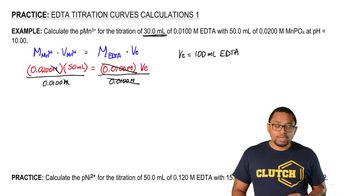
 04:28
04:28