Skip to main content
Analytical Chemistry
My Course
Learn
Exam Prep
AI Tutor
Study Guides
Flashcards
Explore
Try the app
My Course
Learn
Exam Prep
AI Tutor
Study Guides
Flashcards
Explore
Try the app
Back
Fractional Compositions and Concentrations quiz
You can tap to flip the card.
What happens to the fractional composition of a weak acid solution as pH decreases?
You can tap to flip the card.
👆
What happens to the fractional composition of a weak acid solution as pH decreases?
As pH decreases, the fraction of the acid form increases and the solution becomes more acidic.
Track progress
Control buttons has been changed to "navigation" mode.
1/15
Related flashcards
Related practice
Recommended videos
Fractional Compositions and Concentrations definitions
Fractional Compositions and Concentrations
15 Terms
Fractional Compositions and Concentrations
12. Advanced Topics in Equilibrium
5 problems
Topic
Dependence of Solubility on pH
12. Advanced Topics in Equilibrium
5 problems
Topic
12. Advanced Topics in Equilibrium
3 topics
9 problems
Chapter
Guided course
03:52
Fractional Composition
474
views
8
rank
Guided course
03:30
Fractional Concentrations
240
views
Guided course
04:51
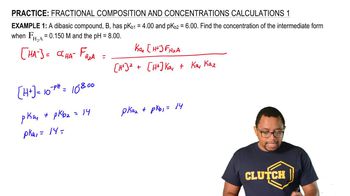
Fractional Concentrations Calculations 1
239
views
1
comments
Terms in this set (15)
Hide definitions
What happens to the fractional composition of a weak acid solution as pH decreases?
As pH decreases, the fraction of the acid form increases and the solution becomes more acidic.
At what pH are the concentrations of a weak acid and its conjugate base equal?
The concentrations are equal when pH equals the pKa of the acid.
Which equation describes the relationship between pH, pKa, and the ratio of conjugate base to acid?
The Henderson-Hasselbalch equation: pH = pKa + log([conjugate base]/[acid]).
How is the fraction of acid molecules (α) in a monoprotic system calculated?
It is calculated as [H+]/([H+] + Ka).
How is the fraction of conjugate base molecules (α_A-) in a monoprotic system calculated?
It is calculated as Ka/([H+] + Ka).
What is the sum of the fractions of acid and conjugate base forms in a monoprotic system?
The sum is always 1, representing 100% of the molecules present.
How does the fraction of conjugate base change as pH increases in a weak acid solution?
As pH increases, the fraction of conjugate base increases while the fraction of acid decreases.
What are the three possible forms in a diprotic acid system?
The three forms are the acidic form, the intermediate form, and the basic form.
What marks the intersection point between the acid and intermediate forms in a diprotic system?
The intersection occurs at pH = pKa1, where the concentrations of acid and intermediate forms are equal.
What marks the intersection point between the intermediate and basic forms in a diprotic system?
The intersection occurs at pH = pKa2, where the concentrations of intermediate and basic forms are equal.
How is the concentration of the intermediate form in a diprotic system calculated after losing the first acidic hydrogen?
It is calculated as the concentration of the acid form times Ka1 divided by [H+].
How is the concentration of the basic form in a diprotic system calculated after losing both acidic hydrogens?
It is calculated as the acid form concentration times Ka1 times Ka2 divided by [H+] squared.
What happens to the fraction of the basic form in a diprotic system as pH increases?
The fraction of the basic form increases as pH increases.
How can the actual concentrations of acid and conjugate base in a monoprotic system be determined?
Multiply the fraction of each form by the formal concentration of the solution.
What does a graphical representation of fractional composition versus pH show in both mono- and diprotic systems?
It shows how the proportions of different forms change with pH, with intersections at pKa values where concentrations of forms are equal.
 BackBack
 03:52
03:52