Skip to main content
Analytical Chemistry
My Course
Learn
Exam Prep
AI Tutor
Study Guides
Flashcards
Explore
Try the app
My Course
Learn
Exam Prep
AI Tutor
Study Guides
Flashcards
Explore
Try the app
Back
Isoelectric and Isoionic pH definitions
You can tap to flip the card.
Isoelectric Point
You can tap to flip the card.
👆
Isoelectric Point
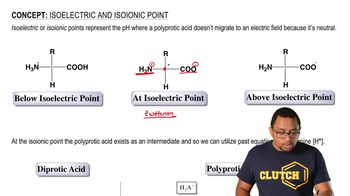
pH where a polyprotic acid is neutral, does not migrate in an electric field, and exists as a zwitterion.
Track progress
Control buttons has been changed to "navigation" mode.
1/15
Related flashcards
Related practice
Recommended videos
Isoelectric and Isoionic pH quiz
Isoelectric and Isoionic pH
15 Terms
Isoelectric and Isoionic pH
9. Polyprotic Acid-Base Equilibria
5 problems
Topic
Principal Species
9. Polyprotic Acid-Base Equilibria
5 problems
Topic
9. Polyprotic Acid-Base Equilibria - Part 1 of 2
4 topics
12 problems
Chapter
9. Polyprotic Acid-Base Equilibria - Part 2 of 2
2 topics
6 problems
Chapter
Guided course
03:34
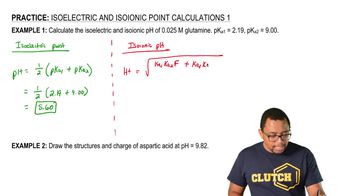
Isoelectric and Isoionic Points Calculations 1
280
views
1
rank
Guided course
04:16
Isoelectric and Isoionic Points Calculations 1
444
views
1
rank
Guided course
03:10
Isoelectric and Isoionic Points
701
views
1
rank
Terms in this set (15)
Hide definitions
Isoelectric Point
pH where a polyprotic acid is neutral, does not migrate in an electric field, and exists as a zwitterion.
Isoionic Point
pH where a polyprotic acid exists as an intermediate form, calculated using specific equations for H+ concentration.
Zwitterion
Molecule with both positive and negative charges but overall neutral, common at the isoelectric point of amino acids.
Diprotic Acid
Compound with two ionizable hydrogens, displaying three forms: acidic, intermediate, and basic.
Polyprotic Acid
Compound with more than two ionizable hydrogens, often having multiple intermediate forms and pKa values.
pKa
Negative logarithm of the acid dissociation constant, used to determine the pH at which a group is half dissociated.
Cation
Positively charged ion, formed when an amino acid is in a solution more acidic than its isoelectric point.
Anion
Negatively charged ion, formed when an amino acid is in a solution more basic than its isoelectric point.
Carboxyl Group
Acidic functional group in amino acids, contributing to one of the pKa values and charge states.
Amino Group
Basic functional group in amino acids, can be protonated or deprotonated, affecting overall charge.
Alpha Carbon
Central carbon in amino acids, bonded to the carboxyl group, amino group, hydrogen, and variable R group.
Intermediate Form
Species present between fully protonated and fully deprotonated states in polyprotic acids.
Acidic Amino Acid
Amino acid with three pKa values, isoelectric point calculated using the two lower pKa values.
Basic Amino Acid
Amino acid with three pKa values, isoelectric point calculated using the two higher pKa values.
Ion Product of Water
Constant (Kw) representing the product of H+ and OH- concentrations in water, used in isoionic calculations.
 BackBack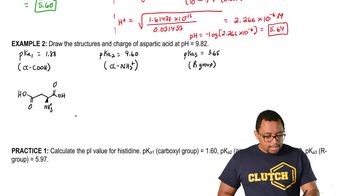
 03:34
03:34