Skip to main content
Analytical Chemistry
My Course
Learn
Exam Prep
AI Tutor
Study Guides
Flashcards
Explore
Try the app
My Course
Learn
Exam Prep
AI Tutor
Study Guides
Flashcards
Explore
Try the app
Back
Lewis Acids and Bases definitions
You can tap to flip the card.
Lewis Acid
You can tap to flip the card.
👆
Lewis Acid
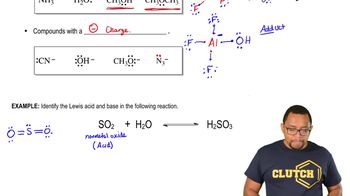
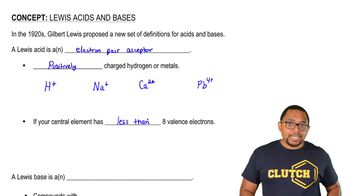
An electron-deficient species capable of accepting a lone pair, often a cation, or a molecule with an incomplete octet or central atom with pi bonds.
Track progress
Control buttons has been changed to "navigation" mode.
1/15
Related flashcards
Related practice
Recommended videos
Lewis Acids and Bases quiz
Lewis Acids and Bases
15 Terms
Lewis Acids and Bases
8. Monoprotic Acid-Base Equilibria
5 problems
Topic
Auto-Ionization
8. Monoprotic Acid-Base Equilibria
5 problems
Topic
8. Monoprotic Acid-Base Equilibria - Part 1 of 2
4 topics
12 problems
Chapter
8. Monoprotic Acid-Base Equilibria - Part 2 of 2
4 topics
12 problems
Chapter
Guided course
03:59
Lewis Acids and Bases
407
views
Guided course
02:42
Lewis Acids and Bases
325
views
Guided course
04:51
Lewis Acids and Bases
392
views
1
rank
Terms in this set (15)
Hide definitions
Lewis Acid
An electron-deficient species capable of accepting a lone pair, often a cation, or a molecule with an incomplete octet or central atom with pi bonds.
Lewis Base
A species with extra electrons, typically possessing lone pairs or a negative charge, able to donate an electron pair to another species.
Electron Pair
A set of two electrons occupying the same orbital, often involved in bond formation or donation in acid-base reactions.
Lone Pair
A non-bonding pair of electrons on an atom, frequently responsible for the reactivity of bases in electron donation.
Octet Rule
A principle stating atoms tend to have eight electrons in their valence shell, driving their tendency to accept or donate electrons.
Cation
A positively charged ion, often acting as an electron pair acceptor in acid-base interactions.
Adduct
A product formed when an acid and base combine, resulting from the sharing of an electron pair between two species.
Nonmetal Oxide
A compound consisting of a nonmetal and oxygen, often featuring a central atom with pi bonds capable of accepting electron pairs.
Pi Bond
A type of covalent bond formed by sideways overlap of orbitals, often present in molecules that can act as electron pair acceptors.
Charge Redistribution
A shift in electron density during acid-base reactions, causing changes in the formal charges of the reacting species.
Valence Electron
An electron in the outermost shell of an atom, crucial for bond formation and chemical reactivity.
Hydronium Ion
A positively charged species formed by the association of a proton with water, serving as a classic example of an electron pair acceptor.
Cyanide Ion
A negatively charged species with a lone pair on carbon, commonly acting as an electron pair donor in reactions.
Hydroxide Ion
A negatively charged ion with a lone pair on oxygen, frequently serving as a strong electron pair donor.
Methoxide Ion
A negatively charged species derived from methanol, possessing a lone pair on oxygen for electron donation.
 BackBack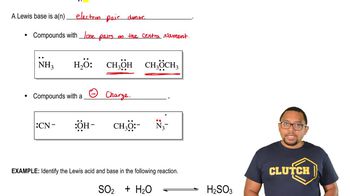
 03:59
03:59