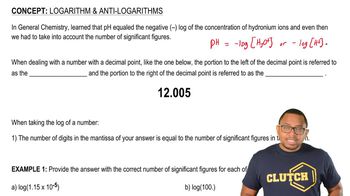
How do you determine the number of digits in the mantissa when calculating the logarithm of a number?
The number of digits in the mantissa of the log result equals the number of significant figures in the original value.
What is the mantissa in a logarithmic value?
The mantissa is the portion of the logarithm after the decimal point.
If you calculate log(1.15 × 10⁻⁵), how many digits should the mantissa have?
The mantissa should have three digits, matching the three significant figures in 1.15.
What is the correct way to report log(1.15 × 10⁻⁵) to the proper number of significant figures?
It should be reported as -4.939, with three digits in the mantissa.
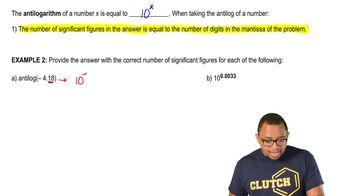
How do you determine the number of significant figures in the answer when calculating an antilogarithm?
The number of significant figures in the answer equals the number of digits in the mantissa of the input value.
What is the mathematical operation for finding the antilogarithm of a number x?
The antilogarithm of x is 10 to the power of x (10^x).
If the mantissa of a logarithmic value has three digits, how many significant figures should the antilogarithm result have?
The antilogarithm result should have three significant figures.
Why is it important to match significant figures in logarithm and antilogarithm calculations?
Matching significant figures ensures accuracy and consistency in scientific calculations.
How many significant figures should the answer have for log(100.0)?
The answer should have four digits in the mantissa, matching the four significant figures in 100.0.
What is the correct way to report log(100) if 100 has three significant figures?
It should be reported as 2.000, with three digits in the mantissa.
In which scientific contexts is it especially important to use correct significant figures in logarithmic calculations?
It is especially important in chemistry and physics, such as when calculating pH, reaction rates, or thermodynamic properties.
What part of the logarithm result reflects the precision of the original number?
The mantissa reflects the precision, as its number of digits matches the significant figures of the original number.
What should you do if you are unsure about the number of significant figures to use in a logarithmic calculation?
Count the significant figures in the original value to determine the number of digits in the mantissa.
How does the process of determining significant figures differ between logarithms and antilogarithms?
For logarithms, the original number's significant figures determine the mantissa's digits; for antilogarithms, the mantissa's digits determine the answer's significant figures.
What is the general rule for significant figures when using scientific notation in logarithmic calculations?
The number of significant figures in the scientific notation value dictates the number of digits in the mantissa of the logarithm.
 Back
Back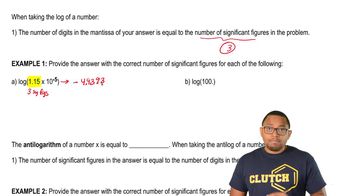
 02:23
02:23