Back

Nernst Equation quiz

Control buttons has been changed to "navigation" mode.
1/15
  • What does the Nernst equation quantitatively connect in electrochemistry?

    It connects the concentrations of compounds to the cell potential under nonstandard conditions.
  • Under what conditions do we use the Nernst equation instead of the standard cell potential?

    We use the Nernst equation when concentrations, temperature, pH, or pressure differ from standard conditions.
  • What is the general form of the Nernst equation?

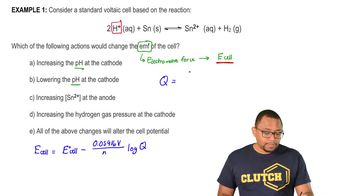
    E = E0 - (RT/nF) * ln(Q), where E is cell potential, E0 is standard cell potential, R is the gas constant, T is temperature in Kelvin, n is the number of electrons, F is Faraday's constant, and Q is the reaction quotient.
  • What value does (RT/F) simplify to at 25°C in the Nernst equation?

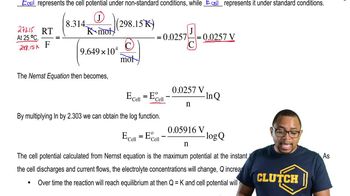
    At 25°C, (RT/F) simplifies to 0.0257 volts.
  • How is the Nernst equation modified when using base-10 logarithms instead of natural logarithms?

    It becomes E = E0 - (0.05916V/n) * log(Q).
  • What does Q represent in the Nernst equation?

    Q is the reaction quotient, representing the ratio of product activities to reactant activities.
  • What happens to cell potential as the reaction in an electrochemical cell approaches equilibrium?

    The cell potential decreases and eventually becomes zero at equilibrium.
  • What does it mean when the cell potential equals zero in an electrochemical cell?

    It means the cell has reached equilibrium and is considered a 'dead battery.'
  • How can the equilibrium constant K be calculated from the standard cell potential using the Nernst equation?

    At equilibrium, K = e^(nE0/0.0257) when using natural logarithms, or K = 10^(nE0/0.05916) when using base-10 logarithms.
  • What is the value of Faraday's constant (F) used in the Nernst equation?

    Faraday's constant is 9.649 x 10^4 coulombs per mole of electrons.
  • How do you convert the Nernst equation from natural logarithm (ln) to common logarithm (log)?

    Multiply the coefficient of ln by 2.303 to convert to log, since ln(x) = 2.303 log(x).
  • What is the relationship between Gibbs free energy (ΔG), equilibrium constant (K), and the Nernst equation at equilibrium?

    At equilibrium, ΔG = 0 and K = e^(ΔG0/RT).
  • What does the variable n represent in the Nernst equation?

    n is the number of electrons transferred in the redox reaction.
  • What is the significance of the standard cell potential (E0) in the Nernst equation?

    E0 is the cell potential under standard conditions (1 M, 25°C, 1 atm, pH 7).
  • Why does the cell potential calculated from the Nernst equation represent the maximum potential?

    It represents the maximum potential at the instant the cell circuit is connected, before concentrations change due to current flow.