Skip to main content
Analytical Chemistry
My Course
Learn
Exam Prep
AI Tutor
Study Guides
Flashcards
Explore
Try the app
My Course
Learn
Exam Prep
AI Tutor
Study Guides
Flashcards
Explore
Try the app
Back
Principal Species definitions
You can tap to flip the card.
Acid Dissociation Constant
You can tap to flip the card.
👆
Acid Dissociation Constant
A numerical measure indicating how easily an acidic hydrogen is removed, reflecting acid strength.
Track progress
Control buttons has been changed to "navigation" mode.
1/12
Related flashcards
Related practice
Recommended videos
Principal Species quiz
Principal Species
15 Terms
Principal Species
9. Polyprotic Acid-Base Equilibria
5 problems
Topic
Isoelectric and Isoionic pH
9. Polyprotic Acid-Base Equilibria
5 problems
Topic
9. Polyprotic Acid-Base Equilibria - Part 1 of 2
4 topics
12 problems
Chapter
9. Polyprotic Acid-Base Equilibria - Part 2 of 2
2 topics
6 problems
Chapter
Guided course
00:17
Principal Species
272
views
Guided course
03:52
Principal Species
257
views
3
rank
Guided course
03:10
Principal Species
296
views
3
rank
Terms in this set (12)
Hide definitions
Acid Dissociation Constant
A numerical measure indicating how easily an acidic hydrogen is removed, reflecting acid strength.
Ka
A value greater than 1 signals a strong acid, while less than 1 indicates a weak acid.
pKa
A logarithmic transformation of Ka, used to compare with pH to predict predominant solution species.
Principal Species
The chemical form, acidic or basic, present in the highest concentration under specific pH conditions.
Monoprotic Acid
A substance capable of donating only one proton per molecule during dissociation.
Acidic Form
The species that predominates when solution pH is less than the pKa value.
Basic Form
The species that predominates when solution pH exceeds the pKa value.
pH
A measure of hydrogen ion concentration, used to determine which chemical form predominates.
Diprotic Acid
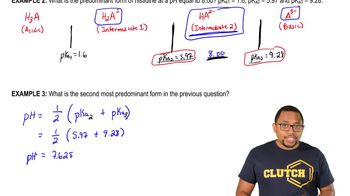
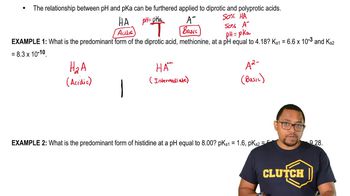
A molecule capable of donating two protons, with pH and pKa relationships applying to each step.
Polyprotic Acid
A molecule able to donate more than one proton, with multiple pKa values influencing species distribution.
A Minus
The deprotonated, basic form of an acid, represented as the conjugate base in equilibrium.
Dividing Line
The point where pH equals pKa, resulting in equal concentrations of acidic and basic forms.
 BackBack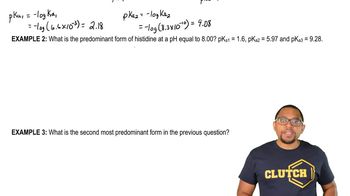
 00:17
00:17