Skip to main content
Analytical Chemistry
My Course
Learn
Exam Prep
AI Tutor
Study Guides
Flashcards
Explore
Try the app
My Course
Learn
Exam Prep
AI Tutor
Study Guides
Flashcards
Explore
Try the app
Back
Principal Species quiz
You can tap to flip the card.
What does the acid dissociation constant (Ka) indicate about an acid?
You can tap to flip the card.
👆
What does the acid dissociation constant (Ka) indicate about an acid?
Ka indicates the strength of an acid; a higher Ka means a stronger acid.
Track progress
Control buttons has been changed to "navigation" mode.
1/15
Related flashcards
Related practice
Recommended videos
Principal Species definitions
Principal Species
12 Terms
Principal Species
9. Polyprotic Acid-Base Equilibria
5 problems
Topic
Isoelectric and Isoionic pH
9. Polyprotic Acid-Base Equilibria
5 problems
Topic
9. Polyprotic Acid-Base Equilibria - Part 1 of 2
4 topics
12 problems
Chapter
9. Polyprotic Acid-Base Equilibria - Part 2 of 2
2 topics
6 problems
Chapter
Guided course
00:17
Principal Species
272
views
Guided course
03:52
Principal Species
257
views
3
rank
Guided course
03:10
Principal Species
296
views
3
rank
Terms in this set (15)
Hide definitions
What does the acid dissociation constant (Ka) indicate about an acid?
Ka indicates the strength of an acid; a higher Ka means a stronger acid.
What does it mean if Ka is greater than 1?
If Ka > 1, the acid is considered strong.
What does it mean if Ka is less than 1?
If Ka < 1, the acid is considered weak.
How can you use pKa to determine the principal species in a solution?
By comparing the solution's pH to the acid's pKa, you can determine whether the acidic or basic form predominates.
What happens when pH is less than pKa for a monoprotic acid?
The acidic form predominates over the basic form.
What happens when pH is greater than pKa for a monoprotic acid?
The basic form predominates over the acidic form.
At what point do the acidic and basic forms exist in equal concentrations?
When pH equals pKa, both forms exist in equal concentrations (50% each).
What is the principal species when pH equals pKa?
Both the acidic and basic forms are present at 50% each.
How does increasing the pH above the pKa affect the principal species?
The basic form becomes the principal species.
How does decreasing the pH below the pKa affect the principal species?
The acidic form becomes the principal species.
What are the two forms considered when discussing principal species for acids?
The acidic form (HA) and the basic form (A−).
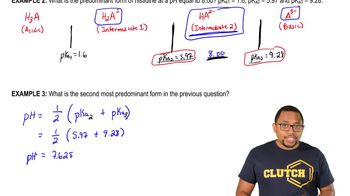
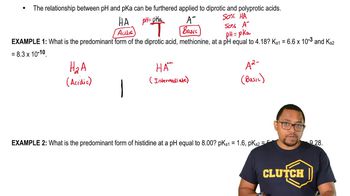
Can the relationship between pH and pKa be applied to polyprotic acids?
Yes, the relationship applies to diprotic and polyprotic acids as well.
What does the dividing line between acidic and basic forms represent?
It represents the pKa value, where both forms are present in equal amounts.
Why is converting Ka to pKa useful?
It allows easier comparison with the solution's pH to determine the predominant species.
What does the acid dissociation constant (Ka) numerically represent?
It represents how easily an acidic hydrogen can be removed from the acid.
 BackBack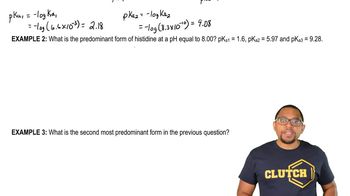
 00:17
00:17