Skip to main content
Analytical Chemistry
My Course
Learn
Exam Prep
AI Tutor
Study Guides
Flashcards
Explore
Try the app
My Course
Learn
Exam Prep
AI Tutor
Study Guides
Flashcards
Explore
Try the app
Back
Properties of Light definitions
You can tap to flip the card.
Electromagnetic Spectrum
You can tap to flip the card.
👆
Electromagnetic Spectrum
A continuum of radiant energy ranging from long radio waves to gamma rays, encompassing all types of electromagnetic radiation.
Track progress
Control buttons has been changed to "navigation" mode.
1/15
Related flashcards
Related practice
Recommended videos
Properties of Light quiz
Properties of Light
15 Terms
Properties of Light
17. Fundamentals of Spectrophotometry
5 problems
Topic
Absorption of Light
17. Fundamentals of Spectrophotometry
5 problems
Topic
17. Fundamentals of Spectrophotometry - Part 1 of 2
4 topics
12 problems
Chapter
17. Fundamentals of Spectrophotometry - Part 2 of 2
1 topic
3 problems
Chapter
Guided course
03:22
Properties of Light Calculations 1
278
views
1
rank
Guided course
02:06
Properties of Light Calculations 1
272
views
Guided course
02:45
Properties of Light
459
views
1
rank
Terms in this set (15)
Hide definitions
Electromagnetic Spectrum
A continuum of radiant energy ranging from long radio waves to gamma rays, encompassing all types of electromagnetic radiation.
Visible Light
The small portion of the electromagnetic spectrum detectable by the human eye, spanning roughly 700 to 380 nanometers.
Frequency
The number of wave cycles passing a point per second, measured in Hertz, directly proportional to energy.
Wavelength
The distance between consecutive wave crests, measured in meters, inversely proportional to frequency.
Energy
A property of electromagnetic radiation that increases with frequency and decreases with wavelength.
Speed of Light
A constant value of approximately 2.998 x 10^8 meters per second for electromagnetic waves in a vacuum.
Planck's Constant
A fundamental constant (6.626 x 10^-34 J·s) used to relate the energy of a photon to its frequency.
Photon
A discrete packet of electromagnetic energy, whose energy is determined by frequency or wavelength.
Amplitude
The height of a wave from its midpoint to its crest, not directly affecting the energy of electromagnetic radiation.
Nuclear Spin
A property of atomic nuclei influenced by radio waves, relevant in nuclear magnetic resonance.
Molecular Rotation
A motion of molecules affected by microwaves, leading to changes in rotational energy states.
Molecular Vibration
A movement within molecules influenced by infrared radiation, used to identify functional groups.
Valence Electrons
Outer electrons in atoms affected by visible and ultraviolet light, involved in electronic transitions.
Core Electrons
Inner electrons in atoms impacted by x-rays, associated with deeper atomic transitions and ionization.
Gamma Rays
The highest energy electromagnetic radiation, capable of inducing nuclear reactions.
 BackBack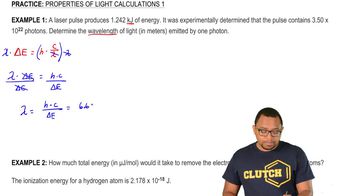
 03:22
03:22