Back

Standard Cell Potential & the Equilibrium Constant quiz

Control buttons has been changed to "navigation" mode.
1/15
  • What happens to the cell potential of a galvanic cell when it reaches equilibrium?

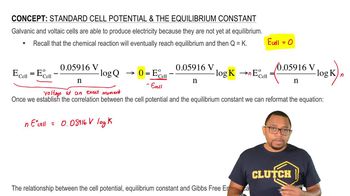
    The cell potential under non-standard conditions becomes zero at equilibrium.
  • What is the relationship between the reaction quotient (Q) and the equilibrium constant (K) at equilibrium?

    At equilibrium, Q equals K.
  • What equation is used to calculate cell potential under non-standard conditions?

    The Nernst equation is used to calculate cell potential under non-standard conditions.
  • How is the Nernst equation written for cell potential under non-standard conditions?

    E_cell = E°_cell - (0.05916/n) × log(Q), where n is the number of electrons transferred.
  • What variable replaces Q in the Nernst equation at equilibrium?

    At equilibrium, Q is replaced by K, the equilibrium constant.
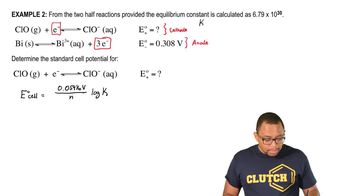
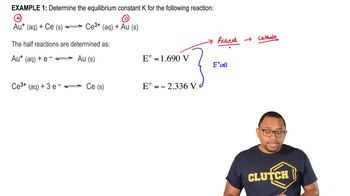
  • How can you calculate the equilibrium constant (K) from the standard cell potential (E°_cell)?

    K = 10^(n × E°_cell / 0.05916), where n is the number of electrons transferred.
  • What is the equation relating Gibbs free energy (ΔG) and the equilibrium constant (K)?

    ΔG = -RT ln(K), where R is the gas constant and T is the temperature in Kelvin.
  • What is the value of the gas constant (R) used in the ΔG equation?

    R = 8.314 J/(mol·K).
  • How is Gibbs free energy (ΔG) related to the standard cell potential (E°_cell)?

    ΔG = -nFE°_cell, where n is the number of electrons transferred and F is Faraday's constant.
  • What is Faraday's constant (F)?

    Faraday's constant is approximately 96,485 coulombs per mole of electrons.
  • How do you calculate standard cell potential at standard conditions?

    Standard cell potential is calculated as E°_cell = E°_cathode - E°_anode.
  • When is the Nernst equation not needed for cell potential calculations?

    The Nernst equation is not needed when concentrations are 1 M and conditions are standard (25°C).
  • What does multiplying by 2.303 in the Nernst equation accomplish?

    Multiplying by 2.303 converts the natural logarithm (ln) to the common logarithm (log).
  • What is the significance of the interconnectedness between cell potential, equilibrium constant, and Gibbs free energy?

    Understanding their relationships is crucial for predicting and explaining electrochemical cell behavior under different conditions.
  • Why is the Nernst equation used when concentrations are not 1 M?

    The Nernst equation adjusts cell potential calculations for non-standard concentrations, reflecting real-time conditions.