Skip to main content
Analytical Chemistry
My Course
Learn
Exam Prep
AI Tutor
Study Guides
Flashcards
Explore
Try the app
My Course
Learn
Exam Prep
AI Tutor
Study Guides
Flashcards
Explore
Try the app
Back
Standard Potentials quiz
You can tap to flip the card.
What does voltage (e) represent in an electrochemical cell?
You can tap to flip the card.
👆
What does voltage (e) represent in an electrochemical cell?
Voltage represents the amount of work done as electrons move from one electrode to another.
Track progress
Control buttons has been changed to "navigation" mode.
1/15
Related flashcards
Related practice
Recommended videos
Standard Potentials definitions
Standard Potentials
15 Terms
Standard Potentials
13. Fundamentals of Electrochemistry
5 problems
Topic
Nernst Equation
13. Fundamentals of Electrochemistry
5 problems
Topic
13. Fundamentals of Electrochemistry - Part 1 of 2
4 topics
12 problems
Chapter
13. Fundamentals of Electrochemistry - Part 2 of 2
1 topic
3 problems
Chapter
Guided course
03:08
Standard Potential Calculations 1
307
views
2
rank
Guided course
03:59
Standard Potential
360
views
2
rank
Guided course
03:16
Standard Potential
325
views
3
rank
Terms in this set (15)
Hide definitions
What does voltage (e) represent in an electrochemical cell?
Voltage represents the amount of work done as electrons move from one electrode to another.
How is one volt defined in terms of units?
One volt is defined as joules per coulomb.
How are half reactions typically written in electrochemistry?
Half reactions are typically written as reductions, with electrons as reactants.
What happens to the oxidation number in a reduction half reaction?
The oxidation number decreases from reactant to product in a reduction half reaction.
What is the Standard Hydrogen Electrode (SHE) used for?
The SHE is used as a reference electrode to compare the potential of other half reactions.
What does a higher cell potential indicate about a half reaction?
A higher cell potential indicates a greater likelihood of reduction.
What does a smaller e value suggest about a half reaction?
A smaller e value suggests the reaction is more likely to undergo oxidation.
How can you determine which half reaction will be oxidized or reduced?
By comparing cell potentials, the reaction with the higher potential is more likely to be reduced, and the lower is more likely to be oxidized.
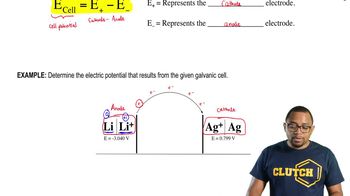
What is the formula for calculating the overall cell potential (E cell) when concentrations are 1 molar?
E cell = E+ (cathode) minus E- (anode).
What do E+ and E- represent in the cell potential equation?
E+ represents the cathode electrode, and E- represents the anode electrode.
When can the simple cell potential equation (E cell = E+ - E-) be used?
It can be used when ion concentrations are at 1 molar.
What equation must be used if ion concentrations are not 1 molar?
The Nernst equation must be used to determine the cell potential.
What assumption is made if concentrations are not given in a redox reaction problem?
We assume the concentrations are 1 molar (unity).
What is the significance of comparing cell potentials in a galvanic cell?
Comparing cell potentials helps determine which electrode acts as the cathode and which as the anode.
How do you calculate the overall cell potential for a galvanic cell using lithium and silver half reactions?
You subtract the anode potential from the cathode potential using their given cell potential values.
 BackBack
 03:08
03:08