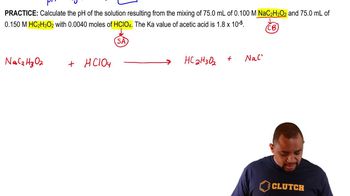
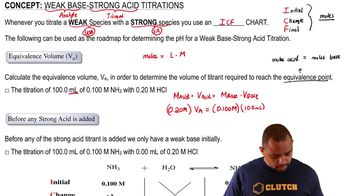
What is the role of the weak base and strong acid in a weak base-strong acid titration?
The weak base acts as the analyte (starting material), and the strong acid is the titrant added to it.
What chart is used to track moles during a weak base-strong acid titration?
An ICF (Initial, Change, Final) chart is used, with moles as the units.
How do you calculate the equivalence volume in a titration?
Use the equation M_acid × V_acid = M_base × V_base, where M is molarity and V is volume.
What is the pH of a solution containing only a weak base before any acid is added?
The pH is above 11, calculated using an ICE chart and the base's Kb value.
What is the 5% approximation method used for in ICE charts?
It determines if the 'minus x' in the equilibrium expression can be ignored; if the initial concentration divided by Kb is greater than 500, 'minus x' can be ignored.
How is pOH calculated from the concentration of OH⁻?
pOH is the negative log of the OH⁻ concentration.
How is pH determined from pOH?
pH equals 14 minus pOH.
What forms before the equivalence point in a weak base-strong acid titration?
A buffer system forms, consisting of a weak base and its conjugate acid.
Which equation is used to calculate pH in the buffer region of a titration?
The Henderson-Hasselbalch equation is used: pH = pKa + log([conjugate base]/[conjugate acid]).
How is Ka for a weak acid calculated from Kb?
Ka = Kw / Kb, where Kw is the ionization constant of water (1.0 × 10⁻¹⁴).
What happens at the equivalence point in a weak base-strong acid titration?
The weak base and strong acid completely neutralize each other, forming a weak acid (conjugate acid), and the solution becomes acidic.
How is the molarity of the weak acid at the equivalence point calculated?
Divide the moles of the weak acid formed by the total volume of the solution.
What chart is used to determine pH at the equivalence point?
An ICE chart is used, with molarity as the units.
What dominates the pH calculation after the equivalence point?
Excess strong acid dominates, and pH is calculated directly from its concentration.
How does the pH change throughout a weak base-strong acid titration?
The pH starts above 11 with only weak base, decreases as acid is added, drops below 7 at equivalence, and falls below 1 after the equivalence point.
 Back
Back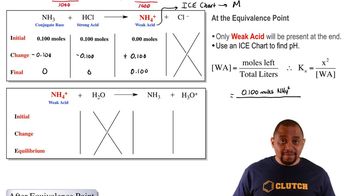
 04:27
04:27