Skip to main content
Anatomy & Physiology
My Course
Learn
Exam Prep
AI Tutor
Study Guides
Textbook Solutions
Flashcards
Explore
Try the app
My Course
Learn
Exam Prep
AI Tutor
Study Guides
Textbook Solutions
Flashcards
Explore
Try the app
Back
Acid-Base Balance definitions
You can tap to flip the card.
Acid
You can tap to flip the card.
👆
Acid
Any chemical that increases the concentration of hydrogen ions in an aqueous solution, impacting biological processes.
Track progress
Control buttons has been changed to "navigation" mode.
1/15
Related flashcards
Related practice
Recommended videos
Acid-Base Balance quiz #1
Acid-Base Balance
10 Terms
Acid-Base Balance
26. Fluid and Electrolyte Balance, Acid Base Balance
7 problems
Topic
Jason
Electrolyte Balance
26. Fluid and Electrolyte Balance, Acid Base Balance
7 problems
Topic
Jason
26. Fluid and Electrolyte Balance, Acid Base Balance
3 topics
9 problems
Chapter
Jason
Guided course
02:45
Acids
1301
views
19
rank
Guided course
01:29
Acids and Bases
1454
views
18
rank
Guided course
03:48
Bases
1187
views
34
rank
Terms in this set (15)
Hide definitions
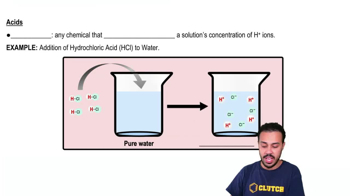
Acid
Any chemical that increases the concentration of hydrogen ions in an aqueous solution, impacting biological processes.
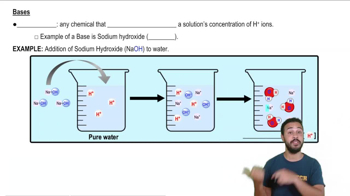
Base
Any chemical that decreases the concentration of hydrogen ions in a solution, often by forming water molecules.
Hydrogen Ion
A positively charged particle, symbolized as H+, whose concentration determines acidity in solutions.
Hydrochloric Acid
A strong acid, with the formula HCl, that dissociates in water to release hydrogen ions and chloride anions.
Sodium Hydroxide
A strong base, with the formula NaOH, that dissociates in water to yield sodium ions and hydroxide ions.
Chloride Anion
A negatively charged ion, Cl−, produced when hydrochloric acid dissociates in water.
Sodium Ion
A positively charged ion, Na+, formed when sodium hydroxide dissociates in water.
Hydroxide Ion
A negatively charged ion, OH−, produced when bases like sodium hydroxide dissociate in water.
Aqueous Solution
A liquid mixture where water is the solvent, allowing acids and bases to alter hydrogen ion concentration.
Dissociation
The process by which molecules like acids or bases split into ions when added to water.
Concentration
The amount of a specific substance, such as hydrogen ions, present in a given volume of solution.
Autoionization
A property of water where it spontaneously forms small amounts of hydrogen and hydroxide ions.
pH
A scale reflecting the concentration of hydrogen ions in a solution, indicating its acidity or basicity.
Biological Process
A cellular or metabolic activity influenced by the concentration of hydrogen ions in the environment.
Acid-Base Balance
The regulation of hydrogen ion concentration to maintain optimal conditions for physiological functions.
 BackBack
 02:45
02:45